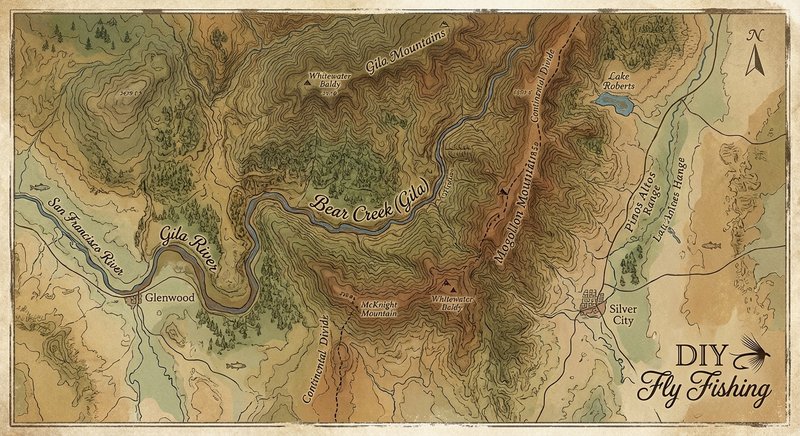
Bear Creek (Gila)
Fly fishing in New Mexico · Advanced · Best seasons: Spring, Summer, Fall
Target Species
Gila Trout, Rainbow Trout
About This Water
Remote stream in the Gila Wilderness. Native Gila trout recovery waters.
Fishing Recommendations
Welcome to the Gila National Forest. As your guide, I’m excited to walk you through one of the most rugged and rewarding small-water fisheries in the Southwest. Bear Creek, located near Silver City and Pinos Altos, is a gem for the adventurous angler looking to chase rare, native trout in a stunning desert-canyon environment.
🎣 Location Overview
Bear Creek is a classic high-desert freestone stream that drains from the Pinos Altos Mountains into the Gila River. What makes it special is the dramatic contrast in scenery: you’ll find yourself moving from ponderosa pine forests down into rugged, rocky canyons lined with sycamores and cottonwoods.
The water is generally small, characterized by tight pocket water, shallow riffles, and occasional deep, emerald-green plunge pools. It is a "hike-in" destination, which means the further you are willing to walk from the trailheads, the better the fishing gets. It offers a true sense of solitude and the rare opportunity to catch one of the rarest trout species in North America.
🐟 Target Species & Behavior
The primary draw here is the Gila Trout, a species once on the brink of extinction. Thanks to intensive conservation efforts, Bear Creek is one of the few places where you can legally fish for them.
- Gila Trout: They are beautiful, with a golden hue and small, fine spots. They are opportunistic but can be "spooky." In the clear, thin water of Bear Creek, they have excellent vision. They tend to hold in the "bubble line" at the head of pools or tucked tightly against canyon walls and boulders.
- Rainbow Trout: Found primarily in the lower reaches or mixed in with the Gilas. They behave similarly but are often slightly more aggressive in faster water.
- Feeding Habits: These fish are primarily insectivores. Because the nutrient base in high-desert streams is lean, they aren't usually picky—if you can present a fly without scaring them, they will usually eat.
📅 Best Times to Fish
- Spring (March – May): This is prime time. As the mountain snow melts, water levels rise, and the fish become very active. Watch for the first hatches of Baetis (BWO) and March Browns.
- Summer (June – August): Be cautious of the "Monsoon Season" (July/August). Flash floods are a serious danger in these narrow canyons. However, the terrestrial fishing (hoppers/ants) during a dry summer day is world-class.
- Fall (September – November): My personal favorite. The water cools down, the cottonwoods turn gold, and the Gila Trout feed heavily to prepare for winter.
- Time of Day: During Spring and Fall, 10:00 AM to 4:00 PM is the sweet spot. In the heat of Summer, get on the water at dawn and off by noon to protect the fish from heat stress.
🪰 Recommended Flies & Techniques
Top Fly Patterns
- Dry Flies:
- Parachute Adams (#14–18): The gold standard for Gila Trout.
- Chubby Chernobyl (#10–14): Great as a high-vis attractor and to hang a dropper.
- Elk Hair Caddis (#14–16): Perfect for the riffles.
- Black Ants or Foam Beetles (#16): Essential for summer afternoons.
- Nymphs:
- Bead-head Pheasant Tail (#16–20): Mimics almost everything in the creek.
- Gold-ribbed Hare’s Ear (#14–18): Great for the deeper plunge pools.
- Prince Nymph (#14–16): Use this when the water is slightly off-color.
Techniques
- Dry-Dropper: This is the most effective way to fish Bear Creek. Use a buoyant dry fly with a 12-18 inch 5x or 6x tippet attached to a small nymph.
- The Stealth Approach: Because the water is often crystal clear and shallow, you must stay low. Approach pools from downstream and avoid casting your shadow over the water.
- Short Line Casting: You rarely need to cast more than 20 feet. Focus on accuracy and managing your line to avoid drag.
💡 Pro Tips & Local Knowledge
- The "One-Cast" Rule: In these small pools, you often get one chance. If you "slap" the water or line the fish, they will dive under a rock and won't come out for an hour.
- Look for the "Deep" Spots: In a creek this shallow, "deep" might only mean 2 or 3 feet. These spots are magnets for the larger Gila Trout.
- Hike to the Box: If you access via the Signal Peak area or the lower access points near Gila, hike until the canyon narrows (the "box"). The water stays cooler here, and the fishing pressure drops to almost zero.
- Gear Recommendation: Use a 2-weight or 3-weight rod, 7–8 feet in length. A 9-foot rod is often too cumbersome among the overhanging trees.
⚠️ Important Information
- Access: Access points are available via the Gila National Forest. Popular entries include the trailheads near Pinos Altos or via the Gila River confluence. Be prepared for rugged hiking; bring plenty of water and a GPS.
- Regulations: Check the current New Mexico Department of Game and Fish (NMDGF) regulations. Gila Trout waters often have specific "Special Trout Water" designations which may require barbless hooks and catch-and-release only.
- Permits: You must have a valid New Mexico Fishing License and a Habitat Management & Access Validation (HMAV).
- Safety: This is remote country. Cell service is non-existent. Watch for rattlesnakes on the rocky trails and be extremely mindful of the weather; if you see dark clouds upstream, exit the canyon immediately to avoid flash floods.
Tight lines, and enjoy the pursuit of the Golden Trout of the Gila!
Bug Hatches & Matching Flies
| Hatch | Type | Peak months | Time of day | Hook sizes | Matching flies |
|---|---|---|---|---|---|
| Blue-Winged Olive (BWO) Baetis tricaudatus | mayfly | March, April, October, November | Late Morning/Afternoon | #18-22 | Parachute Adams #18-22, RS2 #20-22, Pheasant Tail #18-20 |
| Spotted Sedge (Caddis) Hydropsyche spp. | caddis | May, June, July | Late Afternoon/Evening | #14-16 | Elk Hair Caddis (Tan) #14-16, LaFontaine's Deep Sparkle Pupa #14-16, Holy Grail Caddis #16 |
| Western March Brown Rhithrogena morrisoni | mayfly | April, May | Mid-day | #12-14 | March Brown Dry #12-14, Hare's Ear Nymph #12-14 |
| Golden Stonefly Hesperoperla pacifica | stonefly | June, July | Morning/Evening | #8-12 | Golden Rogue Stone #8-10, Pat's Rubber Legs (Gold/Brown) #8-12 |
| Yellow Sally Isoperla spp. | stonefly | June, July | Afternoon/Evening | #14-16 | Yellow Sally Foam Dry #14-16, Iron Lotus #16 |
| Grasshoppers Acrididae | terrestrial | July, August, September | All Day | #8-14 | Parachute Hopper #10-12, Amy's Ant #12-14 |
| Trico Tricorythodes spp. | mayfly | August, September | Early Morning | #20-24 | Trico Spinner #22-24, Drowned Trico #22 |
| Midges Chironomidae | midge | January, February, March, December | All Day | #18-24 | Zebra Midge (Red or Black) #18-22, Griffith's Gnat #20-22 |