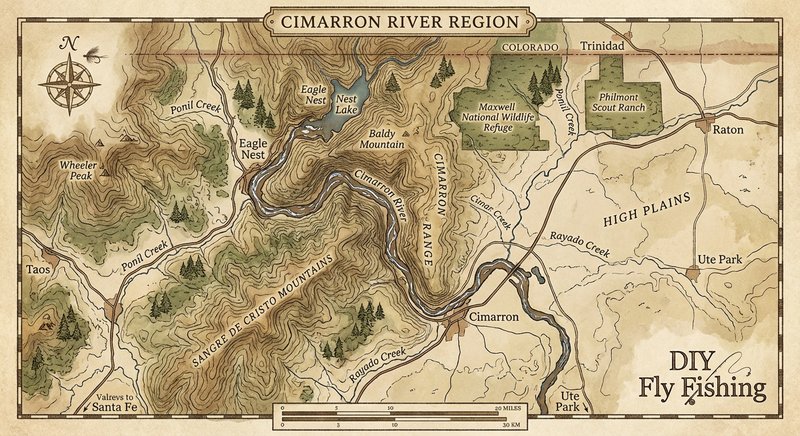
Cimarron River
Fly fishing in New Mexico · Beginner · Best seasons: Spring, Summer, Fall
Target Species
Rainbow Trout, Brown Trout
About This Water
Private waters at Cimarron Canyon State Park offer excellent trout fishing. Beautiful canyon scenery.
Fishing Recommendations
The Cimarron River in Northeastern New Mexico is a crown jewel of the Enchanted Circle. Flowing out of the Eagle Nest Dam and through the dramatic palisades of Cimarron Canyon State Park, this is a "tailwater" that acts like a mountain freestone. It is famous for its high trout density, technical pocket water, and the stunning scenery of high desert canyons.
Here is your comprehensive guide to fishing the Cimarron.
🎣 Location Overview
The Cimarron is a relatively small, intimate river characterized by riffles, tight pockets, and deep undercut banks. Unlike the wide-open San Juan, the Cimarron requires short, accurate casts and stealthy wading.
What makes it special is the biomass. Despite its small size, the river holds an incredible number of fish per mile. The water is nutrient-rich, supporting massive insect hatches. The "Special Trout Water" section within the State Park offers some of the most consistent fly fishing in the Southern Rockies, surrounded by towering granite walls and ponderosa pines.
🐟 Target Species & Behavior
- Brown Trout: The stars of the show. The Cimarron is primarily a wild Brown Trout fishery. These fish are opportunistic but wary. They love to tuck deep into undercut banks and behind large boulders.
- Rainbow Trout: Often stocked by New Mexico Game & Fish in certain high-use areas, though wild rainbows are present. They tend to hold in the faster riffles and the heads of pools.
Behavior: Because the river is narrow, these fish are "splash-sensitive." They feed aggressively during hatches but will bolt for cover if they see a high-profile angler or a heavy fly line landing over their heads.
📅 Best Times to Fish
- Spring (April – May): Pre-runoff can be excellent. This is the time for Mother’s Day Caddis hatches. Watch the flows; if the dam release is steady, the fishing is world-class.
- Summer (June – August): The "Prime Time." This is the window for the famous Golden Stonefly hatch and terrestrial season. Morning and late evening are best to avoid the midday heat.
- Fall (September – October): My personal favorite. The Brown Trout become aggressive as they prepare to spawn. The crowds thin out, and the changing aspens are breathtaking. Blue Winged Olives (BWO) are the main event on cloudy days.
Optimal Window: 9:00 AM to 4:00 PM during Spring/Fall; 7:00 AM to 11:00 AM and 5:00 PM to Dusk during mid-summer.
🪰 Recommended Flies & Techniques
Top Fly Patterns
- Nymphs:
- Caddis Pupa: Holy Grail (tan/green), Buckskin (#14-18).
- Stoneflies: Pat’s Rubber Legs (brown/orange) (#8-12).
- Attractors: Copper John (red), Flashback Pheasant Tail (#16-20).
- Dries:
- Stoneflies: Stimulators (orange/yellow) (#10-14).
- Caddis: Elk Hair Caddis (tan) (#14-18).
- Terrestrials: Amy’s Ant, Dave’s Hopper, or any foam beetle pattern.
- Streamers:
- Wooly Buggers (olive/black) or small Thin Mints (#10-12).
Techniques & Presentation
- The "Dry-Dropper" is King: Because the water is shallow and pocketed, a heavy bobber-style indicator often scares fish. Use a high-visibility dry fly (like a Stimulator) with a small nymph tied 18-24 inches below it.
- Short Line Nymphing: You rarely need to cast more than 20 feet. High-sticking through the pockets is the most effective way to manage the complex currents.
- Stealth: Wear drab colors (earth tones). Kneel when approaching pools to stay below the fish’s window of vision.
💡 Pro Tips & Local Knowledge
- The "Palisades" Section: This is the most scenic area, but it gets the most pressure. If it's crowded, head downstream toward the Tolby Campground or the Graveyard section for more solitude.
- Watch the Flows: The Cimarron is an irrigation-dependent tailwater. Flows between 20cfs and 50cfs are ideal. If the flow drops below 10cfs, the fish get extremely spooky; if it jumps above 100cfs, fishing becomes difficult. Check the USGS gauges before you drive.
- The Golden Stonefly Hatch: In late June and early July, the large Golden Stones crawl out. This is the best time to throw large dries. Don't be afraid to "skitter" the fly occasionally to mimic the natural movement.
- Check the "Gravel Pit": A great spot for beginners to practice as the river widens slightly and the wading is easier.
⚠️ Important Information
- Access: Most fishing occurs within Cimarron Canyon State Park along Highway 64. A New Mexico State Park pass is required for parking ($5/day or annual pass).
- Regulations:
- The section from the Tolby Creek confluence downstream to the Maverick Creek confluence is "Special Trout Water."
- Barbless hooks only.
- Catch and release only for Brown Trout in specific sections (check current NM Game & Fish proclamations as these can change annually).
- Permits: You need a valid New Mexico Fishing License and a Habitat Management & Access Validation (HMAV).
- Wildlife: This is high-density Black Bear and Mountain Lion country. Keep your food secured and be aware of your surroundings, especially if fishing at dawn or dusk.
Guide’s Final Word: The Cimarron is a "thinking man's" river. It rewards precision and patience over long-distance casting. Slow down, observe the water, and you’ll find it to be one of the most rewarding technical streams in the American West.
Bug Hatches & Matching Flies
| Hatch | Type | Peak months | Time of day | Hook sizes | Matching flies |
|---|---|---|---|---|---|
| Midges Chironomidae | midge | January, February, March, December | Morning/Afternoon | #18-24 | Zebra Midge #18-22, Griffith's Gnat #20-24, RS2 #20-22 |
| Blue Winged Olive Baetis | mayfly | March, April, September, October | Mid-day | #18-22 | Parachute Adams #18-22, Pheasant Tail Nymph #18-20, WD-40 #20-22 |
| Pale Morning Dun Ephemerella excrucians | mayfly | June, July | Late Morning/Early Afternoon | #16-18 | PMD Sparkle Dun #16-18, Split Case PMD #16-18, Barr's PMD Emerger #16-18 |
| Mother's Day Caddis Brachycentrus | caddis | May | Afternoon | #14-16 | Elk Hair Caddis (Dark) #14-16, LaFontaine's Deep Sparkle Pupa #14-16, Peacock Caddis #16 |
| Golden Stonefly Hesperoperla pacifica | stonefly | June, July | Morning/Evening | #8-12 | Pat's Rubber Leg #8-12, Chubby Chernobyl #10-12, Golden Stone Nymph #10-12 |
| Spotted Sedge Hydropsyche | caddis | July, August | Evening | #14-18 | Godzilla Caddis #14-16, Holy Grail #16-18, Hemingway Caddis #16 |
| Trico Tricorythodes | mayfly | August, September | Early Morning | #22-26 | Trico Spinner #22-24, Drowned Trico #22-24 |
| Terrestrials Formicidae / Acrididae | terrestrial | July, August, September | Late Morning/Afternoon | #10-18 | Amy's Ant #12-14, Parachute Hopper #10-14, Cinnamon Ant #16-18 |