Bluewater Lake
Fly fishing in New Mexico · Beginner · Best seasons: Spring, Summer, Fall
Target Species
Rainbow Trout, Channel Catfish
About This Water
Western New Mexico reservoir with rainbow trout and catfish. Good family fishing.
Fishing Recommendations
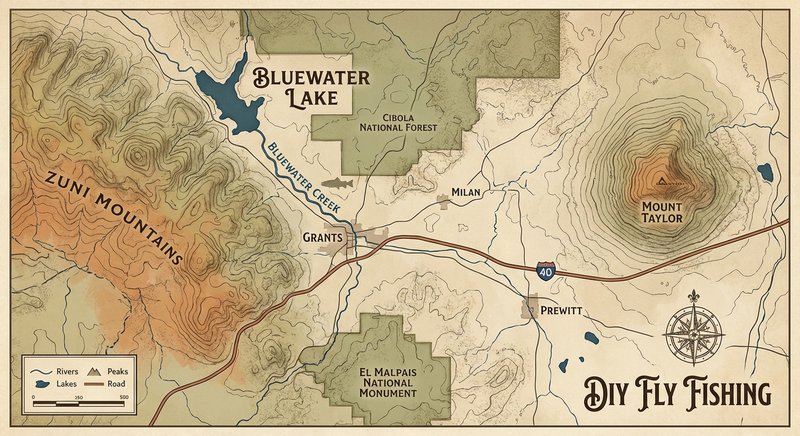
Welcome to Bluewater Lake, New Mexico. As your guide, I’ll tell you right off the bat: this isn't your typical high-mountain trout stream. Situated at about 7,400 feet on the northern edge of the Zuni Mountains, Bluewater is a high-plains reservoir that offers a unique, rugged fly fishing experience.
While it is nationally famous for its Tiger Muskie, the Rainbow Trout and Channel Catfish offer fantastic sport for the fly angler who knows how to navigate these alkaline waters.
🎣 Location Overview
Bluewater Lake is a "hidden gem" located between Gallup and Grants, NM. What makes it special is its productivity; the water is rich in nutrients, meaning fish grow fast and heavy. The landscape is a striking mix of high-desert sagebrush and volcanic rimrock.
The water characteristics are typically "off-color" or murky compared to mountain lakes, with a greenish tint due to high nutrient levels. This actually works in the fly angler's favor, as fish are less "leader-shy" than they are in crystal-clear alpine lakes. When the wind picks up (and it will), the lake can get choppy, requiring stout rods and aggressive casting.
🐟 Target Species & Behavior
Rainbow Trout
The trout here are often stocked as "catchables" but quickly transition to a wild diet.
- Behavior: Because Bluewater is home to apex predators (Tiger Muskie), the trout are often "skittish" and hold near structure or drop-offs.
- Feeding: They focus heavily on Chironomids (midges), Scuds, and Damsel Fly larvae. During the fall, they become highly aggressive, feeding on small fathead minnows to bulk up for winter.
Channel Catfish
Yes, you can catch these on a fly! Bluewater has a healthy population of cats that are surprisingly active.
- Behavior: While they spend much of the day in deeper water, they move into the rocky shallows and mudflats during low-light hours (dawn/dusk) to hunt.
- Feeding: They are opportunistic. They will take large, dark streamers that disturb the water or mimic a wounded baitfish or large leech.
📅 Best Times to Fish
- Spring (April – June): This is the "Prime Window." As the ice melts (Ice-off), the trout move into the shallows to soak up the sun. Mid-morning to late afternoon is best as the water warms slightly.
- Summer (July – August): Focus on the "Golden Hours" (first two hours of light and the last two). During mid-day, trout retreat to the deeper, cooler water near the dam. Catfish activity peaks on warm summer nights.
- Fall (September – November): My personal favorite. As water temperatures drop, trout return to the shorelines. This is when you'll find the most aggressive strikes on streamers.
- Conditions: Overcast days are gold here. The clouds cut the glare on the water and make the fish feel secure enough to hunt in the shallows.
🪰 Recommended Flies & Techniques
For Rainbow Trout
- Technique: Indicator Nymphing. Use a long leader (12–15 feet) and suspend your flies 1–2 feet off the bottom.
- Fly Patterns:
- Chironomids: Zebra Midges (Size 14–18) in black/silver or red.
- Scuds: Olive or Orange Scud patterns (Size 14–16).
- Dries: Only on very calm evenings; use a Parachute Adams or a Griffith’s Gnat.
For Channel Catfish (and Trophy Trout)
- Technique: Stripping Streamers. Use an intermediate sinking line to keep the fly in the "zone" (3–6 feet deep). Use a slow, "twitchy" retrieve.
- Fly Patterns:
- Woolly Buggers: Black, Olive, or Dark Brown (Size 6–10) with plenty of flash.
- Simi Seal Leeches: Especially in "Peacock" or "Black/Red" colors.
- Clouser Minnows: For catfish, go with Chartreuse/White or Black/Purple.
💡 Pro Tips & Local Knowledge
- The "Muskie Factor": You are fishing in a lake full of 40-inch predators. If the trout fishing suddenly "dies" in a specific cove, a Tiger Muskie has likely moved in. If you see trout jumping frantically, tie on a 6-inch streamer and a wire tippet—you might just hook the fish of a lifetime.
- The Cliffs vs. The Flats: The "Cliffs" area on the south side offers deeper water and structure, which is great for summer. The northern "Flats" near the boat ramps are better for spring and fall wading.
- Wind is Your Friend: Don't stay home if it's breezy. Wind pushes "plankton" toward the windward shore, which brings in the baitfish, which brings in the trout. Fish the shore that the wind is blowing into.
- Rod Choice: Leave the 3-weight at home. A 9-foot 6-weight is the standard tool here to handle the wind and the size of the fish.
⚠️ Important Information
- Access: Entry is through Bluewater Lake State Park. There is a daily vehicle pass fee (usually $5) unless you have a New Mexico State Parks annual pass.
- Regulations:
- A valid New Mexico Fishing License and Habitat Management & Access Validation are required.
- Tiger Muskie: Note that Tiger Muskies are strictly Catch and Release at Bluewater. Even if you aren't targeting them, you must handle them with care if hooked.
- Trout Limits: Check the current NM Department of Game and Fish (NMDGF) proclamation, as bag limits can change based on lake levels.
- Special Considerations: The "mud" at Bluewater can be "sink-your-boot" sticky. If wading the flats, move slowly and test your footing. Always carry water and sun protection; the high-altitude sun is intense even when it's cold.
Tight lines, and enjoy the rugged beauty of Bluewater!
Bug Hatches & Matching Flies
| Hatch | Type | Peak months | Time of day | Hook sizes | Matching flies |
|---|---|---|---|---|---|
| Callibaetis (Speckled Duns) Callibaetis | mayfly | June, July, August | Late Morning to Mid-Afternoon | #12-16 | Parachute Adams #14-16, Callibaetis Spinner #14-16, Hare's Ear Nymph #12-16 |
| Chironomids (Midges) Chironomidae | midge | April, May, September, October | All Day | #16-22 | Zebra Midge #18-20, Ice Cream Cone #16-18, Griffith's Gnat #18-22 |
| Damselflies Enallagma | terrestrial | June, July | Morning to Afternoon | #10-14 | Marabou Damsel Nymph #10-12, Adult Damsel #12-14, Braided Butt Damsel #12 |
| Blood Midges Chironomus plumosus | midge | May, June | Evening | #10-14 | San Juan Worm (Red) #12-14, Blood Midge Larva #10-14, Chan's Chironomid #12 |
| Grasshoppers Melanoplus | terrestrial | August, September | Afternoon | #6-12 | Dave's Hopper #8-12, Yee's Bogus Hopper #10, Amy's Ant #8-12 |
| Traveling Sedge Hesperophylax | caddis | June, July | Evening | #8-12 | Mikulak Sedge #8-10, Godzilla Caddis #10, Elk Hair Caddis #12 |
| Water Boatmen Corixidae | terrestrial | September, October | Afternoon | #14-16 | Water Boatman #14-16, Prince Nymph #14-16, Backswimmer #12-14 |
| Carpenter Ants Camponotus | terrestrial | May, June | Afternoon | #12-16 | Chernobyl Ant #12-14, Black Foam Ant #14-16, Fur Ant #16 |