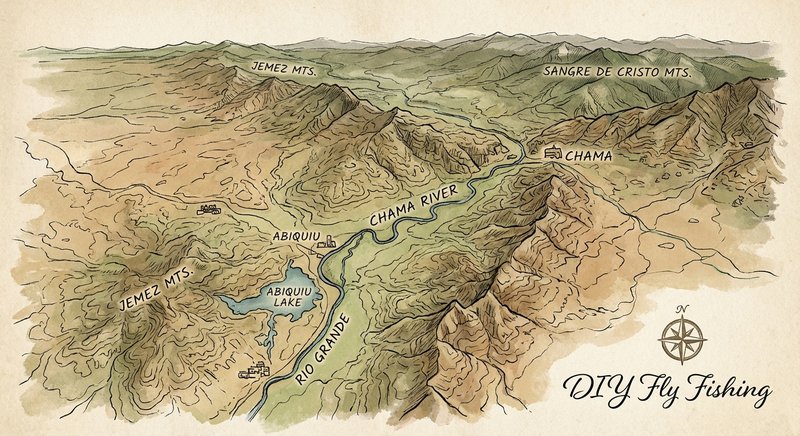
Chama River
Fly fishing in New Mexico · Intermediate · Best seasons: Spring, Summer, Fall
Target Species
Brown Trout, Rainbow Trout
About This Water
Remote northern New Mexico river with wild brown trout. Float fishing popular in the canyon section.
Fishing Recommendations
The Chama River in Northern New Mexico is a rugged, scenic, and technically diverse fishery. Flowing through stunning sandstone canyons that look like a Georgia O’Keeffe painting, it offers everything from classic tailwater nymphing to aggressive streamer stripping for trophy-sized browns.
Here is your comprehensive guide to fly fishing the Chama River.
🎣 Location Overview
The Chama River is a major tributary of the Rio Grande, but for fly anglers, it is defined by its sections between three major reservoirs: Heron, El Vado, and Abiquiu.
What makes it special is the diversity of the water. You have the "Wild and Scenic" canyon section above El Vado, which requires a permit or a stout hike, and the high-yield tailwater section below El Vado Dam. The river is characterized by its deep tea-colored tint (due to tannins), large boulders, and undercut banks. It feels more remote and "wild west" than the nearby San Juan, making it a favorite for those who value solitude and scenery as much as the fish.
🐟 Target Species & Behavior
- Brown Trout: The Chama is legendary for its wild Brown Trout. They are the dominant species and can reach impressive sizes (20"+). They are predatory and highly structure-oriented, hugging the volcanic rocks and deep undercut banks.
- Rainbow Trout: Generally stocked by NM Department of Game & Fish, though "holdovers" become quite savvy. They tend to congregate in the faster riffles and oxygenated water below the dams.
Behavior: Because the water can be off-color, Chama fish rely heavily on their lateral lines and silhouette recognition. They aren't always as "leader shy" as San Juan fish, but they are very cautious about overhead movement due to the high population of ospreys and eagles.
📅 Best Times to Fish
Optimal Seasons
- Spring (March – April): Before the snowmelt hits, the Blue Winged Olive (BWO) hatches are prolific. This is the best time for dry fly enthusiasts.
- Summer (July – August): High flows for irrigation are common, but the terrestrial fishing (hoppers/ants) along the grassy banks can be explosive.
- Fall (Late September – November): The Gold Standard. As flows drop and the Cottonwoods turn yellow, the big Browns move up to spawn. They become aggressive and territorial.
Best Times of Day
- Morning/Evening: Low light is crucial on the Chama. Browns are photophobic and will stay deep in the shadows during mid-day.
- Overcast Days: A cloudy day on the Chama is a gift; it brings the big fish out of the shadows and triggers massive Baetis hatches.
🪰 Recommended Flies & Techniques
Nymphing (The Bread & Butter)
Nymphing is the most consistent way to catch fish here. Use a two-fly rig under a strike indicator.
- Patterns: Size 16-20 Pheasant Tails, Copper Johns (Red or Blue), and Bead-head Hares Ears.
- Midge Patterns: Size 20-24 Zebra Midges (Black or Red) are essential year-round.
Dry Flies
- Spring/Fall: Parachute Adams (18-22), RS2, or CDC BWO patterns.
- Summer: Large Foam Grasshoppers (Size 8-12), Dave’s Hopper, or Carpenter Ants.
Streamers (For the Trophies)
If you want a 20-inch Brown, put away the 5-weight and grab a 7-weight with a sink-tip line.
- Patterns: Wooly Buggers (Olive or Black), Thin Mints, and Sculpin patterns.
- Technique: Cast tight to the banks and "strip-stop" to mimic a wounded baitfish or crawfish.
💡 Pro Tips & Local Knowledge
- The "Tailwater Section": Focus on the 5.5-mile stretch below El Vado Dam. This is the most productive water. Cooper’s El Vado Ranch offers paid parking and easy access to some of the best holes.
- Watch the Flows: The Chama is a "working river." Flows can jump from 200 CFS to 1,500 CFS overnight for irrigation needs. Always check the USGS Gauge for Chama Below El Vado before driving. Anything over 500 CFS makes wading difficult.
- The "Chama Tea": The water often has a slight brown tint. Don't let this discourage you. Use flies with a bit of "flash" or "beads" to help the fish find your offering in the murky water.
- Stealth Matters: Even though the water is tinted, the fish are wary. Avoid wading deep into the "buckets" where fish hold; fish the near-shore water first.
⚠️ Important Information
Access
- El Vado Section: Access via NM State Road 112. Cooper's El Vado Ranch is the primary access point (private land, small fee for parking).
- Abiquiu Section: Access is available below the Abiquiu Dam, though this area is more prone to flow fluctuations.
Regulations & Permits
- License: A valid New Mexico Fishing License and a Habitat Management & Access Validation (HMAV) are required.
- Special Trout Water: Certain sections have "Special Trout Water" designations (catch and release or limited harvest). Always check the current NM Department of Game & Fish Ribbons for the specific mile marker regulations.
Special Considerations
- Safety: The canyon walls are steep and the rocks are slippery. Felt soles or studs are highly recommended.
- Wildlife: This is Black Bear and Mountain Lion country. Carry bear spray if you are hiking into the wilderness sections above the reservoirs.
Bug Hatches & Matching Flies
| Hatch | Type | Peak months | Time of day | Hook sizes | Matching flies |
|---|---|---|---|---|---|
| Midges Chironomidae | midge | January, February, March, April, December | All Day | #18-24 | Zebra Midge #18-22, Griffith's Gnat #20-24, Top Secret Midge #20-22 |
| Blue Winged Olives Baetis | mayfly | March, April, October, November | Late Morning/Afternoon | #18-22 | RS2 #20-22, Parachute Adams #18-22, Pheasant Tail Nymph #18-20 |
| Pale Morning Duns Ephemerella | mayfly | June, July | Morning/Early Afternoon | #14-18 | PMD Sparkle Dun #16-18, Military Mayfly #16-18, Trigger Finger PMD #16-18 |
| Caddis Hydropsyche / Brachycentrus | caddis | May, June, July | Evening | #14-18 | Elk Hair Caddis #14-16, Holy Grail #16-18, LaFontaine's Deep Sparkle Pupa #14-16 |
| Stoneflies Pteronarcys californica / Hesperoperla pacifica | stonefly | May, June | Morning | #6-12 | Pat's Rubber Legs #8-12, Chubby Chernobyl #8-12, Golden Stone Nymph #10-12 |
| Tricos Tricorythodes | mayfly | August, September | Early Morning | #20-24 | Trico Spinner #20-24, Sunray Trico #20-22 |
| Crane Flies Tipulidae | other | August, September | Afternoon | #8-12 | Crane Fly Larva #10-12, Daddy Long Legs #10-12 |
| Terrestrials Formicidae / Acrididae | terrestrial | July, August, September | Afternoon | #10-16 | Parachute Hopper #10-12, Black Foam Ant #14-16, Beefus Beetle #12-14 |