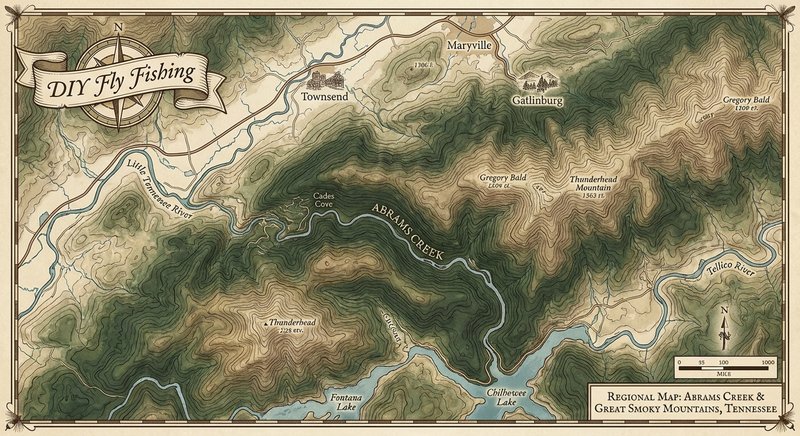
Abrams Creek
Fly fishing in Tennessee · Intermediate · Best seasons: Spring, Summer, Fall
Target Species
Rainbow Trout, Brown Trout
About This Water
Great Smoky Mountains stream with wild rainbow trout. Beautiful Cades Cove area fishing.
Fishing Recommendations
Abrams Creek is widely considered the "crown jewel" of the Tennessee side of the Great Smoky Mountains National Park (GSMNP). Unlike the high-gradient, freestone streams found elsewhere in the park, Abrams flows through a limestone valley (Cades Cove), giving it unique water chemistry and characteristics that set it apart from its neighbors.
Here is your comprehensive guide to fishing Abrams Creek.
🎣 Location Overview
Abrams Creek is a biological anomaly in the Smokies. Because it drains the limestone-rich Cades Cove, the water has a higher pH and higher nutrient levels than the acidic, sterile streams found at higher elevations. This results in more aquatic insect life, more vegetation, and, consequently, larger trout.
The creek is characterized by deep, slow-moving pools connected by short, turbulent riffles. It is a "big water" experience in a mountain setting, featuring massive boulders and undercut banks. Anglers love it because it offers a genuine chance at a 12-14 inch wild rainbow—a trophy by GSMNP standards—and the elusive, large brown trout that haunt the deeper holes.
🐟 Target Species & Behavior
- Rainbow Trout: The primary residents. They are wild, vibrant, and incredibly scrappy. They hold in the faster water at the heads of pools during hatches but retreat to the deep "guts" of the pools during the heat of the day.
- Brown Trout: Found primarily in the lower reaches and the deepest, darkest pools. They are notoriously predatory and shy. To catch a big Abrams brown, you often have to fish during low-light conditions or right after a rain when the water has a slight "tea" stain.
- Behavior: Due to the fertile water, these fish are "pickier" than other park trout. They have more food options, so your presentation needs to be precise. They are also easily spooked by shadows or heavy wading because the water in the pools can be exceptionally clear.
📅 Best Times to Fish
Optimal Seasons
- Spring (March – May): The absolute prime time. Water temperatures rise into the 50s, triggering massive hatches. The trout are hungry after winter and less wary.
- Early Summer (June): Excellent dry fly fishing, but be mindful of water temperatures as July approaches.
- Fall (Late September – November): A "second spring." As temperatures drop, the fish become active again. This is also the best time to target large, spawning brown trout (please stay off their redds/spawning beds).
Best Times of Day
- Spring/Fall: Mid-morning to late afternoon. You want the sun to warm the water slightly to trigger insect activity.
- Summer: Dawn and dusk. The "Cades Cove" section can get warm; if the water hits 68°F, stop fishing to protect the trout.
🪰 Recommended Flies & Techniques
Top Fly Patterns
- Dry Flies:
- Abrams Creek Special: Yellow Sally (Size 14-16)
- Classic: Parachute Adams (14-18)
- Attractor: Stimulators in orange or yellow (12-14)
- Terrestrials: Black foam ants or beetles (14-16) are deadly in mid-summer.
- Nymphs:
- Pheasant Tail: (14-18) Works year-round.
- Prince Nymph: (12-16) Great for the swifter riffles.
- Tellico Nymph: A local legend for the Smokies.
- Streamers:
- Woolly Bugger: Black or Olive (8-12) for those deep pools.
Effective Techniques
- Dry-Dropper: This is the "bread and butter" on Abrams. Use a high-visibility dry (like a Stimulator) and hang a Pheasant Tail nymph 18-24 inches below it.
- The "Slow Swing": In the large pools, cast a streamer or a heavy nymph across the current and let it swing slowly through the deep water.
- Stealth Approach: Because of the slow water, you must fish "upstream." If you stand at the head of a pool and fish down, every fish in that pool will see you.
💡 Pro Tips & Local Knowledge
- The "Abrams Hike": Most people fish the area near the Abrams Falls trailhead. To find the best fishing, hike past the falls or enter from the "Abrams Creek Campground" (the lower end). The water between the campground and the falls is rugged, remote, and holds the biggest fish.
- Mind the Slick Rocks: The rocks in Abrams are notoriously slippery—worse than other park streams. Felt soles (where legal) or studs are highly recommended.
- The "Cove" Section: The water inside Cades Cove is very slow and meadow-like. It’s great for sight-fishing with terrestrials, but the fish are extremely "spooky." Use long 9ft to 12ft leaders and 6x tippet.
- Watch for Bears: Cades Cove is bear country. Keep your lunch in a bear-proof container and be aware of your surroundings, especially when cleaning fish (though catch and release is highly encouraged).
⚠️ Important Information
- Access:
- Upper Access: Cades Cove Loop Road (Note: The loop road is vehicle-free on Wednesdays from May through September).
- Lower Access: Abrams Creek Campground (near Happy Valley).
- Regulations:
- A valid Tennessee or North Carolina fishing license is required.
- Artificial lures only. No bait is allowed anywhere in the park.
- Single hook only.
- Check the GSMNP website for current size and creel limits (currently 7-inch minimum for trout).
- Safety: There is zero cell service in the Abrams Creek drainage. If you are hiking into the lower gorge, tell someone your plan. The hike out from the falls is uphill and can be strenuous in the humidity.
Bug Hatches & Matching Flies
| Hatch | Type | Peak months | Time of day | Hook sizes | Matching flies |
|---|---|---|---|---|---|
| Quill Gordon Epeorus pleuralis | mayfly | March, April | Midday | #12-14 | Quill Gordon Dry #12-14, Quill Gordon Nymph #12-14 |
| Blue-Winged Olive Baetis spp. | mayfly | March, April, October, November | Midday/Afternoon | #18-22 | Parachute Adams #18-22, RS2 #20-22, Pheasant Tail Nymph #18-20 |
| March Brown Maccaffertium vicarium | mayfly | April, May | Afternoon | #10-14 | American March Brown #10-12, Gold Ribbed Hare's Ear #10-14 |
| Grannom Caddis Brachycentrus | caddis | April | All Day | #14-16 | Elk Hair Caddis (Olive) #14-16, Holy Grail #14-16 |
| Yellow Sally Isoperla spp. | stonefly | May, June, July | Late Afternoon/Evening | #14-16 | Yellow Stimulator #14-16, Little Yellow Stone Nymph #14-16 |
| Light Cahill Stenonema/Stenacron | mayfly | May, June, July | Evening | #12-16 | Light Cahill #12-16, Cream Usual #14-16 |
| Giant Black Stonefly Pteronarcys dorsata | stonefly | April, May | Night/Early Morning | #4-8 | Pat's Rubber Legs #6-10, Girdle Bug #4-8 |
| Terrestrials Formicidae / Coleoptera | terrestrial | June, July, August, September | Afternoon | #12-18 | Black Foam Beetle #14-16, Cinnamon Ant #16-18, Joe's Hopper #10-12 |
| Cinnamon Caddis Hydropsyche | caddis | June, July, August, September | Evening | #14-18 | Tan Elk Hair Caddis #14-18, Soft Hackle Hare's Ear #14-16 |