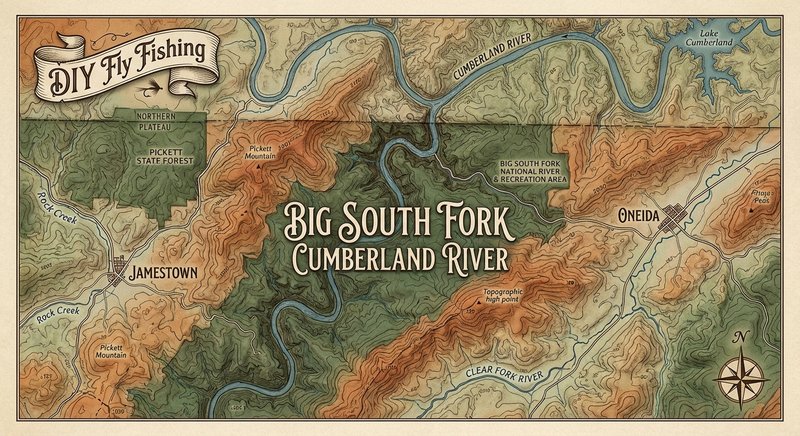
Big South Fork Cumberland
Fly fishing in Tennessee · Intermediate · Best seasons: Spring, Summer, Fall
Target Species
Smallmouth Bass, Rock Bass, Musky
About This Water
Scenic gorge river with excellent smallmouth bass. National River and Recreation Area.
Fishing Recommendations
Welcome to the Big South Fork of the Cumberland River (BSF). As a guide, I consider this one of the most rugged, beautiful, and rewarding fly fishing destinations in the Southeast. Spanning the border of Tennessee and Kentucky, this river flows through a massive sandstone gorge characterized by towering bluffs, giant boulders, and a truly wild "backcountry" feel.
Unlike the gentle tailwaters of Middle Tennessee, the BSF is a freestone river that demands respect and physical effort. Here are my professional recommendations for conquering these waters.
🎣 Location Overview
The Big South Fork is a wild, free-flowing river system. It is famous for its "boulder garden" hydraulics—massive sandstone slabs the size of houses have fallen into the river, creating complex currents, deep plunge pools, and perfect ambush points for predators.
What makes it special is the solitude. Because much of the river is tucked deep within the National River and Recreation Area, you often have miles of water to yourself. The water is generally tea-colored due to tannins but remains clear enough for sight-fishing in the shallows. It is a high-gradient river, meaning it drops quickly, creating world-class whitewater and deep, oxygenated pockets that hold trophy fish.
🐟 Target Species & Behavior
Smallmouth Bass (The Main Event)
The "Bronzeback" here is king. These are wild, lean fish conditioned by heavy currents.
- Behavior: They hold in the "seams" between fast water and slack water. During high sun, they retreat under the shadows of giant boulders.
- Feeding: They focus on crawfish and hellgrammites (the "big macs" of the BSF) and move to baitfish (shiners and chubs) as they mature.
Rock Bass (Redeye)
Often dismissed by others, but on a 4-weight fly rod, they are a blast.
- Behavior: They are ubiquitous and congregate in slower moving water near woody debris and smaller rock piles.
- Feeding: They are aggressive opportunistic feeders, hitting almost any small terrestrial or nymph.
Musky (The Ghost of the River)
The BSF holds a native population of "Southern Strain" Musky.
- Behavior: They are the apex predators, often found in the deepest, slowest pools (eddies) or at the very tail-outs of long runs.
- Feeding: They want a large meal. They track large streamers but are notoriously difficult to hook.
📅 Best Times to Fish
- Spring (April – June): This is prime time. As water temperatures hit 55°F, Smallmouth become aggressive. June is arguably the best month of the year as the water levels stabilize and the topwater bite begins.
- Summer (July – August): Great for "wet wading." Focus on the early morning (first light to 10:00 AM) and late evening. The fish move into the faster, oxygenated "white water" riffles to stay cool.
- Fall (September – November): A "sleeper" season. As the leaves change, the Musky activity spikes (the "Fall Feed"). Smallmouth gorge on baitfish to prepare for winter.
- Optimal Conditions: Look for a "dropping and clearing" hydrograph. If the river is rising due to heavy rain, the BSF becomes dangerous and the fishing turns off.
🪰 Recommended Flies & Techniques
For Smallmouth Bass
- Topwater: BoogleBugs (size 4) in "claret" or "yellow," and Murdich Minnows fished right in the surface film.
- Sub-surface: Clouser Minnows (Chartreuse/White or Olive/White) are mandatory.
- The "Secret Weapon": Hellgrammite patterns (like the Murray’s Hellgrammite). Fish these deep along the bottom of boulder faces.
For Musky
- Fly: Large (8–12 inch) articulated streamers in orange/black or firetiger colors.
- Technique: Use a 10-weight rod with a sinking tip. You must perform a "Figure-8" at the end of every single cast—BSF Musky are notorious for following the fly right to your boots.
Presentation Tips
- The "Shadow Cast": Smallmouth in this clear water are spooky. Cast your fly into the shadows of the bluffs or boulders before your shadow hits the water.
- Swing the Streamer: Don't just strip. Cast 45 degrees downstream and let the current "swing" your minnow pattern through the pocket water.
💡 Pro Tips & Local Knowledge
- Focus on the Confluences: Where the New River and the Clear Fork meet to form the Big South Fork is legendary. Also, look for where small cold-water creeks enter the main river during the heat of summer.
- The "Big Rock" Strategy: Don't just fish the front of a boulder. The "cushion" (the water just in front of the rock) and the "eddy" (the swirling water behind the rock) both hold fish, but the biggest Smallmouth often sit in the dark crevices right underneath the rock's undercut.
- Stealth is Mandatory: The BSF is a quiet place. Rattling rocks while wading will shut down a pool for 30 minutes. Wade slowly and wear camouflage or dull-colored clothing.
- Gear Up: Use a 6-weight or 7-weight fast-action rod for Smallmouth to handle the wind and the bulky flies. Use a 12lb to 15lb fluorocarbon leader; these fish aren't usually leader-shy, and you’ll need the strength to pull them away from sharp rocks.
⚠️ Important Information
- Access: Key access points include Leatherwood Ford, Station Camp, and Blue Heron (KY). Leatherwood Ford offers the best foot access for wading. For the adventurous, a kayak/raft float from Brewster Bridge to Leatherwood is world-class but involves Class III-IV rapids—do not attempt without experience.
- Regulations: You need a Tennessee fishing license. If you cross the state line into the Kentucky portion, you need a Kentucky license (there is no reciprocal agreement here). Check current TWRA regulations for size and creel limits on Smallmouth.
- Safety: This is a remote area. Cell service is non-existent in the gorge. Always bring a first aid kit, plenty of water, and tell someone your "float plan" or hiking route. Watch for copperheads and timber rattlesnakes on the rocky banks.
Guide’s Final Word: The Big South Fork doesn't give up its secrets easily. You will walk a lot, you might slip on a mossy rock, and you’ll work for every fish. But when a 20-inch bronze Smallmouth slams a popper in the shadow of a 400-foot sandstone cliff, you’ll realize there is nowhere else you’d rather be.
Bug Hatches & Matching Flies
| Hatch | Type | Peak months | Time of day | Hook sizes | Matching flies |
|---|---|---|---|---|---|
| Blue-Winged Olive Baetis spp. | mayfly | March, April, October, November | Late Morning/Afternoon | #18-22 | Parachute Adams #18-20, RS2 #20-22, Pheasant Tail Nymph #18-20 |
| Sulphur Ephemerella invaria/dorothea | mayfly | May, June | Evening | #14-18 | Sulphur Parachute #16-18, Pheasant Tail #14-16, Sulphur Snowshoe Emerger #16 |
| March Brown Maccaffertium vicarium | mayfly | March, April | Afternoon | #10-14 | March Brown Dry #12-14, Gold Ribbed Hare's Ear #10-14, March Brown Wet Fly #12 |
| Slate Drake Isonychia bicolor | mayfly | June, September, October | Late Afternoon/Evening | #10-14 | Isonychia Parachute #12, Zug Bug #10-12, Prince Nymph #10-14 |
| Tan Caddis Hydropsyche spp. | caddis | April, May, June, September | Morning/Evening | #14-18 | Elk Hair Caddis #14-16, Holy Grail #14-18, Green Caddis Larva #14-16 |
| Giant Black Stonefly Pteronarcys dorsata | stonefly | April, May | Night/Early Morning | #4-8 | Pat's Rubber Legs #4-8, Black Stimulator #6-10, Kaufmann's Stone #6-8 |
| Golden Stonefly Acroneuria spp. | stonefly | May, June, July | Evening/Night | #8-12 | Golden Stimulator #8-12, Golden Stone Nymph #8-12 |
| Hellgrammite Corydalus cornutus | terrestrial | June, July, August | All Day | #2-6 | Murray's Hellgrammite #4-8, Bitch Creek Nymph #6-8 |
| Terrestrials Formicidae/Coleoptera | terrestrial | July, August, September | Mid-day/Afternoon | #10-16 | Chernobyl Ant #10-12, Black Foam Beetle #14-16, Fur Ant #16-18 |