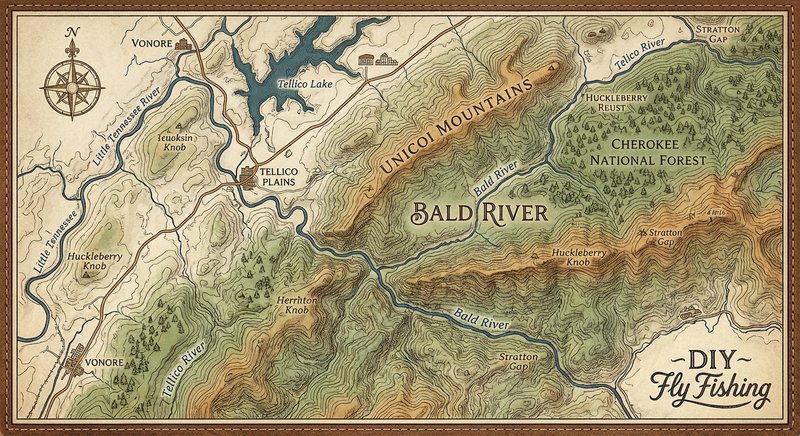
Bald River
Fly fishing in Tennessee · Intermediate · Best seasons: Spring, Summer, Fall
Target Species
Brown Trout, Rainbow Trout
About This Water
Trophy trout waters with catch and release section. Beautiful waterfall scenery.
Fishing Recommendations
As an expert guide who has spent years navigating the rhododendron-choked banks of the Southern Appalachians, I can tell you that the Bald River is one of the crown jewels of Tennessee fly fishing. Located within the Cherokee National Forest, this is a wild trout sanctuary that demands physical effort but rewards you with some of the most beautiful fish and scenery in the Eastern United States.
🎣 Location Overview
The Bald River is a major tributary to the Tellico River. Unlike the main Tellico, which is heavily stocked and easily accessible by road, the Bald River is a managed wild trout stream.
The river is defined by its ruggedness. Starting at the iconic 90-foot Bald River Falls, the river carves through a deep, steep-walled gorge. This is high-gradient "pocket water" fishing at its finest. You’ll find a staircase of plunge pools, crystalline runs, and massive boulders. It is special because it offers a true backcountry experience; once you hike a mile past the falls, the crowds vanish, and you are left with pristine water and wild, spooky trout.
🐟 Target Species & Behavior
The Bald River is home to Wild Rainbow Trout and Wild Brown Trout. You may also encounter native Brook Trout in the extreme headwaters.
- Wild Rainbows: These are the primary residents. They are opportunistic but wary. They hold in the "bubble line" (the fast water at the head of pools) and in small pockets behind rocks. They are known for their vibrant coloring and aggressive strikes.
- Wild Browns: The "ghosts" of the Bald. They prefer the deeper, darker undercut banks and the tail-outs of large pools during low light. To catch a wild Bald River Brown, you need stealth and precise presentation.
- Feeding Behavior: Because this is a freestone stream with relatively low nutrient levels, these fish are not "picky" about species, but they are very sensitive to overhead movement and sloppy casting. If they see you, the fishing is over for that pool.
📅 Best Times to Fish
- Spring (March – May): Prime Time. This is the window for major hatches (Quill Gordons, March Browns, and Hendricksons). Water levels are usually ideal, and fish are coming out of winter dormancy hungry.
- Summer (June – August): Excellent for "dry-dropper" rigs. The canopy provides shade, keeping water temperatures cooler than the main Tellico. Focus on the early morning and late evening. Terrestrials (ants and beetles) become the primary food source.
- Fall (September – November): Another peak season. The Brown Trout become more aggressive as they prepare to spawn. The foliage is world-class, and the lower water levels require a very stealthy approach and longer leaders.
Best Time of Day: During the heat of summer, 6:00 AM to 10:00 AM is best. In the shoulder seasons, the "mid-day warmth" from 11:00 AM to 3:00 PM often triggers the best insect activity.
🪰 Recommended Flies & Techniques
Top Fly Patterns
- Dry Flies:
- Yellow Stimulator (#12-16): Great for high-visibility in broken water.
- Parachute Adams (#14-18): The gold standard for matching most grey mayflies.
- Elk Hair Caddis (#14-16): Tan or Olive; perfect for the skittering caddis hatches.
- Chernobyl Ant or Foam Beetle: Essential for summer terrestrial fishing.
- Nymphs:
- Pheasant Tail (#16-20): Mimics almost any mayfly nymph.
- Prince Nymph (#14-18): The flash helps in the bubbly plunge pools.
- Pat’s Rubber Legs (Small, #12): Effective in the deeper pools for larger Browns.
- Streamers:
- Black or Olive Wooly Bugger (#10-12): Best used after a rain when the water has a slight "tea" stain.
Techniques
- The Dry-Dropper: This is the most effective way to fish the Bald. Use a high-floating dry (like a Stimulator) and hang a small nymph (like a Pheasant Tail) 18–24 inches below it.
- Short Line High-Sticking: Due to the conflicting currents in pocket water, long casts create instant drag. Keep your rod tip high and as little fly line on the water as possible.
- Upstream Approach: Always fish moving upstream. These fish sit facing the current; if you approach from behind, you stay out of their field of vision.
💡 Pro Tips & Local Knowledge
- The "Sneak": Before you even cast, crouch down. Use the boulders for cover. If you stand tall on a rock overlooking a pool, the wild trout will see your silhouette against the sky and dart for cover.
- The Bald River Gorge Trail (#88): Don't just fish the bottom near the falls. Hike up Trail 88. The further you hike (2+ miles in), the better the fishing gets. The "Middle Section" of the gorge holds some surprisingly large pools that house the bigger Browns.
- Watch the Flow: The Bald can rise rapidly after a heavy rain in the mountains. If the water looks murky or "blown out," head to the smaller high-elevation feeder creeks where the water clears faster.
- Gear Recommendation: A 7.5-foot to 8.5-foot 3-weight or 4-weight rod is perfect. A 9-foot rod is often too long for the tight overhead canopy.
⚠️ Important Information
- Access: Access is primarily via the Bald River Gorge Trail. You can park at the parking lot for Bald River Falls off Tellico River Road (FS 210).
- Regulations:
- The Bald River is a Wild Trout Stream.
- Lure Restriction: Only single-hook, artificial lures are permitted. No bait (corn, worms, powerbait) is allowed.
- License: You need a valid Tennessee Fishing License with a Trout Silhouette (Special Western North Carolina/TN permits may apply if you cross certain boundaries, but generally, a standard TN resident or non-resident trout license is required).
- Safety: The gorge is remote. Cell service is non-existent. The rocks are notoriously slick—felt-soled boots or studs are highly recommended. Always tell someone where you are going and when you expect to be back. Be bear-aware, as this is prime Black Bear habitat.
Bug Hatches & Matching Flies
| Hatch | Type | Peak months | Time of day | Hook sizes | Matching flies |
|---|---|---|---|---|---|
| Quill Gordon Epeorus pleuralis | mayfly | March, April | Mid-day | #12-14 | Quill Gordon #12-14, Quill Gordon Nymph #12-14 |
| Blue-Winged Olive Baetis spp. | mayfly | March, April, October, November | Afternoon | #18-22 | RS2 #20-22, Parachute BWO #18-22 |
| Hendrickson Ephemerella subvaria | mayfly | April | Afternoon | #12-14 | Red Quill #12-14, Pheasant Tail Nymph #12-16 |
| Yellow Sally Isoperla spp. | stonefly | May, June, July | Late Afternoon/Evening | #14-16 | Yellow Sally Stone #14-16, Little Yellow Sloan #14-16 |
| March Brown Maccaffertium vicarium | mayfly | May | Mid-day/Afternoon | #10-14 | March Brown American #10-12, Hare's Ear Nymph #10-14 |
| Cinnamon Caddis Hydropsyche spp. | caddis | May, June, July, August | Evening | #14-18 | Elk Hair Caddis (Tan) #14-18, Holy Grail #14-16 |
| Light Cahill Stenonema ithaca | mayfly | June, July | Evening | #12-16 | Light Cahill #12-16, Cream Variant #14-16 |
| Golden Stonefly Acroneuria spp. | stonefly | June, July | Morning/Evening | #6-10 | Pat's Rubber Legs #6-10, Stimulator (Orange/Yellow) #8-12 |
| Terrestrials (Ants/Beetles) Formicidae / Coleoptera | terrestrial | July, August, September | All Day | #12-18 | Chernobyl Ant #10-14, Crowe Beetle #14-18 |