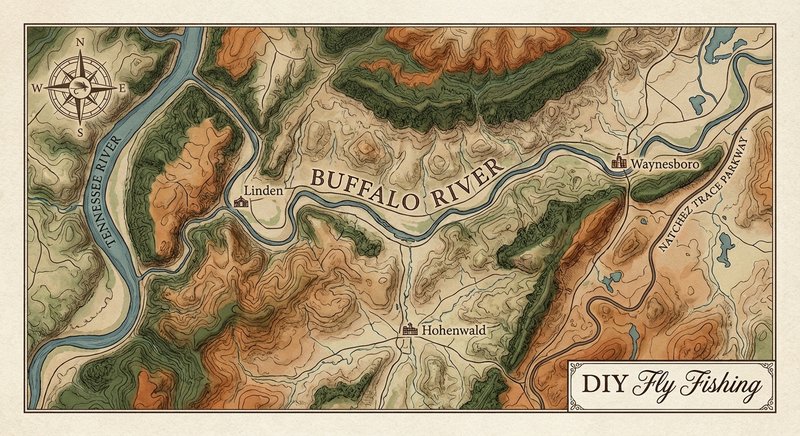
Buffalo River
Fly fishing in Tennessee · Beginner · Best seasons: Spring, Summer, Fall
Target Species
Smallmouth Bass, Largemouth Bass, Bluegill
About This Water
Scenic middle Tennessee river. Excellent smallmouth bass and bluegill fishing.
Fishing Recommendations
The Buffalo River in Middle Tennessee is one of the state’s hidden gems for the warm-water fly angler. Designated as a "Scenic River," it flows through the rolling hills of the Highland Rim, offering a classic gravel-bottomed, limestone-bluff experience. It is one of the longest un-dammed rivers in the region, providing a natural flow that caters perfectly to the life cycles of wild Smallmouth Bass.
As your guide, here is everything you need to know to find success on the Buffalo.
🎣 Location Overview
The Buffalo River is a tributary of the Duck River, winding through Lewis, Wayne, Perry, and Humphreys counties. What makes it special is its clarity and pace. Unlike many Southern rivers that turn "muddy" quickly, the Buffalo maintains a beautiful emerald-to-clear tint during normal flows due to its gravel substrate and spring-fed tributaries.
Anglers love it because it feels remote. You’ll drift past towering limestone bluffs, dense hardwood forests, and pastoral farmlands. It is a "float-centric" river, meaning it is best explored by canoe or kayak, though wade-fishing is possible at various public access points during low summer flows.
🐟 Target Species & Behavior
- Smallmouth Bass (The Main Event): These are the "Bronzebacks" of the Buffalo. They are lean, aggressive, and pound-for-pound the hardest fighters in the river. They hold in "push water" just above riffles, in the deep eddies behind boulders, and along the shaded bluff walls.
- Largemouth Bass: While less common than Smallmouth in the swifter sections, you’ll find them in the slower, deeper "sloughs" and backwaters where downed timber provides overhead cover.
- Bluegill & Longear Sunfish: The Buffalo has a massive population of panfish. They are exceptionally colorful and will hit almost any small fly. They are perfect for introducing beginners to the sport.
- Rock Bass (Redeyes): Don't overlook these guys. They hide in the same rocky crevices as Smallmouth and hit streamers with surprising violence.
📅 Best Times to Fish
- Spring (April – May): This is the "Pre-Spawn" and "Spawn" window. As water temps hit 55–60°F, fish become very active. This is the best time for trophy Smallmouth, though spring rains can occasionally blow out the river.
- Summer (June – August): The most consistent time. Low, clear water makes for incredible topwater action. Focus on the "Golden Hours"—the first three hours of light and the last two before dark.
- Fall (September – October): My personal favorite. As the water cools, bass feed heavily to prepare for winter. The falling leaves can make casting tricky, but the "feeding frenzy" is real.
- Prime Conditions: Look for a stable or falling river gauge. If the water is rising rapidly, the fish will move to the banks and the clarity will drop.
🪰 Recommended Flies & Techniques
Topwater (The Most Fun)
- Patterns: BoogleBugs (size 4-8), Murdich Minnows (weighted for subsurface or unweighted for waking), and foam "Gurgler" patterns.
- Technique: Cast tight to the bank or right against a bluff wall. Let the rings disappear before giving the fly a "pop." In the Buffalo, Smallmouth often hit on the pause.
Subsurface (The Most Effective)
- Patterns: Clouser Minnows (Chartreuse/White or Olive/White), Woolly Buggers (Black or Olive), and Near Nuff Crayfish.
- Technique: The Buffalo is a crayfish-rich environment. Use a "strip-strip-pause" retrieve near the bottom. If the water is high, use a sink-tip line to get your flies down to the root balls.
The "Hellgrammite" Secret
The Buffalo is full of Dobsonfly larvae (Hellgrammites). A black, rubber-legged nymph or a specialized Hellgrammite pattern drifted under an indicator through riffles will catch fish when nothing else works.
💡 Pro Tips & Local Knowledge
- The Bluff Wall Strategy: On the Buffalo, the deep water is almost always against the limestone bluffs. Smallmouth use the "ledges" of these underwater rocks like apartments. Cast your fly as close to the rock as possible—if you aren't hitting the rock occasionally, you aren't close enough.
- Shadow Management: Smallmouth are light-sensitive. As the sun rises, they move into the shadows cast by the trees and bluffs. Follow the shade to find the fish.
- Longer Leaders: Because the water is clear, use a longer leader (9ft) tapered to 10lb or 12lb fluorocarbon. These fish can be "leader shy" in the flat, slow pools.
- The "Lazy" Float: Don't just paddle through the flat water. Some of the biggest Largemouth sit in the "dead water" sections where there is heavy submerged wood.
⚠️ Important Information
- Access: Key access points include the bridge at Flatwoods (Hwy 13), Linden, and Lobelville. There are several commercial canoe liveries (like Buffalo River Resort or Heath’s Canoe Rental) that offer shuttle services—highly recommended for 1-day floats.
- Regulations: A valid Tennessee Fishing License is required. There are specific size and creel limits for Smallmouth Bass (often a "slotted" limit where small fish can be kept but mid-sized fish must be released). Always check the current TWRA Guide before heading out.
- Safety: The Buffalo is generally a Class I river (easy), but watch out for "Strainers" (downed trees in moving current). They can be dangerous for inexperienced paddlers.
- Respect Private Property: While the riverbed is public, the land on either side is often private. Be respectful when stopping to wade or eat lunch.
Guide’s Final Word: The Buffalo River isn't about catching a 10lb bass; it’s about the sheer volume of 12-16 inch Smallmouth and the beauty of the Tennessee landscape. Pack a 6-weight fly rod, plenty of hydration, and some olive streamers, and you're in for one of the best days of fishing in the South.
Bug Hatches & Matching Flies
| Hatch | Type | Peak months | Time of day | Hook sizes | Matching flies |
|---|---|---|---|---|---|
| White Fly Ephoron leukon | mayfly | August, September | Evening/Dusk | #12-14 | White Wulff #12-14, Ephoron Dun #12-14, White Stimulator #12 |
| Cinnamon Caddis Hydropsyche | caddis | April, May, June | Evening | #14-18 | Elk Hair Caddis (Tan) #14-16, Hydropsyche Larva #14-16, Pupa (Cinnamon) #14-18 |
| Hellgrammite Corydalus cornutus | other | June, July | All Day | #2-8 | Murray's Hellgrammite #4-8, Bitch Creek Nymph #6-10, Near Nuff Hellgrammite #2-6 |
| Hexagenia Hexagenia limbata | mayfly | June, July | Evening/Night | #6-10 | Hexagenia Dun #6-8, Hex Nymph #6-10, Yellow Stimulator #8-10 |
| March Brown Maccaffertium vicarium | mayfly | April, May | Afternoon | #10-14 | March Brown Western #12-14, Hare's Ear Nymph #10-14, March Brown Wet #12-14 |
| Blue-Winged Olive Baetis | mayfly | March, April, October, November | Mid-day/Overcast | #18-22 | Parachute BWO #18-20, RS2 #20-22, Pheasant Tail Nymph #18-22 |
| Light Cahill Stenacron interpunctatum | mayfly | May, June, July | Evening | #12-16 | Light Cahill Dry #14-16, Gold Ribbed Hare's Ear #14-16 |
| Grasshopper Orthoptera | terrestrial | July, August, September | Late Morning/Afternoon | #6-12 | Dave's Hopper #8-10, Morrish Hopper #6-12, Amy's Ant #10 |