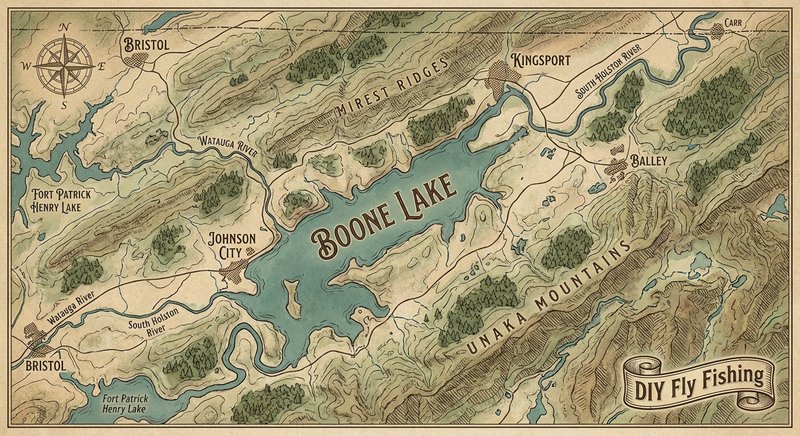
Boone Lake
Fly fishing in Tennessee · Beginner · Best seasons: Spring, Summer, Fall
Target Species
Largemouth Bass, Crappie, Catfish
About This Water
Northeast Tennessee reservoir with good bass and crappie. Family-friendly fishing.
Fishing Recommendations
Welcome to the "Tri-Cities" area of East Tennessee. As your guide, I’m excited to break down Boone Lake. While many fly anglers flock to the nearby tailwaters (the South Fork Holston and Watauga) for trout, Boone Lake offers a phenomenal warm-water fly fishing experience that is often overlooked.
Boone is a TVA reservoir where the South Fork Holston and Watauga Rivers converge. After several years of dam repairs and lowered water levels, the lake is back to full pool, and the fishery is in a "rebound" phase with high productivity and fast-growing fish.
🎣 Location Overview
Boone Lake is a 4,500-acre reservoir characterized by steep rocky bluffs, numerous private docks, and long, winding river arms. What makes it special for the fly angler is the diversity of structure. You can fish high-gradient rocky banks in the morning and transition to shallow, weedy pockets or submerged timber by afternoon.
The water clarity varies significantly. The Watauga arm tends to stay clearer, while the South Fork Holston arm can be more stained. Because it is a valley lake, it features "classic" reservoir behavior: significant spring rises and drawdowns in the winter. For the fly fisher, this means the "shoreside" targets—like overhanging trees and dock pilings—are the primary focus.
🐟 Target Species & Behavior
Largemouth Bass
Boone’s largemouth are "structure-oriented." In the spring, they move into the shallow secondary points and backs of creeks to spawn. In summer, they retreat to deeper offshore humps or hide under the deep shadows of boat docks to escape the sun. They feed heavily on Gizzard Shad, Threadfin Shad, and Bluegill.
Crappie
Crappie are schooling fish that love "vertical" structure. On a fly rod, you are looking for fish suspended around submerged brush piles or the "shady side" of bridge pilings. They are visual hunters, feeding almost exclusively on small minnows and fry.
Catfish (Channel & Flathead)
While rarely targeted on the fly, it is entirely possible here, especially during the "Cicada" years or during heavy summer rains. They hold in the channel bends and move onto the mudflats at night to feed. They rely on scent but are opportunistic predators that will absolutely smash a heavy streamer stripped slowly across the bottom.
📅 Best Times to Fish
- Spring (March – May): Prime Time. As the water hits 55°F, bass move shallow. This is your best window for topwater action and sight-fishing the flats in the back of creeks.
- Summer (June – August): Focus on the "Golden Hour" (dawn and dusk). During the heat of the day, fish go deep (15-25 feet), which is difficult for fly lines. Night fishing under dock lights is a local secret for summer success.
- Fall (September – November): As temperatures drop, shad migrate to the backs of creeks. This triggers a feeding frenzy. Look for "boiling" water where bass are pushing baitfish to the surface.
🪰 Recommended Flies & Techniques
For Largemouth Bass
- Technique: Use an 8-weight rod with a weight-forward floating line for topwater, or a 200-250 grain sinking tip for streamers.
- Top Fly Patterns:
- BoogleBugs (Poppers) in Chartreuse or White.
- Game Changers (White/Grey) to mimic shad.
- Dahlberg Divers in Frog or Bluegill patterns.
- Clouser Minnows (Chartreuse/White) for fishing deeper points.
For Crappie
- Technique: Use a 3-weight or 4-weight rod. Use a "slow-strip, pause" retrieve. The hit usually happens on the pause (the drop).
- Top Fly Patterns:
- Micro-Zonkers (White or Pink).
- Marabou Minnows (Size 8-10).
- Crappie Candy (Bead-head patterns with flash).
For Catfish
- Technique: Heavy 8-weight rod. You must get the fly to the bottom. Use a "dead-drift and twitch" method near creek mouths after a rain.
- Top Fly Patterns:
- Woolly Buggers (Black or Olive, oversized #2-4) with heavy lead eyes.
- Meat Whistles (Black/Red).
💡 Pro Tips & Local Knowledge
- The "Dock Skipping" Game: Boone is a "dock lake." To catch the biggest largemouth, you must learn to skip your fly under the walkways of floating docks. Use a side-arm cast with a heavy-bodied foam popper to reach the dark corners where the big fish hide.
- Mud Lines: After a heavy rain, look for where "red" water meets "clear" water near the mouth of the rivers. Predators (Bass and Catfish) sit right on that line to ambush disoriented baitfish.
- Night Lights: Many homeowners have green "Snook lights" or underwater LEDs. On summer nights, these attract clouds of baitfish. Casting a small white streamer into these lights is a surefire way to hook into Bass and even the occasional Hybrid Striped Bass.
- Follow the Birds: If you see Blue Herons lined up on a bank or Gulls diving, move there immediately. They are tracking the shad schools that Boone’s predators rely on.
⚠️ Important Information
- Access: Public boat ramps are available at Boone Dam, Devault Bridge, and Jay’s Boat Dock. If you are fishing from shore, the area around the Winged Deer Park offers some public bank access.
- Regulations: A valid Tennessee Fishing License is required. There are specific length and creel limits for Bass and Crappie that change periodically—always check the TWRA (Tennessee Wildlife Resources Agency) website before heading out.
- Safety: Boone is a popular recreational lake. During summer weekends, jet skis and wake boats create significant chop. If you are in a kayak or a small rowing frame, stick to the "no-wake" coves or fish early in the morning to avoid heavy traffic.
- Water Levels: Check the TVA Lake Info App. It will tell you the current elevation and whether the dam is "generating." High generation creates a current in the river arms that can trigger a feeding cycle.
Guide’s Final Word: Boone Lake is a "thinking man's" fishery. It rewards those who study the structure and the shad movements. Don't be afraid to go big with your fly patterns—the bass here are used to eating large Gizzard Shad!
Bug Hatches & Matching Flies
| Hatch | Type | Peak months | Time of day | Hook sizes | Matching flies |
|---|---|---|---|---|---|
| Midges Chironomidae | midge | January, February, March, December | All Day | #18-24 | Zebra Midge #18-22, Griffith's Gnat #20-24, Morgan's Midge #20-22 |
| Blue Winged Olives (BWO) Baetis | mayfly | March, April, October, November | Mid-day/Afternoon | #18-22 | RS2 #20-22, Parachute Adams #18-22, Pheasant Tail Nymph #18-20 |
| Sulphurs Ephemerella invaria | mayfly | May, June, July | Late Afternoon/Evening | #14-18 | Sulphur Parachute #14-18, Split Case Sulphur #16-18, Sulphur CDC Emerger #16-18 |
| Tan Caddis Hydropsyche | caddis | April, May, June | Morning/Evening | #14-18 | Elk Hair Caddis #14-18, Holy Grail Caddis #16-18, Pupa-chute #14-16 |
| White Fly Ephoron leukon | mayfly | August, September | Dusk/Night | #12-14 | White Wulff #12-14, Ephoron Spinner #12-14, White Nymph #12-14 |
| Crane Flies Tipulidae | other | August, September, October | Morning/Afternoon | #8-12 | Daddy Long Legs #8-12, Crane Fly Larva #10-12, Skating Crane Fly #10 |
| Terrestrials (Ants/Beetles) Formicidae/Coleoptera | terrestrial | July, August, September | All Day | #12-18 | Black Foam Beetle #14-16, Cinnamon Ant #16-18, Chernobyl Ant #8-12 |
| Trico Tricorythodes | mayfly | July, August, September | Early Morning | #22-26 | Trico Spinner #22-26, Sunken Trico Spinner #22-24, Trico Duns #24 |