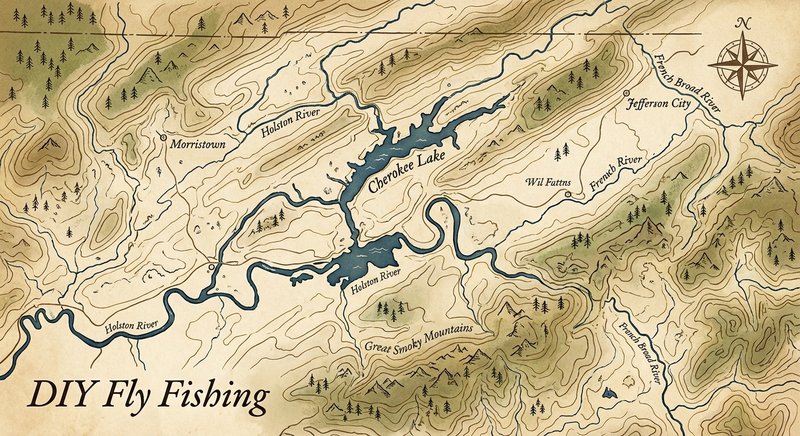
Cherokee Lake
Fly fishing in Tennessee · Beginner · Best seasons: Spring, Summer, Fall
Target Species
Largemouth Bass, Smallmouth Bass, Crappie
About This Water
Northeast Tennessee reservoir with excellent bass fishing. Good crappie in spring.
Fishing Recommendations
Welcome to East Tennessee. As a guide in these waters, I can tell you that Cherokee Lake (a TVA reservoir on the Holston River) is a hidden gem for the warm-water fly angler. While many head to the nearby tailwaters for trout, Cherokee offers over 28,000 acres of prime habitat for Smallmouth, Largemouth, and some of the most productive Crappie fishing in the region.
Here is your comprehensive guide to fly fishing Cherokee Lake.
🎣 Location Overview
Cherokee Lake is a classic Highland Reservoir characterized by its massive fluctuations in water level (TVA drawdown) and its diverse structure. You’ll find everything from sheer shale bluffs and rocky points to muddy flats and submerged timber.
What makes it special for the fly angler is the clarity and structure. In the spring and fall, the fish move onto the rocky shelves and into the "buckbrush," putting them well within reach of a well-placed fly. Unlike some of the deeper, clearer lakes to the south, Cherokee’s fertility supports a massive biomass of Gizzard Shad and Threadfin Shad, which fuels an aggressive predatory environment.
🐟 Target Species & Behavior
Smallmouth Bass
The "Bronzebacks" are the stars of Cherokee. They prefer the cooler, clearer water near the dam and the mid-lake rocky points.
- Behavior: They are highly nomadic, following schools of shad. They love "transition zones" where gravel turns to chunk rock.
- Diet: Primarily shad and crawfish.
Largemouth Bass
Found more frequently in the mid-to-upper sections of the lake and in the backs of the major creek arms (like Mooresburg or Poor Valley).
- Behavior: Ambush predators. They hold tight to wood, boat docks, and submerged vegetation (when available).
- Diet: Larger forage—bluegill, shad, and frogs.
Crappie
Cherokee is famous for "slab" crappie.
- Behavior: They are school-oriented and structure-dependent. They hold on submerged brush piles and bridge pilings. During the spring spawn, they move remarkably shallow (1–5 feet) into the shoreline cover.
- Diet: Micro-minnows and aquatic insects.
📅 Best Times to Fish
Spring (March – May) [Prime Time]
- Window: This is the pre-spawn and spawn period. Fish are in the shallows.
- Conditions: Look for rising water levels. When the TVA fills the lake and the water hits the shoreline brush, the bass and crappie move in immediately.
Summer (June – August)
- Window: Low light is mandatory. Fish from 5:00 AM to 9:00 AM or the last two hours of daylight.
- Conditions: Deep summer "dredging" with sinking lines is required during the day. Night fishing with black surface poppers can be legendary for Smallmouth on the bluffs.
Fall (September – November)
- Window: As the water cools, the "Shad Kill" and shad migration begin.
- Conditions: Fish move from the main lake into the creek mouths. Look for "boiling" water where bass are pushing shad to the surface.
🪰 Recommended Flies & Techniques
For Bass (Smallmouth & Largemouth)
- Streamers:
- Game Changers (White/Pearl): Best for mimicking erratic shad.
- Clouser Minnows (Chartreuse/White): The gold standard for getting deep on rocky points.
- Near Nuff Craws: Essential for dragging along the bottom when Smallmouth are keyed on crawfish.
- Topwater:
- BoogleBugs: Durable poppers that create a "pop" Smallmouth can't resist.
- Dahlberg Divers: Great for fishing around wood for Largemouth.
- Technique: Use a Type 3 or Type 6 Sinking Tip line to get streamers down to the 8–15 foot range on points. For topwater, use a heavy 7-weight floating line with a 9ft 0X leader.
For Crappie
- Patterns:
- Wooly Buggers (Size 10-12) in White or Pink.
- Mop Flies: Surprisingly effective under a strike indicator.
- Chartreuse Micro-Clousers.
- Technique: "Vertical Nymphing." Use a long leader and a strike indicator. Suspend the fly over submerged brush and give it the slightest twitches.
💡 Pro Tips & Local Knowledge
- The "Float and Fly" on a Fly Rod: In the early spring, local gear anglers use a bobber and a tiny jig. You can replicate this with a fly rod using a heavy indicator and a weighted balanced leech pattern. It is deadly for Smallmouth on the shale bluffs near the dam.
- Follow the Birds: If you see gulls diving in the fall, get there immediately. They are targeting shad pushed up by schools of Smallmouth and Striped Bass.
- The Holston Influence: The very upper end of the lake (near Rogersville) behaves more like a river. If the lake is low, focus here for Smallmouth using traditional river smallmouth tactics (swinging streamers).
- Wind is your Friend: A "Cherokee Chop" on the water breaks up the light. If it’s glass-calm, the Smallmouth become very spooky. A little wind on a point usually turns the bite on.
⚠️ Important Information
- Access:
- Cherokee Dam: Great boat ramp and some limited bank access.
- 25E Bridge: Good central access point for reaching both mid-lake and upper-lake sections.
- Public Parks: Panther Creek State Park offers great facilities and ramps.
- Regulations:
- A valid Tennessee Fishing License is required.
- Smallmouth: 1 per day, 18-inch minimum length (check current TN Wildlife Resources Agency - TWRA - regs as they can change seasonally).
- Crappie: 15 per day, 10-inch minimum.
- Safety: Cherokee can get rough quickly when the wind blows out of the West. If you are in a kayak or a small drift boat, stay close to the coves. Also, be wary of submerged "islands" when the lake is at winter pool.
Guide’s Final Word: If you want the fish of a lifetime, target the rocky points with a white Game Changer in late April. The Smallmouth are aggressive, heavy, and will give your 7-weight a workout you won't forget. Tight lines!
Bug Hatches & Matching Flies
| Hatch | Type | Peak months | Time of day | Hook sizes | Matching flies |
|---|---|---|---|---|---|
| Midges Chironomidae | midge | February, March, December | All Day | #18-24 | Zebra Midge #18-22, Griffith's Gnat #20-24, Palomino Midge #20-22 |
| Giant Michigan Mayfly Hexagenia limbata | mayfly | June, July | Dusk/Night | #6-10 | Hexagenia Dry #6-8, Burrowing Mayfly Nymph #8-10, Deer Hair Hex #6-8 |
| Damselfly Enallagma | terrestrial | June, July, August | Morning/Afternoon | #10-14 | Marabou Damsel Nymph #10-12, Adult Damsel #12-14 |
| Cinnamon Caddis Hydropsyche | caddis | April, May, September | Evening | #14-16 | Elk Hair Caddis #14-16, LaFontaine's Deep Sparkle Pupa #14-16 |
| White Curse (Tiny White Wing) Caenis | mayfly | July, August | Early Morning | #20-24 | Caenis Spinner #22-24, RS2 #20-22 |
| Carpenter Ants Camponotus | terrestrial | August, September | Afternoon | #12-16 | Chernobyl Ant #12-14, Black Foam Ant #14-16 |
| Trico Tricorythodes | mayfly | August, September, October | Morning | #20-24 | Trico Spinner #22-24, Sunken Trico Spinner #20-22 |
| Japanese Beetle Popillia japonica | terrestrial | June, July | Afternoon | #12-14 | Foam Beetle #12-14, Coffee's Sparkle Beetle #14 |