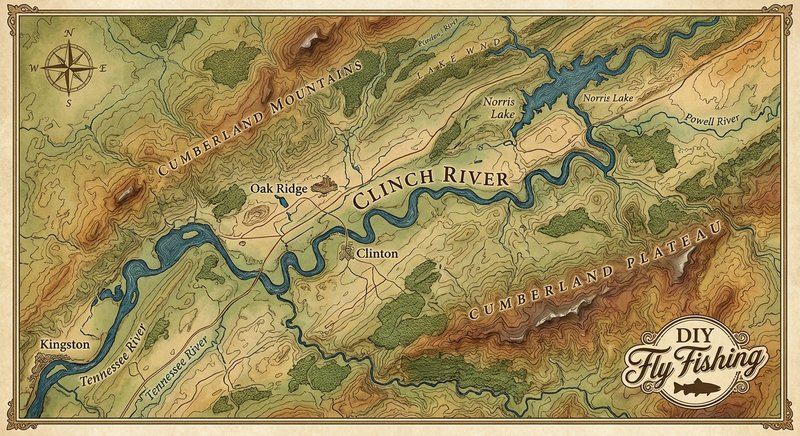
Clinch River
Fly fishing in Tennessee · Intermediate · Best seasons: Spring, Summer, Fall, Winter
Target Species
Brown Trout, Rainbow Trout
About This Water
Excellent tailwater fishery below Norris Dam. Large brown trout and consistent hatches year-round.
Fishing Recommendations
The Clinch River below Norris Dam in Anderson County, Tennessee, is widely considered the "crown jewel" of Southern tailwaters. As Tennessee’s oldest tailwater fishery, it offers a remarkably stable environment that produces both high numbers of fish and legitimate trophy-class Brown Trout.
Here is your comprehensive guide to fishing the Clinch.
🎣 Location Overview
The Clinch River is a classic tailwater flowing from the depths of Norris Lake. Because the water is pulled from the bottom of the dam, it remains a consistent 50–55°F year-round. This "refrigerator effect" creates an ideal laboratory for trout growth and incredible insect biomass.
The river is characterized by long, glassy pools, shallow gravel shelves, and "shoals" (riffle sections). The water is notoriously gin-clear. Because the river is wide and relatively shallow in many spots, it is a wading angler's paradise during low water, but it transforms into a powerful, dangerous river during power generation.
What makes it special is the technical nature of the fishing. These fish are educated; the Clinch is often called a "PhD river" for fly anglers. Success here requires stealth, light tippets, and perfect presentations.
🐟 Target Species & Behavior
- Rainbow Trout: These make up the bulk of the population. They are hard-fighting and often hold in the faster oxygenated water of the shoals. They are notorious "midge eaters," often rising to tiny specks in the surface film.
- Brown Trout: The Clinch is famous for its wild and holdover Browns. These fish are predatory and wary. Large Browns often hold in the deeper undercut banks or in the dark slots behind large boulders. During the fall spawn, they become more active, but the river maintains a "Trophy Section" to protect these giants.
- Behavior: Due to the clarity of the water, these fish are "spooky." If they see your shadow or a splashy cast, the pool is done for 20 minutes. They focus heavily on micro-midges and crustaceans (scuds/sowbugs).
📅 Best Times to Fish
Optimal Seasons
- Spring (March – May): Prime Time. This is the window for the legendary Sulphur hatch. As the air warms, the river comes alive with yellow mayflies, offering some of the best dry fly fishing in the Eastern US.
- Summer (June – August): Excellent fishing, but highly dependent on the "generation schedule." Terrestrials (beetles/ants) become important. The cold water is a refuge from the Tennessee heat.
- Fall (September – November): Great for streamers and big Browns. The scenery is spectacular, and the crowds thin out.
- Winter (December – February): This is "Midge Season." While the air is cold, the water temp remains stable. On overcast days, you can see massive midge hatches that bring fish to the surface even in January.
The "Generation Schedule"
The most important factor is the TVA (Tennessee Valley Authority) release schedule.
- Low Water (0 generators): Best for wading.
- High Water (1-2 generators): Best for drift boats; wading becomes dangerous or impossible.
- Always check the TVA app before heading out.
🪰 Recommended Flies & Techniques
Top Fly Patterns
- Midges (Sizes 18–24): Zebra Midges (black, silver, mercury), Griffith’s Gnat, and the "Clinch River Zebra" (red/silver).
- Sulphurs (Sizes 16–20): Parachute Sulphurs, CDC Comparaduns, and Pheasant Tail nymphs (to represent the nymphs moving up the water column).
- Scuds & Sowbugs (Sizes 16–20): Ray Charles, Rainbow Warriors, and Ray-type sowbugs in grey or tan. These are the "bread and butter" of the Clinch.
- Streamers: Woolly Buggers (olive/black) or Galloup-style streamers for those hunting trophy Browns during high water.
Techniques & Presentation
- The "Long Leader" Nymphing: Use 9–12 foot leaders tapering down to 6X or 7X fluorocarbon tippet. If you use 5X, you will likely get refused by older fish.
- Micro-Shot: Use the smallest split shot possible. The goal is to get the fly to the fish's level without it dragging unnaturally.
- Dry Fly Stealth: When fish are rising in glassy water, do not cast at the fish. Cast well upstream and let the fly drift down into their window.
💡 Pro Tips & Local Knowledge
- Focus on the Shoals: Places like Miller’s Island and Peach Orchard are famous for a reason. They provide the oxygen and habitat trout love.
- The "Clinch River Twitch": When fishing a midge or sowbug under an indicator, sometimes a microscopic "twitch" of the rod tip can trigger a strike from a lethargic fish.
- Wear Greys and Greens: Avoid bright white hats or shirts. The water is so clear that fish can see your silhouette against the sky from a long distance.
- The "High Water" Strategy: If the sirens go off and the water starts rising, don't leave immediately. The first 30 minutes of rising water often flushes insects out of the rocks, creating a feeding frenzy. Fish the edges as you retreat to the bank.
⚠️ Important Information
Access Points
- Norris Dam State Park: Just below the dam. Good for wading at low water.
- Miller’s Island: Perhaps the most popular wading spot. Easy access and great shoals.
- Peach Orchard: Further downstream; offers a mix of deep pools and nice riffles.
Regulations
- Trophy Section: There is a protected slot limit. From the Highway 61 bridge upstream to Norris Dam: 7-trout creel limit, only one of which may be greater than 20 inches. All trout between 14 and 20 inches must be released immediately.
- License: You need a Tennessee Fishing License with a Trout Small Game supplement.
- Safety: The sirens indicate the dam is about to release water. Do not ignore them. The water rises rapidly and can trap you on islands or sweep you away.
Expert Summary
The Clinch is a rewarding but humbling river. Bring your lightest tippet, your smallest flies, and your most patient attitude. When you finally hook into a 22-inch Clinch Brown on a size 22 midge, you'll understand why this river is legendary.
Bug Hatches & Matching Flies
| Hatch | Type | Peak months | Time of day | Hook sizes | Matching flies |
|---|---|---|---|---|---|
| Sulphurs Ephemerella invaria / dorothea | mayfly | May, June, July | Afternoon/Evening | #16-20 | Comparison Dun #16-18, Split Case Sulphur #16-20, Sulphur Soft Hackle #16-18 |
| Midges Chironomidae | midge | January, February, March, December | All Day | #18-24 | Zebra Midge #18-22, Griffith's Gnat #18-24, Top Secret Midge #20-22 |
| Blue-Winged Olives (BWO) Baetis spp. | mayfly | March, April, October, November | Mid-day/Afternoon | #18-22 | RS2 #20-22, Parachute Adams #18-22, Pheasant Tail Nymph #18-20 |
| Black Caddis Brachycentrus | caddis | March, April | Morning/Afternoon | #16-18 | Elk Hair Caddis (Black) #16-18, Holy Grail #16-18, Deep Sparkle Pupa #16 |
| Craneflies Tipulidae | midge | August, September, October | Morning/Evening | #8-12 | Daddy Long Legs #8-10, Crane Fly Larva #10-12, Killer Bug #12 |
| Tricos Tricorythodes | mayfly | August, September | Early Morning | #22-26 | Trico Spinner #22-26, Trico Drown Spinner #24 |
| Cinnamon Caddis Hydropsyche | caddis | June, July, August | Evening | #16-18 | Elk Hair Caddis (Tan) #16-18, LaFontaine's Emerger #16-18 |
| Terrestrials Formicidae / Coleoptera | terrestrial | July, August, September | All Day | #12-18 | Black Foam Ant #14-18, Cricket #12-14, Beetle #14-16 |