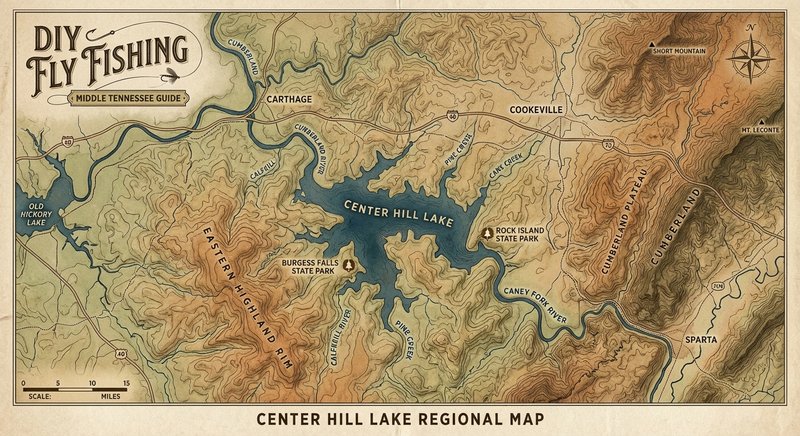
Center Hill Lake
Fly fishing in Tennessee · Beginner · Best seasons: Spring, Summer, Fall
Target Species
Striped Bass, Smallmouth Bass, Walleye
About This Water
Clear reservoir with excellent striped bass. Good walleye and bass fishing.
Fishing Recommendations
Welcome to the "Highland Rim" of Middle Tennessee. As your guide, I can tell you that Center Hill Lake is one of the most scenic and productive fisheries in the Southeast. Unlike the muddy lowland reservoirs further west, "The Hill" is a deep, clear, and rugged highland reservoir characterized by sheer limestone bluffs, deep hollows, and rocky points.
For the fly angler, it offers a "big water" challenge that rewards those who understand seasonal migrations and baitfish movement.
🎣 Location Overview
Center Hill Lake is a 18,220-acre impoundment of the Caney Fork River. What makes it special is its water clarity and dramatic topography. Because the water is so clear, fish often hold deeper than in other Tennessee lakes, making "dredging" with sinking lines a primary tactic.
Anglers love it because it feels wild. Much of the shoreline is undeveloped and managed by the Army Corps of Engineers, offering a wilderness feel just an hour east of Nashville. It is a dual-threat destination: you have the lake itself for warm-water predators, and the world-famous Caney Fork tailwater below the dam for trout.
🐟 Target Species & Behavior
Striped Bass
These are the kings of the lake. Center Hill stripers are nomadic and follow the massive schools of Gizzard and Threadfin Shad.
- Behavior: They are "wolf pack" hunters. In spring, they migrate toward the river arms (up-lake). In summer, they retreat to the deep, cool water near the dam.
- Feeding: Almost exclusively shad.
Smallmouth Bass
Center Hill is a premier "brown fish" destination. These fish love the rocky transitions and gravel points.
- Behavior: They move from deep winter haunts to shallow shelves and secondary points in the spring. They are notorious for suspended behavior—hanging 10–15 feet down over 40 feet of water.
- Feeding: Crawfish and shad.
Walleye
Center Hill is one of the best Walleye lakes in the South.
- Behavior: They are light-sensitive. During the day, they hold tight to bottom structure or deep brush piles. In early spring (Feb–March), they make a famous spawning run up the Caney Fork and Falling Water River arms.
- Feeding: Small baitfish and leeches.
📅 Best Times to Fish
- Spring (March – May): Prime Time. This is the window for the Walleye run (March) and the Smallmouth spawn (April). Stripers are active in the upper river arms and can be caught on topwater during low-light hours.
- Summer (June – August): Focus on Night Fishing or the "crack of dawn." Once the sun hits the water, the bite shuts down. Stripers will be deep (30–50 feet), requiring heavy sinking lines.
- Fall (September – November): The "Second Spring." As water temperatures drop, shad move into the backs of creeks, and the predators follow. Look for "the jump"—Stripers busting shad on the surface.
🪰 Recommended Flies & Techniques
For Striped Bass
- Patterns: 4/0–6/0 Game Changers (white/pearl), Cowen’s Baitfish, and heavy Clouser Minnows (Chartreuse/White).
- Technique: Use an 8wt or 9wt rod with a 350–450 grain sinking head. Cast toward submerged points or "the boil" if you see surface activity. A fast, erratic strip-strip-pause retrieve mimics a wounded shad.
For Smallmouth Bass
- Patterns: Murdich Minnows, Near Nuff Craws, and Rubber-Legged Poppers (for early morning).
- Technique: Target "transition banks" where a bluff wall turns into a gravel bank. Use an intermediate line to swing streamers along the rocks.
For Walleye
- Patterns: Wooly Buggers (Black or Purple) and heavy Dumbbell-eyed Leech patterns.
- Technique: "Dredging" the bottom. You must get the fly deep. Use a slow, rhythmic strip along the bottom of river channels during the spring run.
💡 Pro Tips & Local Knowledge
- Watch the Birds: In the fall and winter, seagulls and terns are your best fish finders. If birds are diving, Stripers are pushing shad to the surface. Get there fast, but cut your motor early and drift in.
- The "Bluehole" and Sligo: The area around Sligo Bridge and the Bluehole is legendary for the spring Walleye and Striper run. This is where the lake transitions into a river.
- The Bluff Shadow: In the summer, fish the "shadow line" of the high bluffs. Smallmouth will linger in the shade several hours longer than they will on open banks.
- Count Down: When using sinking lines, use a "count down" method (e.g., "one-thousand-one, one-thousand-two"). If you get a hit on a count of 15, you’ve found the depth of the thermocline. Stay in that zone.
⚠️ Important Information
- Access:
- Edgar Evins State Park: Great central access with ramps and a marina.
- Burgess Falls: Access to the upper Falling Water River arm (great for spring runs).
- Sligo Marina: Best access for the upper Caney Fork arm.
- Regulations: A valid Tennessee Fishing License is required. Center Hill has specific length and creel limits for Smallmouth and Walleye (check the current TWRA Guide as these change annually).
- Safety: The lake is deep and can get rough with boat traffic on summer weekends. Always watch the weather; wind can whip up quickly in the narrow canyons between the bluffs.
- The Dam: If you decide to fish the tailwater below the dam, check the generation schedule (TVA app). Rising water there is dangerous for waders.
Tight lines, and enjoy one of Tennessee's true gems!
Bug Hatches & Matching Flies
| Hatch | Type | Peak months | Time of day | Hook sizes | Matching flies |
|---|---|---|---|---|---|
| Midges Chironomidae | midge | January, February, March, December | All Day | #18-24 | Zebra Midge #18-22, Griffith's Gnat #20-24, Top Secret Midge #20-22 |
| Blue Winged Olive Baetis | mayfly | March, April, October, November | Midday/Afternoon | #18-22 | Parachute Adams #18-22, Pheasant Tail Nymph #18-20, RS2 #20-22 |
| Sulfurs Ephemerella invaria | mayfly | May, June, July | Late Afternoon/Evening | #14-18 | Sulfur Parachute #14-16, Sulfur CDC Emerger #16-18, Split Case Sulfur #16 |
| Grannom/Black Caddis Brachycentrus | caddis | March, April | Midday | #14-18 | Elk Hair Caddis (Black) #14-16, Holy Grail Caddis #16, Z-Wing Caddis #14-16 |
| Tan Caddis Hydropsyche | caddis | June, July, August | Evening | #14-16 | Pulsating Caddis Pupa #14-16, Elk Hair Caddis (Tan) #14-16, Soft Hackle Hare's Ear #14-16 |
| White Fly Ephoron leukon | mayfly | August, September | Evening/Night | #12-14 | White Wulff #12-14, White Comparadun #14 |
| Terrestrials Formicidae/Coleoptera | terrestrial | July, August, September | Afternoon | #10-16 | Chernobyl Ant #10-12, Black Foam Beetle #14-16, Cinnamon Ant #16-18 |
| Sowbugs Isopoda | terrestrial | March, April, May | All Day | #14-18 | Ray Charles #14-18, Tailwater Sowbug #16-18 |