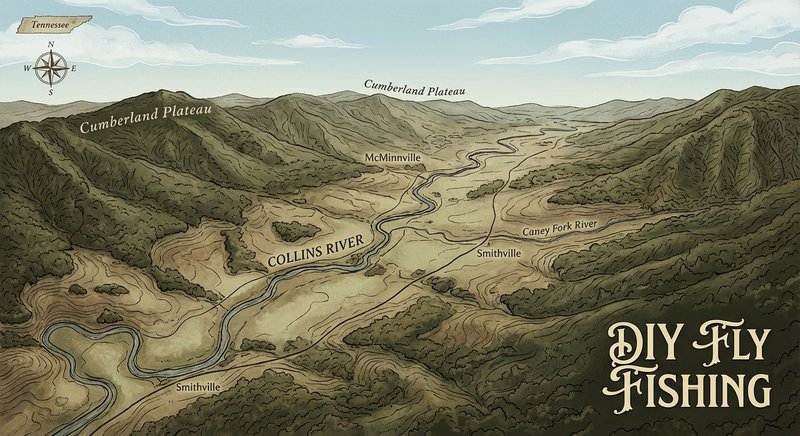
Collins River
Fly fishing in Tennessee · Beginner · Best seasons: Spring, Summer, Fall
Target Species
Smallmouth Bass, Rock Bass
About This Water
Scenic middle Tennessee stream with smallmouth bass. Good float fishing.
Fishing Recommendations
The Collins River is one of Middle Tennessee’s true hidden gems. Flowing through the heart of Warren County and the town of McMinnville, it is a classic limestone river characterized by high bluffs, deep emerald pools, and fertile water. While it is internationally famous among the "toothy critter" crowd as one of the premier Musky fisheries in the South, for the fly angler targeting Smallmouth Bass and Rock Bass, it offers some of the most consistent and scenic river fishing in the region.
🎣 Location Overview
The Collins River is a low-gradient, warm-water stream that winds through pastoral landscapes and dramatic limestone shelf rock formations. What makes it special is its diversity of habitat. You will find everything from fast-moving riffles and "push" water to deep, slow-moving "lake-like" stretches.
The water clarity is generally good, though it can take on a classic "Tennessee Green" tint after rain. Because much of the river is flanked by private land and dense sycamore canopies, it feels secluded and wild. For the fly fisher, this is a river that rewards stealth, accurate casting, and an understanding of how fish use wood and rock structure.
🐟 Target Species & Behavior
Smallmouth Bass (The "Bronzeback")
The Smallmouth here are hardy and athletic.
- Behavior: They are ambush predators. During the heat of the day, they retreat to deeper holes or the shadows of limestone bluffs. In the low light of morning and evening, they move into the tail-outs of pools and shallow riffles to hunt.
- Feeding: Their diet is heavy on crayfish and stoneroller minnows. They also opportunisticly feed on terrestrial insects (grasshoppers/beetles) that fall from the overhanging canopy.
Rock Bass (The "Goggle-eye")
Rock Bass are ubiquitous in the Collins and provide non-stop action.
- Behavior: True to their name, they sit tight against rocky banks, submerged logs, and root balls. They aren't as migratory within the river as Smallmouth; if you find a good-looking pile of "slop" or wood, there is likely a Rock Bass inside it.
- Feeding: They are aggressive and will often strike flies nearly as large as themselves. They love nymphs and small streamers.
📅 Best Times to Fish
Spring (April – June)
This is arguably the best time for trophy Smallmouth. As the water warms into the 55–60°F range, fish become highly active.
- Condition: Watch the USGS gauges; spring rains can "blow out" the river easily.
- Window: Late May is the "Goldilocks" zone when the topwater bite begins to turn on.
Summer (July – August)
The "dog days" are all about Topwater.
- Time of Day: Be on the water at first light (5:30 AM) or stay until the bats come out. The mid-day sun pushes fish deep.
- Condition: Low, clear water. This requires longer leaders and more delicate presentations.
Fall (September – October)
As the water cools, Smallmouth go on a feeding binge to prepare for winter.
- Window: This is "Streamer Season." The fish are aggressive and will move a long way to chase a fly. The autumn colors against the limestone bluffs make this the most scenic time to be on the river.
🪰 Recommended Flies & Techniques
Topwater (The Most Exciting Way)
- Flies: Boogle Bugs (size 4-8) in yellow or "solar flare," Stealth Bombers (chartreuse or black), and Dave’s Hoppers.
- Technique: Cast tight to the bank—literally touching the mud. Let the rings dissipate before the first twitch. Smallmouth often hit on the "pause."
Subsurface (The Most Effective Way)
- Flies: Clouser Minnows (Chartreuse/White or Olive/White), Gamechangers (small 3-inch versions), and Near-Nuff Craws.
- Technique: For Rock Bass, "jig" a weighted fly vertically near wood. For Smallmouth, swing streamers through the "V" of a riffle or strip them erratically across the face of submerged limestone shelves.
The "Dead-Drift" Crawfish
- Flies: Critter Gitter or any rubber-legged brown nymph.
- Technique: Fish these under a strike indicator through deeper runs, just like you would fish for trout. This is a "pro move" for pressured fish in mid-summer.
💡 Pro Tips & Local Knowledge
- The Musky Factor: Even if you are targeting bass, bring an 8 or 9-weight rod rigged with a wire leader and a large (6-10 inch) streamer. You will see Muskies, and they will occasionally eat your 12-inch Smallmouth while you are reeling it in.
- Focus on the "Bluff Pools": Wherever the river turns and hits a rock wall, the current carves out a deep "scour hole." The transition zone where the shallow water drops into that deep blue/green water is the high-rent district for big Smallmouth.
- Kayak is King: The Collins is difficult to wade because of the "slippery-as-ice" limestone shelves and occasional deep holes. A kayak or canoe allows you to cover the long, slow pools to reach the productive riffles.
- The "McMinnville" Stretch: The water around the Shellsford and VFW ramps is classic water. If you want more solitude, head further upstream toward the headwaters, though the water gets "skinnier."
⚠️ Important Information
- Access:
- Rock Island State Park: Located at the confluence; great for downstream access.
- Shellsford Bridge: A popular launch point.
- VFW / Ben Lomond Park: Good access in McMinnville.
- Regulations: A valid Tennessee Fishing License is required. There are specific creel limits for Smallmouth (usually a 1-fish limit over 18 or 20 inches depending on the specific zone/season—always check current TWRA regulations before heading out).
- Safety: The limestone in the Collins is notoriously slick. If wading, felt-soled boots with studs are a must. Also, be mindful of "strainers" (fallen trees) in the current, which can be dangerous for inexperienced paddlers.
Guide’s Final Thought: The Collins isn't a river where you'll catch 50 Smallmouth a day, but the fish you do catch will be high quality, and the environment is one of the most peaceful in the Southeast. Respect the river, watch for Muskies, and keep your fly tight to the wood!
Bug Hatches & Matching Flies
| Hatch | Type | Peak months | Time of day | Hook sizes | Matching flies |
|---|---|---|---|---|---|
| Hexagenia Hexagenia limbata | mayfly | June, July | Dusk/Night | #6-10 | Hexagenia Spinner #6-8, Burrowing Mayfly Nymph #8-10 |
| Light Cahill Maccaffertium vicarium | mayfly | May, June | Late Afternoon/Evening | #12-14 | Light Cahill Dry #12-14, Gold Ribbed Hare's Ear #12-14 |
| Tan Caddis Hydropsyche | caddis | April, May, September | Morning/Evening | #14-18 | Elk Hair Caddis (Tan) #14-16, Hydropsyche Larva #14-18 |
| Golden Stonefly Acroneuria lycorias | stonefly | June, July | Morning/Evening | #6-10 | Kaufmann's Stone (Gold) #6-10, Stimulator (Yellow) #8-10 |
| Slate Drake Isonychia bicolor | mayfly | June, September, October | Afternoon | #10-12 | Isonychia Nymph #10-12, Parachute Adams (Dark) #10-12 |
| White Miller Nectopsyche | caddis | July, August | Evening | #14-16 | White Elk Hair Caddis #14-16, White Miller Emerger #14-16 |
| Grasshoppers Orthoptera | terrestrial | July, August, September | Mid-day/Afternoon | #6-12 | Dave's Hopper #8-10, Rainy's Grand Hopper #6-12 |
| Black Ants Formicidae | terrestrial | June, July, August | All Day | #16-20 | Black Foam Ant #16-18, Cinnamon Ant #16-20 |