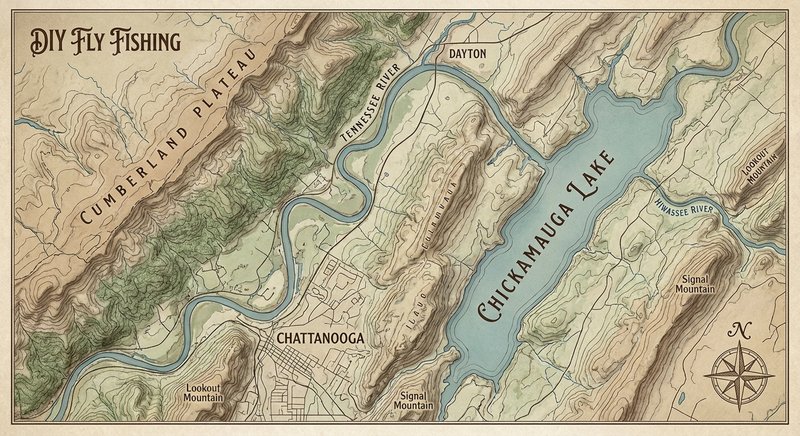
Chickamauga Lake
Fly fishing in Tennessee · Beginner · Best seasons: Spring, Summer, Fall
Target Species
Largemouth Bass, Striped Bass, Crappie
About This Water
Chattanooga area reservoir famous for largemouth bass. Tournament fishing destination.
Fishing Recommendations
Welcome to the "Big Chick." As a guide in the Tennessee Valley, I can tell you that Chickamauga Lake is legendary—not just in the South, but nationwide. While it is famous for its massive Florida-strain Largemouth Bass, it is an increasingly popular destination for fly anglers looking for a "warm water" challenge that rivals any trout stream for technicality and excitement.
Here is your comprehensive guide to fly fishing Chickamauga Lake.
🎣 Location Overview
Chickamauga Lake is a 36,240-acre reservoir on the Tennessee River, stretching from the Watts Bar Dam down to the Chickamauga Dam in Chattanooga.
What makes "The Chick" special is its diversity of habitat. You have the riverine upper end, characterized by current and bluff walls; the mid-lake flats filled with massive beds of submerged aquatic vegetation (hydrilla and milfoil); and the deep lower end near the dam. For the fly angler, this means you can sight-fish in the grass, swing streamers in the current, or dredge ledges. It is a high-protein factory that produces some of the heaviest bass in the country.
🐟 Target Species & Behavior
Largemouth Bass
These are the kings of the lake. Thanks to the introduction of Florida-strain genetics, "double-digit" (10lb+) fish are a real possibility.
- Behavior: They are structure and cover-oriented. They love the "edges"—the edge of a grass line, the edge of a drop-off, or the shade under a dock.
- Feeding: Their diet consists mainly of Gizzard and Threadfin Shad, Bluegill, and Crawfish.
Striped Bass
Stripers in Chickamauga are nomadic, powerful, and current-driven.
- Behavior: They frequent the tailwaters below Watts Bar Dam or the deep river channels. They follow the bait. When the TVA (Tennessee Valley Authority) is pushing water through the dams, the Stripers go into a feeding frenzy.
- Feeding: Almost exclusively on Shad and Skipjack Herring.
Crappie
Often overlooked by fly anglers, Chickamauga’s Crappie are "slabs."
- Behavior: They hold tight to submerged brush piles, fallen timber, and dock pilings. They are schooling fish; if you find one, you’ve found twenty.
- Feeding: Small minnows and aquatic insects.
📅 Best Times to Fish
- Spring (March – May): Prime Time. As water temps hit 55°F, fish move shallow. April is the peak for Largemouth spawning. This is the best time for fly anglers to target trophy fish in 2–6 feet of water.
- Summer (June – August): Early morning and late evening are the only windows for shallow success. During the day, fish move to the "ledges" (15–25 feet deep). This is the best time for Night Fishing with big black poppers.
- Fall (September – November): The "Second Spring." As temps drop, shad migrate into the creeks, and the Bass and Stripers follow. This is the best time for fast-paced streamer action.
Optimal Conditions: Overcast days with a light breeze (to break the surface tension) are ideal. Always check the TVA Lake Info app for "Current Generation"—if the water is moving, the fish are biting.
🪰 Recommended Flies & Techniques
For Largemouth Bass
- Technique: Focus on the grass edges. Use a 7-weight to 9-weight rod with a weight-forward floating line or an intermediate sink tip.
- Top Fly Patterns:
- Dahlberg Divers & Poppers: Essential for low-light conditions.
- Gamechangers (White/Chartreuse): To mimic the erratic movement of a wounded shad.
- Hula Poppers or Weedless Frogs: For fishing directly over the thick hydrilla mats.
For Striped Bass
- Technique: Use a 9-weight or 10-weight rod with a heavy 300-400 grain sinking line. You need to get the fly down 10–15 feet in moving current.
- Top Fly Patterns:
- Cowen’s Albie Shad: Great profile in the current.
- Large Clouser Minnows (Blue/White): The "go-to" for mimicking shad.
- EP Silversides: High durability for toothy hits.
For Crappie
- Technique: A 3-weight or 4-weight rod. Use a slow, "countdown" retrieve around submerged wood.
- Top Fly Patterns:
- Wooly Buggers (Size 8-12): White, pink, or chartreuse.
- Micro-Clousers: To get the fly down to the brush piles.
💡 Pro Tips & Local Knowledge
- The "Grass" is King: If you aren't fishing near vegetation, you’re missing 80% of the fish. Look for "holes" in the grass mats. Drop a weighted streamer into the hole and jig it vertically.
- The TVA App: Download the TVA Lake Info app. Look at the "Release" schedule for Watts Bar Dam. If they are releasing 20,000+ CFS (cubic feet per second), head to the upper river for Stripers. If the water is stagnant, stick to the mid-lake grass.
- Find the "Blow-ups": In the fall, look for "busts" on the surface. These are schools of bass or stripers herding shad. Keep a rod rigged with a white streamer ready at all times.
- The "Hiwassee Connection": The mouth of the Hiwassee River where it enters Chickamauga is a high-traffic area for multiple species and offers great flats-style fishing for fly anglers.
⚠️ Important Information
- Access: There are dozens of public boat ramps (Harrison Bay State Park and Chester Frost Park are the best for mid-lake access). For wade fishing, your options are limited to the tailwaters below the dams, but be extremely careful with rising water levels.
- Regulations: You need a Tennessee Fishing License. If you are fishing the tailwaters, check specific zone regulations for creel limits.
- Safety: Chickamauga is a commercial waterway. Watch out for barges—they create massive swells and cannot stop quickly. Also, summer thunderstorms pop up fast; if you hear thunder, get off the water immediately.
- Invasive Species: Be sure to wash your boat/gear to prevent the spread of invasive species between Tennessee River reservoirs.
Guide’s Final Word: Chickamauga is a "power" fly fishing destination. Leave the delicate 5x tippet at home. Rig up with 20lb fluorocarbon, bring your biggest streamers, and prepare for a fight!
Bug Hatches & Matching Flies
| Hatch | Type | Peak months | Time of day | Hook sizes | Matching flies |
|---|---|---|---|---|---|
| Giant Mayfly (Hex) Hexagenia limbata | mayfly | June, July | Evening/Night | #6-10 | Hexagenia Spinner #6-8, Burrowing Mayfly Nymph #8-10, Parachute Hex #8 |
| White Miller Ephoron leukon | mayfly | August, September | Evening/Dusk | #12-14 | White Wulff #12-14, Snowshoe Cripple #14, White Miller Spinner #12 |
| Midges Chironomidae | midge | January, February, March, December | All Day | #18-24 | Zebra Midge #18-22, Griffith's Gnat #20-24, Palomino Midge #20-22 |
| Cinnamon Caddis Hydropsyche | caddis | May, June, September | Evening | #14-18 | Elk Hair Caddis (Tan) #14-16, LaFontaine's Deep Sparkle Pupa #16, Holy Grail #14-18 |
| Blue Winged Olive (BWO) Baetis | mayfly | March, April, October, November | Late Morning/Afternoon | #18-22 | RS2 #20-22, Parachute Adams #18-22, Pheasant Tail Nymph #18-20 |
| Tricos Tricorythodes | mayfly | July, August, September | Early Morning | #20-24 | Trico Spinner #22-24, Sunken Trico Spinner #20-22 |
| Terrestrial Ants and Beetles Formicidae / Coleoptera | terrestrial | July, August | All Day | #12-18 | Black Foam Ant #14-16, Chernobyl Ant #10-12, Foam Beetle #14-18 |
| Light Cahill Stenonema / Stenacron | mayfly | May, June | Evening | #12-16 | Light Cahill Dry #14-16, Hare's Ear Nymph #12-14 |