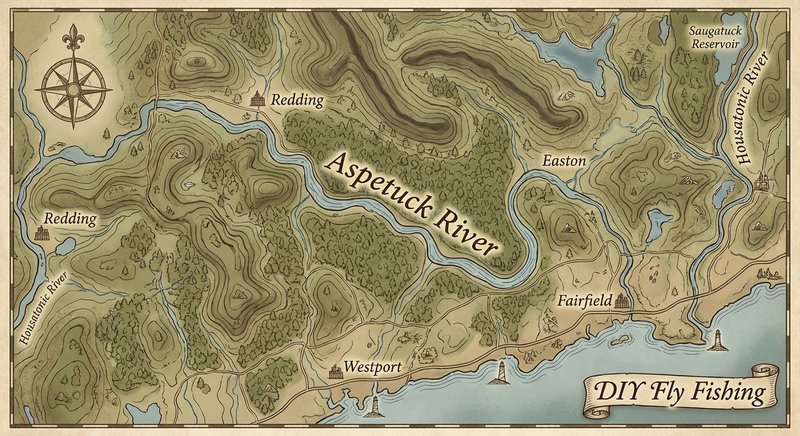
Aspetuck River
Fly fishing in Connecticut · Intermediate · Best seasons: Spring, Summer, Fall
Target Species
Brown Trout
About This Water
Fairfield County stream with wild brown trout. Scenic suburban fishing.
Fishing Recommendations
The Aspetuck River is one of Fairfield County’s best-kept secrets. While it doesn't get the national press of the Farmington or the Housatonic, this intimate tributary to the Saugatuck River offers some of the finest technical small-stream fly fishing in Southern New England. It is a quintessential Connecticut stream: rocky, canopy-covered, and rewarding for the angler who values stealth over long casts.
🎣 Location Overview
The Aspetuck is a low-gradient but rocky stream that winds through the wooded suburbs of Easton and Weston. What makes it special is its "Trout Management Area" (TMA) stretch, which provides year-round catch-and-release opportunities.
The water is generally clear and cool, characterized by tight pocket water, small plunges, and long, glassy glides. Because much of the river is narrow and overhung with mountain laurel and hemlock, it requires a "short game." Anglers love it because it feels remarkably wild despite being less than an hour from New York City. It is a place where you hunt individual fish rather than blind-casting to a crowd.
🐟 Target Species & Behavior
The primary prize here is the Brown Trout.
- Wild vs. Stocked: The state stocks the Aspetuck heavily, but the river also maintains a fragile population of wild, stream-born Brown Trout.
- Behavior: These fish are notoriously "spooky." Due to the small size of the water and heavy overhead cover, they are highly sensitive to shadows and bank vibration.
- Holding Spots: Look for fish tucked tightly against undercut banks, behind larger boulders in the pocket water, or at the very head of pools where oxygen levels are highest. In the summer, they will move into the "bubble line" of swifter riffles.
- Feeding: They are opportunistic but selective during hatches. They feed heavily on caddis larvae, small stoneflies, and occasional midge bursts.
📅 Best Times to Fish
- Spring (April – June): This is the prime window. Water levels are usually stable, and the primary insect hatches occur. May is the "Golden Month" on the Aspetuck.
- Summer (July – August): Fishing can be excellent but requires care. The Aspetuck can get low and warm. Focus on the early morning (6:00 AM – 10:00 AM) or late evening. Pro Tip: If water temps exceed 68°F, stop fishing to protect the trout.
- Fall (September – November): A fantastic time as Brown Trout become aggressive before spawning. The foliage is beautiful, and the fish take streamers and terrestrial patterns more readily.
- Best Time of Day: During Spring, midday is best. In Summer, focus on the "Magic Hour" just before dusk when the caddis are active.
🪰 Recommended Flies & Techniques
Top Fly Patterns
- Nymphs: Pheasant Tail (#16-20), Bead-head Zebra Midge (#18-22), and the Frenchie. The fish here respond well to "tactical" (perdigon) nymphs in the deeper pockets.
- Dry Flies: Elk Hair Caddis (#14-18) is the staple. For the slower glides, use a Blue Winged Olive (#18-22) or a Griffith’s Gnat.
- Terrestrials: In late summer, a small foam ant or beetle dropped near an undercut bank is deadly.
- Streamers: Small Woolly Buggers in olive or black, or a Muddler Minnow to imitate sculpins.
Techniques & Presentation
- The "Short Line" Nymph: Because the river is tight, traditional fly casting is often impossible. Use a European-style nymphing technique or a very short high-sticking method to drop nymphs into pockets without spooking fish with your fly line.
- Stealth Approach: Wade slowly and upstream. If you can see the fish, they have likely already seen you. Wear earthy tones to blend into the forest backdrop.
- The Bow-and-Arrow Cast: Master this cast! It is often the only way to get a fly under the low-hanging branches where the biggest browns hide.
💡 Pro Tips & Local Knowledge
- Focus on the TMA: The Trout Management Area (roughly from the Aspetuck Reservoir dam downstream to the bridge at Route 136) holds fish year-round and generally has the best habitat.
- The "Micro-Eddy": On the Aspetuck, even a swirl the size of a dinner plate behind a rock can hold a 12-inch trout. Don’t bypass the small stuff.
- Read the Bubbles: The fish almost always sit right under the bubble line. If your fly is six inches to the left or right, they likely won't move for it. Accuracy is more important than distance.
- Local Secret: After a light rain, when the water has a "tea" stain but isn't blown out, use a small, weighted black streamer. The larger, resident Browns come out of hiding to hunt in these conditions.
⚠️ Important Information
- Access: Much of the land surrounding the Aspetuck is private or owned by the Aspetuck Land Trust. Stick to designated entry points, primarily near bridge crossings and the marked TMA access spots. Respect "No Trespassing" signs to keep access open for everyone.
- Regulations:
- TMA Section: Catch and Release ONLY, Barbless hooks are highly recommended.
- License: A valid Connecticut Fishing License and a Trout & Salmon Stamp are required for all anglers 16 and older.
- Wading Safety: The rocks in the Aspetuck are notoriously "greasy" with algae. Felt-soled boots or studs are highly recommended to avoid a dunking.
- Environment: Be mindful of the Aspetuck Reservoir nearby; this is a public water supply area. Keep the banks clean and pack out any trash you find.
Bug Hatches & Matching Flies
| Hatch | Type | Peak months | Time of day | Hook sizes | Matching flies |
|---|---|---|---|---|---|
| Blue-Winged Olive Baetis / Pseudocloeon | mayfly | April, May, September, October | Midday | #18-22 | BWO Sparkle Dun #18-22, RS2 #20-22, Pheasant Tail Nymph #18-20 |
| Hendrickson Ephemerella subvaria | mayfly | April, May | Afternoon | #12-14 | Red Quill #12-14, Hendrickson Emerger #14, Gold Ribbed Hare's Ear #12-14 |
| Sulfur Ephemerella invaria / dorothea | mayfly | May, June | Evening | #14-18 | Sulfur Parachute #16-18, Sulfur Cripple #16, Pheasant Tail #14-18 |
| Tan Caddis Hydropsyche | caddis | May, June | Morning/Evening | #14-18 | Elk Hair Caddis #14-16, LaFontaine's Deep Sparkle Pupa #14-16, Soft Hackle Hare's Ear #14-18 |
| March Brown Maccaffertium vicarium | mayfly | May, June | Afternoon | #10-12 | March Brown Parachute #10-12, Gold Ribbed Hare's Ear #10-12 |
| Light Cahill Stenacron interpunctatum | mayfly | June, July | Evening | #12-14 | Light Cahill #12-14, Cahill Wet Fly #12-14 |
| Terrestrials (Ants/Beetles) Formicidae / Coleoptera | terrestrial | July, August, September | All Day | #14-20 | Cinnamon Ant #16-20, Black Foam Beetle #14-18 |
| Zebra Midge Chironomidae | midge | January, February, March, December | Midday | #18-24 | Zebra Midge #18-22, Griffith's Gnat #18-22 |
| Chimarra (Little Black Caddis) Chimarra | caddis | April, May | Late Morning | #18-20 | Black Elk Hair Caddis #18-20, Black Zebra Midge (as pupa) #18-20 |