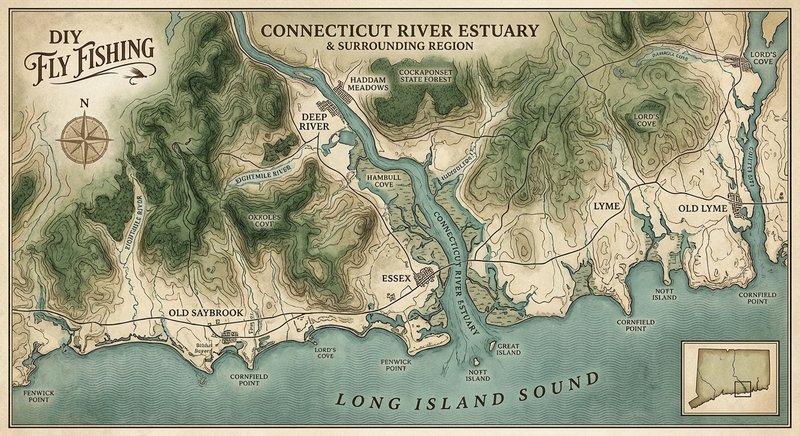
Connecticut River Estuary
Fly fishing in Connecticut · Intermediate · Best seasons: Spring, Summer, Fall
Target Species
Striped Bass, Bluefish, Shad
About This Water
Major estuary with striped bass migration. Old Saybrook area.
Fishing Recommendations
The Connecticut River Estuary, particularly the area between Old Saybrook and Old Lyme where the river meets Long Island Sound, is widely considered one of the premier fly fishing destinations in the Northeast. Known locally as "The Mouth," this area is a massive biological engine, flushing enormous amounts of baitfish and nutrients into the Sound twice a day.
🎣 Location Overview
The Connecticut River is the longest river in New England, and its estuary is unique because it lacks a major deep-water port, preserving much of its natural shoreline and expansive salt marshes. What makes this water special is the incredible diversity of structure: vast tidal flats, deep channels, rocky points (like the Saybrook Breakwater), and the famous "Great Island" salt marsh complex.
Anglers love it because it offers both "big water" boat fishing and intimate "skinny water" kayaking or wading. The mixing of fresh and salt water creates a dynamic environment where current is king. Whether you are sight-fishing for bass on the flats or swinging flies for Shad in the spring, the sheer volume of water movement ensures there is always a "bite" happening somewhere.
🐟 Target Species & Behavior
Striped Bass (Stripers)
The stars of the show. Resident fish stay all year, but the migratory "cows" arrive in late spring.
- Behavior: They are ambush predators. In the estuary, they hold on the edges of drop-offs, behind bridge pilings (like the I-95 or Baldwin Bridge), and in the "thalweg" (the deepest part of the channel).
- Feeding: They key in on "River Herrings" (Alewives and Blueback Herring) in the spring and "Peanut Bunker" (juvenile Menhaden) in the fall.
Bluefish
Known as "yellow-eyed devils," they enter the estuary in late spring and stay through the fall.
- Behavior: Highly aggressive and fast-moving. They often "blitz" bait on the surface, creating chaotic surface action.
- Feeding: Anything that moves. They have razor-sharp teeth and will shred expensive flies in seconds.
American Shad
Known as the "Poor Man’s Salmon," the CT River hosts one of the largest runs on the East Coast.
- Behavior: They enter the river to spawn. While they don't feed actively during the run, they strike out of aggression or instinct. They prefer deep, fast-moving water.
📅 Best Times to Fish
- Spring (Late April – June): This is the peak for Shad and the arrival of large Striped Bass. The "Herring Run" brings the biggest bass of the year into the river.
- Summer (July – August): Best for early morning or late night "low light" sessions. Look for Bluefish in the main channel and schoolie Stripers on the flats at dawn.
- Fall (September – November): The "Fall Run." Massive schools of bait leave the marshes, triggering surface blitzes. This is prime time for topwater action.
- Prime Windows:
- Tides: The outgoing tide is generally preferred, as it flushes bait out of the marshes into the main river.
- Time of Day: False dawn and dusk are high-percentage windows for large Stripers.
🪰 Recommended Flies & Techniques
For Striped Bass & Bluefish
- Flies:
- Hollow Fleyes / Beast Fleyes: Large (7–10 inch) patterns in white/chartreuse to mimic adult Menhaden.
- Clouser Minnows: The "go-to" for fishing deep in the current. White/Chartreuse or Blue/White.
- Gurglers & Bob’s Bangers: For heart-stopping topwater strikes during the fall or at dawn.
- Technique: Use an Intermediate or Sink-Tip line (250–350 grain) to get the fly down in the heavy river current. "Swing" the fly across the current like you would for Atlantic Salmon.
For American Shad
- Flies: Shad Darts or small, weighted Shad Flies in bright colors (Pink, Orange, Chartreuse) with a bit of flash (Krystal Flash).
- Technique: Use a sinking line. Cast 45 degrees upstream, let it sink to the bottom, and allow the fly to swing through the current. The take is usually at the end of the swing.
💡 Pro Tips & Local Knowledge
- The "Hatch" is Bait: In late summer/early fall, look for "Rain Bait" (tiny anchovies). If the fish are picky, downsize your fly to a 1-inch epoxy minnow. If you aren't "matching the hatch," you won't get a look.
- Watch the Birds: In the CT River estuary, Common Terns and Gulls are your best scouts. If they are diving, there is bait being pushed to the surface by predators.
- Bridge Pilings: The shadows created by the Baldwin Bridge at night are legendary. Big Stripers sit just inside the shadow line, waiting for bait to drift through the light.
- The Sandbar: There is a massive sandbar at the mouth of the river. During the incoming tide, fish sit on the Sound side; on the outgoing, they sit on the River side.
⚠️ Important Information
Access
- Boating: The DEEP boat ramp at Old Saybrook (under the Baldwin Bridge) is the primary access point.
- Wading: Ferry Landing State Park in Old Lyme offers great shoreline access. Harkness Memorial State Park (nearby) is excellent for surf casting.
- Kayaking: Launch at Great Island Boat Launch in Old Lyme to access the maze of salt marshes.
Regulations
- Licenses: You need a Connecticut Marine Waters Fishing License. If you head far enough north (above the I-95 bridge), make sure you check where the "Inland" vs. "Marine" line is, though the Marine license covers the estuary.
- Striped Bass: CT follows Atlantic States Marine Fisheries Commission (ASMFC) regulations. Currently, there is a strict slot limit (usually 28" to <31"). Always use inline circle hooks when using bait, though as a fly angler, ensure you use barbless hooks for easier release.
Special Considerations
- Heavy Current: The Connecticut River has a massive volume of water. Be extremely careful in small craft or when wading during a spring freshet (high runoff).
- Conservation: This estuary is a vital nursery. Handle all fish with care, keep them in the water, and practice catch and release for large breeding females.
Bug Hatches & Matching Flies
| Hatch | Type | Peak months | Time of day | Hook sizes | Matching flies |
|---|---|---|---|---|---|
| Midges Chironomidae | midge | March, April, October, November | All Day | #18-24 | Zebra Midge #18-22, Griffith's Gnat #20-24 |
| White Mayfly Ephoron leukon | mayfly | August, September | Evening/Night | #12-14 | White Wulff #12, Snowshoe Emerger #14 |
| Spotted Sedge Hydropsyche | caddis | May, June, July | Evening | #14-18 | Elk Hair Caddis #14-16, LaFontaine's Deep Sparkle Pupa #14-16 |
| Tricos Tricorythodes | mayfly | July, August, September | Morning | #20-26 | Trico Spinner #22-24, RS2 #20-22 |
| Blue-Winged Olives Baetis | mayfly | April, May, September, October | Afternoon | #18-22 | BWO Sparkle Dun #18-20, Pheasant Tail Nymph #18-22 |
| Marsh Ants Formicidae | terrestrial | August, September | Afternoon | #16-20 | Black Foam Ant #16-18, Fur Ant #18-20 |
| Light Cahill Stenacron canadense | mayfly | June, July | Evening | #12-14 | Light Cahill #14, Gold Ribbed Hare's Ear #12-14 |
| Grannom Caddis Brachycentrus | caddis | April, May | Morning/Afternoon | #14-16 | Grannom Pupa #14-16, Peacock Caddis #16 |