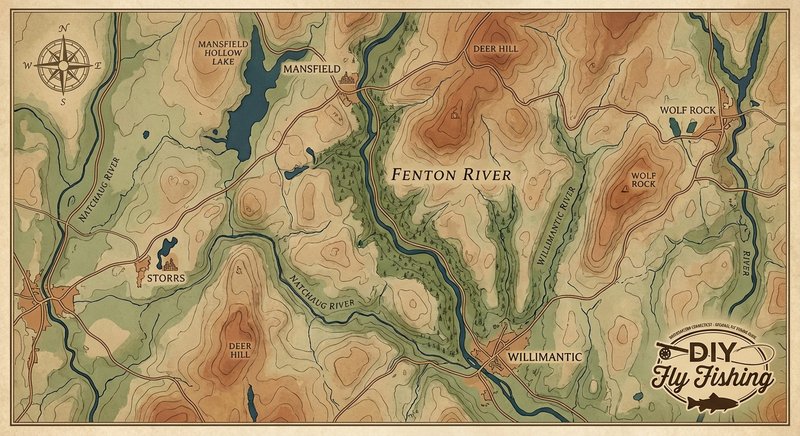
Fenton River
Fly fishing in Connecticut · Beginner · Best seasons: Spring, Summer, Fall
Target Species
Brown Trout, Brook Trout
About This Water
Tolland County stream with wild brown trout. UConn campus area fishing.
Fishing Recommendations
The Fenton River is one of Eastern Connecticut’s most charming and productive "small water" gems. Flowing through the rolling hills of Storrs and Mansfield—much of it buffered by the University of Connecticut (UConn) Forest—the Fenton offers a classic New England freestone experience. It is a intimate river that rewards stealth, precision, and an appreciation for technical small-stream tactics.
Here is your comprehensive guide to fly fishing the Fenton River.
🎣 Location Overview
The Fenton River is a medium-to-small freestone stream that eventually feeds into Mansfield Hollow Lake. What makes it special is its character: it is a mix of tumbling pocket water, deep shaded pools, and long, glassy runs.
The river is heavily forested, which keeps the water cooler than many other streams in the region, but it also creates a "tight" fishing environment. You won't be making 60-foot double hauls here; this is a world of roll casts, bow-and-arrow casts, and high-sticking. Anglers love it for its scenic beauty—especially along the Nipmuck Trail—and the fact that it feels much more remote than its proximity to the UConn campus would suggest.
🐟 Target Species & Behavior
The Fenton is a "Two-Story" fishery, offering both stocked opportunities and wild surprises.
- Brown Trout: These are the kings of the deeper pools and undercut banks. The state stocks the Fenton heavily in the spring, but the river has enough deep "holes" and cold-water seeps to allow a decent number of Browns to hold over and grow quite wary.
- Brook Trout: While the state stocks "Brookies," the real prize of the Fenton is its population of wild Brook Trout. These are primarily found in the upper reaches and near the mouths of tiny cold-water tributaries.
- Behavior: Fish here are opportunistic but spooky. Because the water is often clear and shallow, they are highly sensitive to overhead shadows and heavy wading. They hold tight to structure—boulders, fallen logs, and overhanging mountain laurel are your primary targets.
📅 Best Times to Fish
- Spring (April – June): This is the prime window. The river is at its most robust flow, and the stocking trucks have recently visited. As the water hits 50–55°F, the insect activity begins in earnest.
- Summer (July – August): The Fenton can get quite low. During this time, fishing is best at daybreak or dusk. Focus on the oxygenated "riffles" and the coolest water you can find. Pro Tip: Always carry a thermometer; if the water exceeds 68°F, head to the tavern instead to protect the trout.
- Fall (September – October): A fantastic time for the Fenton. The Brookies are in their spawning colors, and the Brown Trout become aggressive as they prepare for winter. The falling leaves make for tricky casting, but the fish are hungry.
- Prime Windows: Low light is your friend. The "Magic Hour" (the last 60 minutes of daylight) on the Fenton often produces a frantic caddis or midge hatch that brings every fish in the pool to the surface.
🪰 Recommended Flies & Techniques
Top Fly Patterns
- Dry Flies: Elk Hair Caddis (Tan/Olive, #14-18), Parachute Adams (#14-20), Light Cahill (#14-16) for late spring, and Foam Ants or Beetles (#14-16) for summer.
- Nymphs: Pheasant Tail (#16-18), Gold-Ribbed Hare’s Ear (#14-16), and the Zebra Midge (#18-22) for picky fish in slow pools.
- Streamers: Small Woolly Buggers (Black or Olive, #8-12) or the classic Black Ghost to mimic the small dace and minnows present in the system.
Techniques
- Tight-Line Nymphing: Because the river is full of pocket water, a traditional strike indicator can often get caught in conflicting currents. Using a "European style" or tight-line approach allows you to feel the take in the small pockets behind boulders.
- The "Dry-Dropper": This is the most effective way to cover the Fenton. Use a buoyant Elk Hair Caddis as your "indicator" and hang a small Pheasant Tail nymph 18 inches below it.
- Stealth Approach: Fish upstream. By approaching from behind the fish, you stay out of their field of vision.
💡 Pro Tips & Local Knowledge
- Focus on the UConn Forest: The stretch of river that runs through the UConn Forest (accessible via Gurleyville Road or Chaffeeville Road) offers some of the best habitat and most consistent fishing.
- The "Long Walk" Rule: Most anglers fish within 200 yards of the bridges. If you put on your hiking boots and walk 15–20 minutes down the Nipmuck Trail, you will find fish that haven't seen a fly in days.
- Short Rods are Better: Leave the 10-foot 5-weight at home. A 7.5-foot to 8.5-foot 3-weight or 4-weight is the ideal tool for navigating the tight canopy of the Fenton.
- Look for "Micro-Pockets": Don't just fish the big pools. On the Fenton, a trout will often live in a pocket of water no bigger than a dinner plate if there is a rock to hide behind and a current of food passing by.
⚠️ Important Information
- Access: Key access points include the bridge on Gurleyville Road, the small parking areas on Chaffeeville Road, and the UConn Spring Manor Farm area.
- Regulations: The Fenton River is subject to standard Connecticut Inland Fishing Regulations. You need a CT Fishing License and a Trout & Salmon Stamp. Note that while much of it is open to harvest, many local anglers practice strict Catch and Release to preserve the wild Brookie populations.
- Wading Safety: The Fenton is generally easy to wade, but the rocks can be incredibly slippery (covered in "didymo" or slick algae). Felt soles or studs are highly recommended.
- Respect the Land: Much of the river borders university research land or private property. Stay on the established trails (like the Nipmuck) to avoid trespassing and to protect the fragile riparian zones.
Guide’s Final Word: The Fenton isn't about catching "trophy" 20-inch trout; it's about the technical challenge of small-stream fishing in a beautiful, quiet setting. Bring your 3-weight, a box of caddis, and a sense of adventure.
Bug Hatches & Matching Flies
| Hatch | Type | Peak months | Time of day | Hook sizes | Matching flies |
|---|---|---|---|---|---|
| Blue Winged Olive Baetis spp. | mayfly | April, May, September, October | Midday | #18-22 | RS2 #20-22, BWO Sparkle Dun #18-20, Pheasant Tail Nymph #18-20 |
| Hendrickson Ephemerella subvaria | mayfly | April, May | Afternoon | #12-14 | Red Quill #12-14, Hendrickson Emerger #12-14, Gold Ribbed Hare's Ear #12-14 |
| Grannom Caddis Brachycentrus | caddis | April, May | Morning/Afternoon | #14-16 | Elk Hair Caddis (Olive) #14-16, Holy Grail Caddis #14-16, Peacock Caddis #14-16 |
| Sulphur Ephemerella invaria/dorothea | mayfly | May, June | Evening | #14-18 | Sulphur Parachute #16-18, Sulphur Emerger #14-16, Pheasant Tail #16-18 |
| Light Cahill Stenacron / Stenonema | mayfly | June, July | Evening/Dusk | #12-14 | Light Cahill #12-14, Cream Usual #14, Hare's Ear (Light) #12-14 |
| Slate Drake Isonychia bicolor | mayfly | June, September | Afternoon/Evening | #10-12 | Isonychia Parachute #10-12, Zug Bug #10-12, Prince Nymph #10-12 |
| Early Black Stonefly Taeniopteryx | stonefly | March, April | Midday | #14-18 | Early Black Stone #16-18, Black Stone Nymph #14-16, Zebra Midge (Black) #18-20 |
| Terrestrials (Ants/Beetles) Formicidae / Coleoptera | terrestrial | July, August, September | All Day | #12-20 | Black Foam Ant #16-20, Cinnamon Ant #16-18, Crowe Beetle #14-16 |