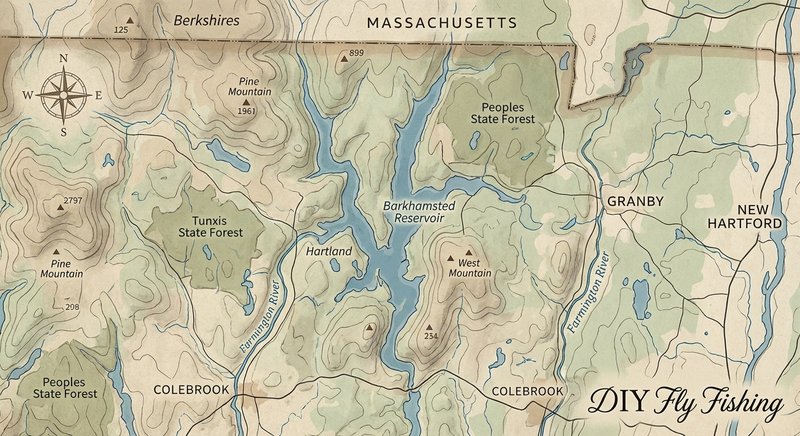
Barkhamsted Reservoir
Fly fishing in Connecticut · Intermediate · Best seasons: Spring, Fall
Target Species
Brown Trout, Rainbow Trout
About This Water
Hartford water supply with trophy trout. Shore fishing only.
Fishing Recommendations
It is important to clarify a critical distinction before we dive in: Barkhamsted Reservoir itself is a strictly protected public water supply and is closed to all fishing and boating.
However, for a fly angler, "fishing Barkhamsted" refers to the legendary West Branch of the Farmington River, which begins at the base of the Saville Dam (Barkhamsted Reservoir). This tailwater is arguably the finest trout fishery in Southern New England. Because the water is released from the bottom of the dam, it remains cold and oxygenated year-round, creating a "refrigerator effect" that supports trophy-sized trout even in the heat of summer.
🎣 Location Overview
The West Branch of the Farmington River, specifically the section from the Goodwin Dam/Saville Dam down through Riverton and Pleasant Valley, is a fly fishing mecca.
What makes it special is its consistency. While other rivers in Connecticut may warm up and become unfishable in July, the Farmington stays in the 50s and 60s. The river features a classic mix of deep pools, technical riffles, and long, glassy flats. The scenery is quintessential New England—heavily forested banks, historic stone bridges, and pristine water quality.
🐟 Target Species & Behavior
The river is famous for its "Survivor Strain" Brown Trout. These are fish that have been bred to survive the river's conditions and have become semi-wild, displaying incredible strength and wariness.
- Brown Trout: The "kings" of the river. They hold in deeper undercut banks, behind large boulders, and in the "gut" of deep pools. They are notoriously selective and often require technical presentations with long, fine leaders.
- Rainbow Trout: Generally found in faster, oxygenated water (riffles and runs). They are often more opportunistic than the Browns but will move into the slower pools during heavy hatches.
- Behavior: These fish are highly educated. They see a lot of flies. They will often "sip" tiny midges in the film rather than splashing at the surface. If your drift isn't perfect, they will ignore it.
📅 Best Times to Fish
While this is a year-round fishery, the specific windows you requested are:
- Spring (April – June): This is "The Big Show."
- April: Expect the famous Hendrickson hatch. This brings every fish in the river to the surface.
- May/June: Transition into March Browns, Sulfurs, and various Caddis species.
- Fall (September – November):
- The water cools down, and the Brown Trout begin their pre-spawn aggression.
- Isonychia (Iso) hatches are the highlight here—large, dark mayflies that trigger violent strikes.
- Prime Windows:
- Spring: Late morning through mid-afternoon as the water warms.
- Fall: Late afternoon until dusk (the "magic hour").
🪰 Recommended Flies & Techniques
Top Fly Patterns
- Dry Flies: Hendrickson (Size 12-14), BWO (Size 18-24), Sulfur (Size 16-18), Cornuta (Size 14), and the "Farmington Special" (a local emerger variant).
- Nymphs: Frenchies, Perdigons (in purple or olive), Pheasant Tails, and Zebra Midges. Note: Small is usually better here; size 18-22 nymphs are standard.
- Streamers: Black or Olive Wooly Buggers, and Sculpin patterns. Use these during higher flows or low-light conditions.
Techniques
- Euro Nymphing: This is the most effective way to catch fish here. Using long rods and thin level lines allows you to maintain contact with your flies in the complex currents.
- Dry-Dropper: Excellent for the riffles in late spring. A buoyant foam caddis with a small perdigon 18 inches below it.
- The "Micro-Midge" Presentation: During flat water periods, use 7X tippet and size 24 midge patterns. Stealth is mandatory.
💡 Pro Tips & Local Knowledge
- Check the Flow: Before you leave, check the USGS Gauge at Riverton. A flow between 150 cfs and 400 cfs is ideal for wading. Anything over 600 cfs becomes difficult and potentially dangerous to wade.
- The "Survivor" Secret: The biggest Browns often hold in "thin" water (less than a foot deep) right against the bank during the evening hatch. Don't wade into the river until you've scanned the edges!
- Tippet Management: These fish are notoriously "leader shy." Use Fluorocarbon for nymphing and high-quality Nylon for dries. If you aren't getting hits, drop down a tippet size.
- Stealth: Because the water is so clear, wear earthy tones (greens/browns) and move slowly. Splashing into the water will shut down a pool for 20 minutes.
⚠️ Important Information
- Regulations: Much of the river from the dam down to the bridge in Unionville is a Trout Management Area (TMA). This means Catch and Release Only for much of the year (check the current CT DEEP handbook for specific date ranges).
- Permits: You must have a valid Connecticut Fishing License and a Trout & Salmon Stamp.
- Access:
- The Bridge Pool (Riverton): Very popular, can be crowded, but holds massive fish.
- Greenwoods: Located downstream of Riverton, offers more "pocket water" and classic nymphing runs.
- People's State Forest: Offers miles of accessible bank and easy parking.
- Wading Safety: The rocks in the Farmington are incredibly slick (often called "bowling balls covered in grease"). Felt soles or studs are highly recommended.
Final Note: Always respect the "100-foot rule." If another angler is in a hole, give them plenty of space. The Farmington is a social river, but etiquette is what keeps the experience world-class.
Bug Hatches & Matching Flies
| Hatch | Type | Peak months | Time of day | Hook sizes | Matching flies |
|---|---|---|---|---|---|
| Hendrickson Ephemerella subvaria | mayfly | April, May | Afternoon | #12-14 | Red Quill #12-14, Hendrickson Emerger #14, Pheasant Tail #12-14 |
| Blue Winged Olive (BWO) Baetis / Acerpenna | mayfly | April, May, September, October | Afternoon | #18-24 | RS2 #20-22, Parachute BWO #18-22, WD-40 #20-24 |
| Sulfurs Ephemerella invaria/dorothea | mayfly | May, June, July | Evening | #14-18 | Sulfur Parachute #16-18, Sulfur Comparadun #14-18, Pheasant Tail #16-18 |
| Isonychia (Slate Drake) Isonychia bicolor | mayfly | June, July, August, September | Late Afternoon/Evening | #10-12 | Iso Parachute #10-12, Zug Bug #10-12, Isonychia Nymph #10-12 |
| White Fly Ephoron leukon | mayfly | August, September | Evening/Night | #12-14 | White Wulff #12-14, White Miller #12-14, Ephoron Nymph #12-14 |
| Grannom Caddis Brachycentrus | caddis | April, May | Morning/Afternoon | #14-16 | Elk Hair Caddis #14-16, LaFontaine's Deep Sparkle Pupa #14-16, Holy Grail Caddis #14-16 |
| Trico Tricorythodes | mayfly | July, August, September | Morning | #22-26 | Trico Spinner #22-26, Trico Dun #24, Zebra Midge #22-24 |
| Zebra Midges Chironomidae | midge | January, February, March, November, December | All day | #18-26 | Zebra Midge #18-24, Griffith's Gnat #18-22, Top Secret Midge #20-24 |