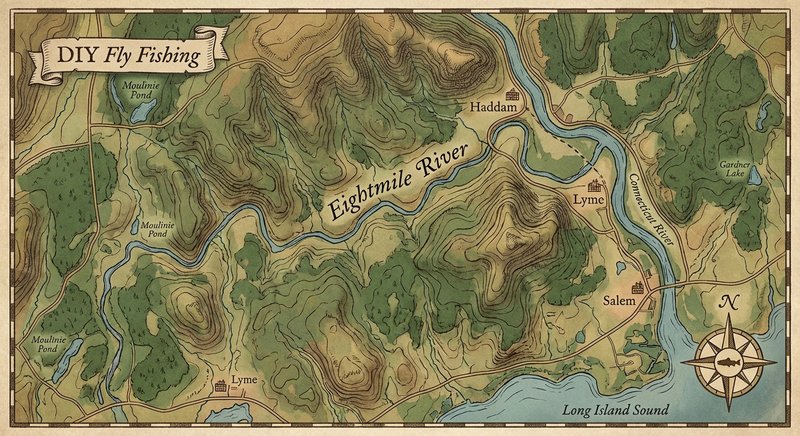
Eightmile River
Fly fishing in Connecticut · Intermediate · Best seasons: Spring, Summer, Fall
Target Species
Brown Trout, Brook Trout
About This Water
New London County stream with wild trout. Wild and Scenic River.
Fishing Recommendations
As an expert guide with years of experience navigating the technical freestones of the Northeast, I can tell you that the Eightmile River in East Haddam and Salem is one of Connecticut’s true gems. Designated as a "National Wild and Scenic River," it offers a classic New England fly fishing experience characterized by hemlock-shaded pools, mossy boulders, and surprisingly productive pocket water.
Here is your comprehensive guide to fly fishing the Eightmile River.
🎣 Location Overview
The Eightmile River is a pristine freestone stream that winds through the rolling hills of New London and Middlesex counties. Unlike the wide, tailwater expanses of the Farmington or the Housatonic, the Eightmile is intimate and technical.
What makes it special is its wild character. Large portions of the river flow through protected lands, most notably Devil’s Hopyard State Park. The river features a diverse mix of classic pool-and-riffle structures, dramatic waterfalls (Chapman Falls), and long, slow glides. The water is exceptionally clear, and the surrounding canopy of hemlocks and hardwoods provides excellent cooling shade, though it can make for challenging backcasts.
🐟 Target Species & Behavior
The Eightmile is managed as a Trout Management Area (TMA) in certain stretches and is heavily stocked by the CT DEEP, but it also maintains a vulnerable population of wild fish.
- Brown Trout: These are the kings of the deeper pools and undercut banks. Stocked browns will hold in the main currents after a hatch, while the occasional holdover or wild brown will be found tucked under root balls or in the "dark water" beneath overhanging branches.
- Brook Trout: You will find smaller, vibrant wild brookies in the cooler tributaries and the upper reaches of the main stem. They are opportunistic feeders but very spooky; they require a stealthy approach and light tippets.
- Behavior: During the day, fish tend to hold in the bubbly oxygenated water at the heads of pools. As the sun drops, they move into the tailouts and shallow flats to intercept emerging insects.
📅 Best Times to Fish
Optimal Seasons
- Spring (April – June): This is the prime window. Water levels are usually ideal, and the major insect hatches occur. This is when you'll find the most active surface feeding.
- Summer (July – August): The Eightmile is a freestone and is susceptible to low water and high temperatures. Check water temps! If the water is above 68°F, please stop fishing to protect the trout. Early mornings are a must during these months.
- Fall (September – November): A beautiful time to fish. Water temps drop, and the brown trout become aggressive as they prepare for spawning. The foliage in Devil's Hopyard makes this a spectacular experience.
Prime Fishing Windows
- Morning: Best during the summer months to beat the heat.
- Evening: The "Magic Hour" (the last 90 minutes of light) is when the Eightmile truly comes alive with caddis and mayfly spinners.
🪰 Recommended Flies & Techniques
Top Fly Patterns
- Dry Flies:
- Hendrickson (Light & Dark): Late April to May.
- Elk Hair Caddis (Tan/Olive, #14-18): A staple all season.
- Sulfurs (#16-20): Vital for late May and June evenings.
- Terrestrials: Black Ants and Beetles are deadly in mid-summer under the overhanging trees.
- Nymphs:
- Pheasant Tail (#14-18): Mimics almost everything.
- Zebra Midge (#18-22): Essential for low-water conditions.
- Pat’s Rubber Legs: Great in high spring water to represent stoneflies.
- Streamers:
- Woolly Bugger (Olive or Black, #8-12): Swing these through the deep holes in the State Park.
Effective Techniques
- Tight-Line/Euro Nymphing: Because the river is full of boulders and varying current speeds, a traditional indicator often creates too much drag. A tight-line approach allows you to get nymphs into the deep pockets behind rocks.
- Dry-Dropper: This is the most effective "searching" technique on the Eightmile. Use a buoyant Elk Hair Caddis with a small Pheasant Tail or Midge dropped 18 inches below it.
- Stealth Casting: This is "small stream" fishing. Kneel when approaching a pool and use short, accurate casts.
💡 Pro Tips & Local Knowledge
- The "Hopyard" Strategy: Most people fish directly around Chapman Falls. If you want better fishing and less crowd, hike a half-mile upstream or downstream from the main parking lots. The fish there are much less pressured.
- The Tributary Secret: Don't ignore the small feeder streams entering the Eightmile. In the heat of the summer, these are cold-water refuges where wild brook trout congregate.
- Wading Safety: The rocks in the Eightmile (especially in Devil's Hopyard) are notoriously slippery. Use felt soles or studs, and a wading staff is highly recommended near the falls.
- Light Tackle: A 7’6” to 8’6” 3-weight or 4-weight rod is perfect. It’s light enough to make small fish fun but has enough backbone to handle a 14-inch brown in the current.
⚠️ Important Information
Access Information
- Devil’s Hopyard State Park: Excellent access with plenty of parking and well-maintained trails along the river.
- Route 156 & Route 82: There are several pull-offs where the river crosses these roads. Look for CT DEEP "Fishing Access" signs.
- Lyme Land Conservation Trust: Several parcels offer public access; check their maps for updated "open to fishing" areas.
Regulations & Permits
- License: A Connecticut Inland Fishing License is required for everyone 16 and older. You must also have a Trout & Salmon Stamp.
- TMA Rules: Note that certain sections are designated as Trout Management Areas. In these spots, it is often Catch and Release Only during the shoulder seasons. Always check the current CT DEEP Fishing Guide for the specific dates and zone boundaries.
- Lead Ban: Remember that Connecticut has strict regulations regarding lead sinkers and jigs in certain waters; non-lead alternatives are always the safer bet for the environment.
Guide’s Final Word: The Eightmile is not a river for those looking for 20-inch monsters; it is a river for those who appreciate the craft of fly fishing, the beauty of a wild landscape, and the jewel-like colors of a wild brook trout. Respect the water, stay stealthy, and enjoy the silence.
Bug Hatches & Matching Flies
| Hatch | Type | Peak months | Time of day | Hook sizes | Matching flies |
|---|---|---|---|---|---|
| Blue Winged Olive Baetis spp. | mayfly | April, May, September, October | Mid-day/Afternoon | #18-22 | RS2 #20-22, BWO Sparkle Dun #18-20, Pheasant Tail Nymph #18-20 |
| Hendrickson Ephemerella subvaria | mayfly | April, May | Afternoon | #12-14 | Red Quill #12-14, Hendrickson Emerger #12-14, Hare's Ear Nymph #12-14 |
| Grannom Caddis Brachycentrus | caddis | April, May | Morning/Afternoon | #14-16 | Elk Hair Caddis (Olive) #14-16, Deep Sparkle Pupa #14-16, LaFontaine's Emergent Pupa #14-16 |
| Sulphur Ephemerella invaria / rotunda | mayfly | May, June | Evening | #14-18 | Sulphur Parachute #16-18, CDC Sulphur Emerger #16-18, Sulphur Spinner #14-16 |
| March Brown Maccaffertium vicarium | mayfly | May, June | Afternoon | #10-12 | March Brown Dry #10-12, Gold Ribbed Hare's Ear #10-12, March Brown Wet #12 |
| Light Cahill Stenacron / Stenonema | mayfly | June, July | Evening/Dusk | #14-16 | Light Cahill Dry #14-16, Cream Usual #14-16, Light Cahill Spinner #14 |
| Slate Drake Isonychia bicolor | mayfly | June, September | Afternoon/Evening | #10-12 | Isonychia Parachute #10-12, Zug Bug #10-12, Prince Nymph #10-14 |
| Ants and Beetles Formicidae / Coleoptera | terrestrial | July, August, September | All day | #14-20 | Black Foam Ant #16-20, Cinnamon Ant #16-18, Crowe Beetle #14-16 |