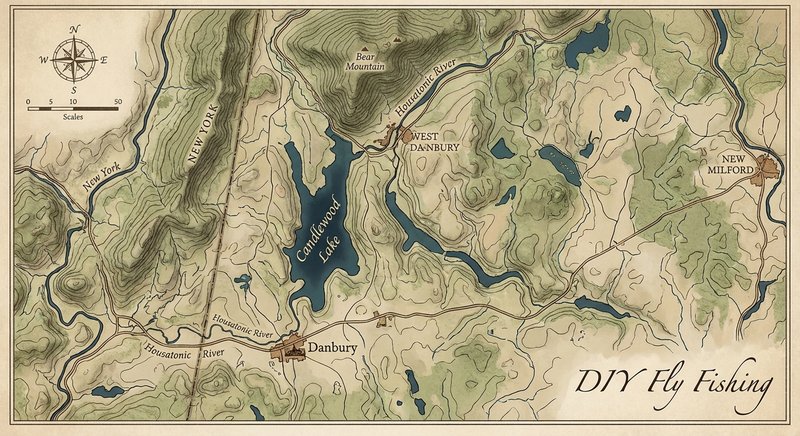
Candlewood Lake
Fly fishing in Connecticut · Intermediate · Best seasons: Spring, Summer, Fall
Target Species
Largemouth Bass, Smallmouth Bass, Trout
About This Water
Connecticut's largest lake with bass and trout. Scenic Litchfield Hills.
Fishing Recommendations
Welcome to Candlewood Lake, the crown jewel of Connecticut’s freshwater fisheries. As a guide, I can tell you that while Candlewood is a man-made reservoir, it has matured into one of the premier bass destinations in the Northeast. At over 5,000 acres with more than 60 miles of shoreline, it offers a diverse "big water" experience that challenges and rewards the technical fly angler.
🎣 Location Overview
Candlewood Lake is a massive, pump-storage reservoir bordering five towns in Fairfield and Litchfield counties. What makes it special for the fly angler is its incredible clarity and complex structure.
The lake is characterized by steep rocky drop-offs, underwater "humps" (islands that didn't reach the surface), massive boulder fields, and dense milfoil beds. Because the water is so clear, it is a "sight-fishing" paradise during the spring, but it also requires long casts and stealthy approaches. It is widely considered one of the best Smallmouth Bass lakes in the United States, frequently appearing on national "Top 10" lists.
🐟 Target Species & Behavior
Smallmouth Bass (The Main Event)
Smallmouths here are famous for their "football" shape—thick, powerful fish fueled by a high-protein diet of Alewives.
- Behavior: They are nomadic. They follow schools of Alewives (landlocked herring) and relate heavily to offshore structure like rock piles and humps.
- Feeding: Primary forage is Alewives and Crawfish.
Largemouth Bass
Often overlooked because of the Smallmouth reputation, the Largemouths here reach trophy sizes (6lb+).
- Behavior: They hold tighter to cover. Look for them deep inside the milfoil beds, under the thousands of private docks, or in the back of the many coves (e.g., Hollywyle or Squantz).
- Feeding: Bluegill, Perch, and large frogs in the weed mats.
Trout (Browns and Rainbows)
Candlewood is deep (max depth 90ft) and holds a "two-story" fishery.
- Behavior: Trout stay in the deep, cold thermocline for most of the summer. However, in early Spring and late Fall, they move into the upper water column and can be caught on streamers near the edges of the main basins.
📅 Best Times to Fish
- Spring (Late April – June): PRIME TIME. This is when the fish move shallow to spawn. From late May to early June, Smallmouths are on the beds or guarding fry. This is the best window for a fly rod.
- Summer (July – August): The "Night Shift" or "Early Bird" season. Daytime boat traffic is heavy. Fish move deep (15–25 feet). You will need heavy sinking lines (300-400 grain) to reach them.
- Fall (September – October): As water temperatures drop, the Alewives move toward the surface and into the coves. The "Blitz" happens here too—Smallmouths will herd baitfish against the surface.
- Best Time of Day: During summer, be on the water by 5:00 AM. By 10:00 AM, the recreational boat wakes make fly casting difficult. On overcast days, the bite can stay shallow all day.
🪰 Recommended Flies & Techniques
For Smallmouth Bass
- The Alewife Mimic: Clouser Minnows or Gamechangers in white, silver, and olive. Smallmouths are visual hunters; use sparse, translucent flies.
- The Crawfish: Near Nuff Craws or Whitlock’s Near Nuff Sculpin in rusty orange or brown.
- Technique: Use an Intermediate or Type 3 sinking line. Cast past a rocky point, let it sink to the bottom, and use erratic, short strips to mimic a fleeing baitfish.
For Largemouth Bass
- Topwater: Dahlberg Divers or Large Foam Poppers in frog or firetiger patterns.
- Weedless Streamers: Murphy’s Blane Chocklett’s Finesse Gamechanger or large Woolly Buggers with weed guards.
- Technique: "Dock Shifting." Use a 7-weight or 8-weight rod to skip poppers under the deep-water docks. This is high-stakes fly fishing.
For Trout
- Streamers: Zonkers or Muddler Minnows on a full-sink line.
- Technique: Trolling a fly behind a kayak or boat at a slow pace near the "pumphouse" area can be surprisingly effective in the early season.
💡 Pro Tips & Local Knowledge
- Find the "Humps": Candlewood has underwater islands that rise from 40 feet to 10 feet. If you find a hump with a "staircase" of rocks, you’ve found a Smallmouth goldmine. Use a GPS/Fishfinder to locate these.
- The "Alewife Rise": In the fall, look for "dimpling" on the surface in the middle of the lake. These are Alewives. Smallmouths will often be underneath them. A fast-stripped streamer through the school is deadly.
- The Mid-Week Advantage: Candlewood is a recreational hub. If you fish on a Saturday in July, the wakes will be 3 feet high. Tuesday and Wednesday mornings are when the lake belongs to the anglers.
- Stealth Matters: Because the water is so clear, use long leaders (9–12 feet) for your intermediate lines. Fluorocarbon is a must.
⚠️ Important Information
- Access:
- Lattins Cove (Danbury): Large state ramp, good for boats.
- Squantz Cove (New Fairfield): Popular for kayaks and smaller boats.
- Danbury Town Park: Good for shore access, though limited for fly casting.
- Regulations:
- A valid Connecticut Fishing License is required.
- AIS Stamp: Ensure you have the Aquatic Invasive Species stamp (included in most CT licenses now).
- Bass Season: Catch and Release only from approx. March 1st to the second Saturday in April (check current CT DEEP Angler's Guide for specific dates).
- Safety: The lake is big. If the wind picks up from the North or South, it can get very choppy very quickly. Always wear a PFD, especially in a kayak.
Guide’s Final Word: Bring your 6-weight for the Smallmouths and an 8-weight for the Largemouths in the weeds. If you can only bring one, a 9-foot 7-weight with an extra spool (one floating, one sink-tip) is the "Swiss Army Knife" for Candlewood Lake. Tight lines!
Bug Hatches & Matching Flies
| Hatch | Type | Peak months | Time of day | Hook sizes | Matching flies |
|---|---|---|---|---|---|
| Chironomids Chironomidae | midge | April, May, September, October | All Day | #18-24 | Zebra Midge #18-22, Griffith's Gnat #20-24, Chromie #18-20 |
| Giant Michigan Mayfly Hexagenia limbata | mayfly | June, July | Dusk/Night | #6-10 | Hexagenia Spinner #6-8, Burrowing Mayfly Nymph #8-10, Parachute Hex #8-10 |
| Speckled Spinner Callibaetis | mayfly | May, June, August, September | Morning/Afternoon | #12-16 | Callibaetis Spinner #14-16, Hare's Ear Nymph #12-16, Crippled Callibaetis #14-16 |
| Cinnamon Caddis Hydropsyche | caddis | May, June, July | Evening | #14-18 | Elk Hair Caddis (Tan) #14-18, LaFontaine's Deep Sparkle Pupa #14-16, Caddis Poopah #16 |
| Angler's Curse Caenis | mayfly | July, August | Early Morning | #22-26 | Caenis Spinner #24-26, Tiny Whitish Midge #22-24 |
| Blue-Winged Olive Baetis | mayfly | April, October, November | Mid-day/Afternoon | #18-22 | BWO Parachute #18-22, RS2 #20-22, Pheasant Tail #18-20 |
| Common Carpenter Ant Camponotus | terrestrial | August, September | Afternoon | #12-16 | Black Foam Ant #12-16, Chernobyl Ant #10-14 |
| Blue Damselfly Enallagma | other | June, July, August | Morning/Afternoon | #10-14 | Marabou Damselfly Nymph #10-12, Adult Damselfly #12-14 |