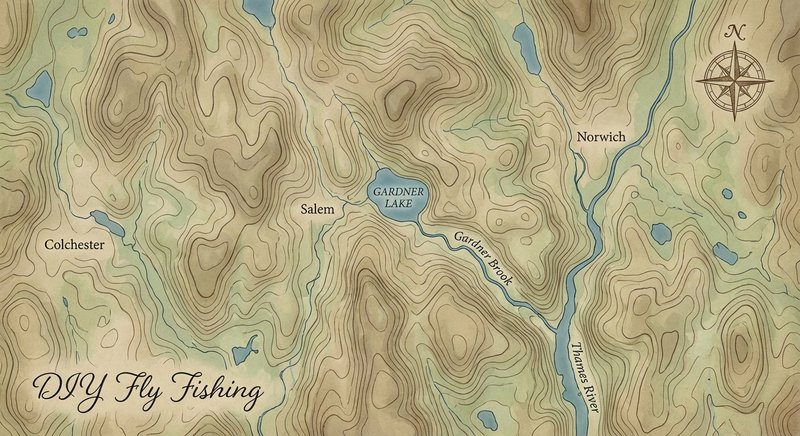
Gardner Lake
Fly fishing in Connecticut · Beginner · Best seasons: Spring, Summer, Fall
Target Species
Largemouth Bass, Calico Bass, Panfish
About This Water
New London County lake with bass and panfish. Salem area.
Fishing Recommendations
Gardner Lake, situated in the towns of Salem, Montville, and Bozrah, is one of Eastern Connecticut’s premier warm-water fisheries. Covering approximately 529 acres, it is a natural lake with a dam that offers a diverse aquatic environment ranging from shallow, weedy bays to rocky drop-offs reaching depths of nearly 45 feet.
Here is your comprehensive guide to fly fishing Gardner Lake.
🎣 Location Overview
Gardner Lake is a "Trophy Bass Lake" under Connecticut state designation, meaning it is managed specifically to produce larger-than-average Largemouth Bass. What makes it special for the fly angler is its varied structure. You have a perfect mix of lily pad fields, submerged weed beds (milfoil and pondweed), and rocky shorelines.
While it is a popular recreational lake, its size allows for quiet corners, particularly in the early morning. The water clarity is generally moderate; it isn't gin-clear, which actually works in the fly fisher's favor by making fish less "leader shy" and more willing to strike aggressive patterns.
🐟 Target Species & Behavior
Largemouth Bass
The king of Gardner Lake. These fish are ambush predators here.
- Behavior: In the spring, they move to the shallow sandy flats and near docks for spawning. In the heat of summer, they retreat to the deep outside weed lines (10–15 feet) or bury themselves deep under lily pads and docks.
- Feeding: They primarily target golden shiners, bluegill, and crayfish.
Calico Bass (Black Crappie)
Gardner has an excellent population of "slabs."
- Behavior: They are school fish. In early spring (April/May), they congregate in massive numbers near submerged brush and the edges of the dam. They are notorious "suspended" fish, often sitting mid-water column over deeper sections.
- Feeding: Small minnows and insect larvae.
Panfish (Bluegill & Pumpkinseed)
Large, aggressive, and perfect for light-tackle fly fishing.
- Behavior: Found in the shallows (1–5 feet) throughout the entire warmer half of the year. They love the edges of the lily pads.
📅 Best Times to Fish
- Optimal Seasons:
- Spring (May - June): This is the prime window. Bass are in the shallows, and Crappie are spawning. The weed growth hasn't become choked yet, making fly presentation easier.
- Fall (September - October): As water temperatures drop, bass go on a "feeding binge" to prepare for winter. They move back into the shallows to follow baitfish.
- Best Times of Day:
- Summer: 5:00 AM to 9:00 AM and 6:00 PM to Dusk. Mid-day summer fishing is difficult due to boat traffic and heat.
- Spring/Fall: Mid-morning can be excellent as the sun warms the shallows.
- Prime Conditions: Overcast, "fishy" days are best for Gardner. Low light brings the trophy bass out from under the heavy cover.
🪰 Recommended Flies & Techniques
For Largemouth Bass
- Topwater: BoogleBugs (Poppers) in yellow or frog patterns, and Dahlberg Divers. Use a "pop-and-stop" retrieve near the lily pads.
- Sub-Surface: Clouser Minnows (Chartreuse/White or Olive/White) to mimic shiners. Game Changers for larger trophy fish.
- Technique: Use a 7-weight or 8-weight rod with a weight-forward floating line. If fishing summer weed lines, switch to an intermediate sinking tip.
For Calico Bass (Crappie)
- Top Patterns: Woolly Buggers (Size 10-12) in white, pink, or chartreuse. Micro-jig flies under a small strike indicator.
- Technique: Slow, rhythmic strips. Crappie have "paper mouths," so don't set the hook too violently.
For Panfish
- Top Patterns: Foam Spiders, Betts’ Spinners, or small Hare’s Ear Nymphs.
- Technique: A 3-weight rod makes these fish feel like monsters. Cast to the pockets in the weeds and wait for the "ring" on the surface to disappear.
💡 Pro Tips & Local Knowledge
- The Northern End: The northern section of the lake is shallower and much weedier. This is "Bass Heaven." Focus on the transition zones where the thick weeds meet open water.
- The "Island" Area: There is a small island on the southern end. The rocky shoals around it are prime spots for Smallmouth Bass (which are present but less common) and larger Sunfish.
- Avoid the "Wake": Gardner Lake allows jet skis and high-speed motorboats. On summer weekends, the lake can get very choppy by 10:00 AM. As a guide, I recommend being off the water by then or tucked into the far northern weedy coves where big boats can't go.
- The Dock Game: In July, the biggest bass sit under the floating docks. Skipping a weightless "Deer Hair Frog" or a "Sneaky Pete" under a dock is a high-skill, high-reward move.
⚠️ Important Information
- Access: There is a large, well-maintained state boat launch located at Gardner Lake State Park off Route 82. It has ample parking and a dock.
- Wading: Wading is limited. The shoreline is mostly private. To truly fish Gardner effectively with a fly rod, a kayak, canoe, or bass boat is highly recommended.
- Regulations:
- Trophy Bass: Gardner has a 12" to 16" protected slot limit. You must check the current CT DEEP Fishing Guide for the most up-to-date creel limits and length requirements.
- License: A valid Connecticut Inland Fishing License is required for everyone 16 and older.
- Invasive Species: Always "Clean, Drain, and Dry" your gear. Gardner has had issues with invasive aquatic plants; don't be the one to spread them to the next pond!
Guide’s Final Word: Gardner Lake is a "grind" lake—you might work for a few hours for one bite, but that bite is very likely to be a 4-pound-plus Largemouth. Bring your heavy fluorocarbon tippet (12-16lb) and don't be afraid to throw big flies!
Bug Hatches & Matching Flies
| Hatch | Type | Peak months | Time of day | Hook sizes | Matching flies |
|---|---|---|---|---|---|
| Chironomids (Midges) Chironomidae | midge | April, May, September | All day | #18-24 | Zebra Midge #18-22, Griffith's Gnat #18-22, Smoke Jumper #20 |
| Giant Michigan Mayfly (Hex) Hexagenia limbata | mayfly | June, July | Dusk/Night | #6-10 | Hexagenia Spinner #6-8, Hexagenia Nymph #6-10, Foam Hex #8 |
| Blue-Winged Olive Baetis | mayfly | April, May, September, October | Mid-day/Afternoon | #18-22 | RS2 #20-22, BWO Sparkle Dun #18-22, Pheasant Tail Nymph #18-20 |
| Damselfly Enallagma/Ischnura | other | June, July, August | Mid-day | #10-14 | Marabou Damsel Nymph #10-12, Adult Damsel #12-14, Braided Butt Damsel #14 |
| Spotted Sedge Hydropsyche | caddis | May, June, July | Evening | #14-18 | Elk Hair Caddis (Tan) #14-16, LaFontaine's Deep Sparkle Pupa #14-18, Caddis Vari-Variant #16 |
| Light Cahill Stenacron interpunctatum | mayfly | June, July | Evening | #12-14 | Light Cahill #12-14, Light Cahill Spinner #14, Gold Ribbed Hare's Ear #12-14 |
| Trico Tricorythodes | mayfly | July, August, September | Early Morning | #20-24 | Trico Spinner #22-24, Trico Dun #20-22 |
| Terrestrials (Ants/Beetles) Formicidae/Coleoptera | terrestrial | July, August, September | Mid-day/Afternoon | #12-18 | Black Foam Ant #14-18, Chernobyl Ant #8-12, Coffee's Sparkle Beetle #12-16 |