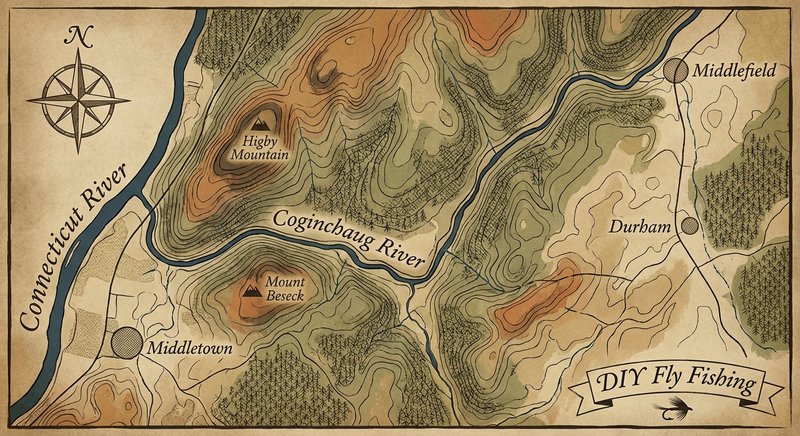
Coginchaug River
Fly fishing in Connecticut · Beginner · Best seasons: Spring, Summer, Fall
Target Species
Brown Trout, Brook Trout
About This Water
Middlesex County stream with wild trout. Durham area fishing.
Fishing Recommendations
The Coginchaug River in Middlesex County, Connecticut, is a hidden gem for anglers who enjoy a classic New England "small stream" experience. While it doesn't get the national press of the Farmington or the Housatonic, it offers intimate water, beautiful scenery, and a rewarding challenge for those who know how to read its currents.
Here is your comprehensive guide to fly fishing the Coginchaug.
🎣 Location Overview
The Coginchaug flows roughly 16 miles from Durham through Middlefield and Middletown before joining the Mattabesset River. It is characterized by a "low-gradient" personality—meaning it has many slow-moving, meandering sections interspersed with rocky riffles and deep, undercut banks.
What makes it special is the diversity of the terrain. You’ll find yourself fishing through lush meadows, dense woodlands, and even through the scenic Wadsworth Falls State Park. Because the water is often tannic (tea-colored) and the bottom can be silty or rocky depending on the bend, it requires an angler to be versatile and stealthy. It is a quintessential "backyard" river that rewards local knowledge.
🐟 Target Species & Behavior
The Coginchaug is primarily a Stocked Trout fishery, though it has the cold-water tributaries necessary to support some holdover fish and wild brookies in the extreme upper reaches.
- Brown Trout: These are the kings of the Coginchaug. They tend to be "structure-oriented." Look for them tucked tightly against fallen timber, under overhanging brush, or in the deep "guts" of the pools. They are more likely to hold over through the winter than the brookies.
- Brook Trout: Mostly stocked fish found in the riffles and oxygenated runs. They are aggressive feeders and will often strike a fly with more abandon than the browns.
- Behavior: Because the river is relatively small, the fish are "spooky." In the slower, glassy sections, a heavy footfall on the bank or a sloppy cast will send them scurrying. They feed heavily on caddis larvae, small mayflies, and—crucially for this river—terrestrials that fall from the dense overhanging canopy.
📅 Best Times to Fish
- Spring (April – June): This is the prime window. The CT DEEP stocks the river heavily in late March and throughout April. Water levels are usually high and cool. May brings the best insect hatches.
- Summer (July – August): This is the "low and slow" period. The Coginchaug can get warm, which is stressful for trout. Focus on the early morning (5:00 AM – 9:00 AM) or late evening. If the water temperature exceeds 68°F, give the trout a break and head elsewhere.
- Fall (September – October): A secondary peak. As water temperatures drop, trout become active again. The state often does a smaller fall stocking run. This is the best time to target aggressive Brown Trout using streamers.
🪰 Recommended Flies & Techniques
Dry Flies
The canopy is tight here, so "searching" with a high-vis dry fly is a great strategy.
- Elk Hair Caddis (Size 14-18): Tan or Olive. The river has a prolific caddis population.
- Adams / Parachute Adams (Size 14-20): A great general attractor.
- Terrestrials (Summer): Black Ants, Foam Beetles, and small Dave’s Hoppers. This is arguably the most fun way to fish the Coginchaug in July.
Nymphs
Since the water can be dark, flies with a bit of "flash" often perform better.
- Pheasant Tail (Size 16-20): A classic for a reason.
- Bead-Head Hare’s Ear (Size 14-16): Great for mimicking the scud and sowbug life in the siltier sections.
- Zebra Midge (Size 18-22): Essential for low-water conditions.
Streamers
The Coginchaug is full of "woody debris." Small streamers are deadly.
- Wooly Bugger (Size 8-12): Black or Olive. Swing these through the deep holes and near fallen logs.
- Muddler Minnow: Excellent for mimicking the small dace and sculpins present in the river.
Techniques & Presentation
- The "Bow and Arrow" Cast: You will encounter tight brush. Master this cast to get your fly into pockets you can't reach with a traditional backcast.
- Short-Line Nymphing: You rarely need to cast more than 20 feet. Focus on "high-sticking" through the pocket water.
- Stealth Approach: Fish upstream. If you walk downstream, you’ll send silt and shadows directly toward the fish's eyes.
💡 Pro Tips & Local Knowledge
- Focus on Wadsworth Falls: The area within and just below Wadsworth Falls State Park offers some of the best oxygenated water and beautiful scenery. The "Little Falls" area often holds fish in the plunge pools.
- The "Wood" is Good: Many anglers skip the messy-looking sections with fallen trees. Don't. Those are the "hotels" for the largest Brown Trout in the river. Use a heavier tippet (4X) so you can pull fish away from the snags.
- Check the Gauge: The Coginchaug rises and falls quickly after rain. If the water is chocolate milk, wait 24 hours. It clears faster in the swifter sections near Middlefield than in the Durham meadows.
- Light Tackle: A 7.5 to 8.5-foot 3-weight or 4-weight rod is perfect. A 9-foot 5-weight can feel a bit "clunky" in the tight brush.
⚠️ Important Information
- Access: Key access points include bridge crossings on Route 147 and Route 157, and the parking areas within Wadsworth Falls State Park. There are also several small pull-offs along Miller Road in Middlefield.
- Regulations: You must have a valid Connecticut Fishing License and a Trout & Salmon Stamp. The Coginchaug is subject to general statewide regulations (Daily limit: 5 trout, no length limit), but always check the current CT DEEP Digital Fishing Guide for any mid-season changes.
- Private Property: While the river moves through public parks, much of it borders private backyards. Always respect "No Trespassing" signs and stay within the high-water marks.
- Safety: The banks can be muddy and slippery. Felt-soled boots or studs are recommended, especially near the rocky sections of the state park.
Guide’s Final Word: The Coginchaug is a "patience" river. You won't find the massive hatches of the West, but you will find a quiet, rewarding slice of Connecticut fly fishing that most people drive right past. Keep your profile low and your fly in the water!
Bug Hatches & Matching Flies
| Hatch | Type | Peak months | Time of day | Hook sizes | Matching flies |
|---|---|---|---|---|---|
| Blue-Winged Olive Baetis | mayfly | April, May, September, October | Afternoon | #18-22 | RS2 #18-22, BWO Sparkle Dun #18-20, Pheasant Tail #18-22 |
| Grannom Caddis Brachycentrus | caddis | April, May | Morning/Afternoon | #14-16 | Grannom Pupa #14-16, Elk Hair Caddis (Olive) #14-16, Holy Grail #14-16 |
| Sulphur Ephemerella invaria/dorothea | mayfly | May, June | Evening | #14-18 | Sulphur CDC Spinner #16-18, Sulphur Emerger #14-16, Pheasant Tail (Orange) #14-18 |
| Light Cahill Stenacron interpunctatum | mayfly | June, July | Evening | #12-14 | Light Cahill #12-14, Hare's Ear (Light) #12-14 |
| Trico Tricorythodes | mayfly | July, August, September | Morning | #22-26 | Trico Spinner #22-26, Zebra Midge #20-24 |
| Cinnamon Caddis Hydropsyche | caddis | June, July, August | Evening | #16-18 | Tan Elk Hair Caddis #16-18, LaFontaine Sparkle Pupa #16-18 |
| Terrestrials (Ants/Beetles) Formicidae/Coleoptera | terrestrial | July, August, September | All Day | #12-18 | Black Foam Ant #16-18, Coffee's Sparkle Beetle #14-16 |
| Zebra Midge Chironomidae | midge | January, February, March, December | Mid-day | #18-24 | Griffith's Gnat #18-22, Zebra Midge (Black/Silver) #18-24 |