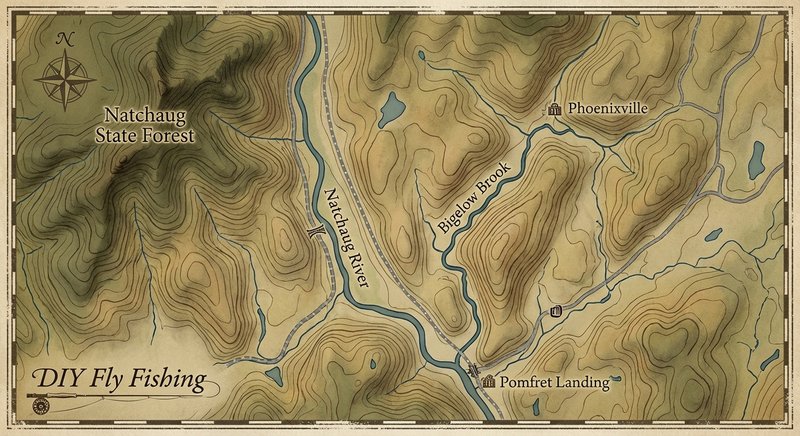
Bigelow Brook
Fly fishing in Connecticut · Intermediate · Best seasons: Spring, Summer, Fall
Target Species
Brook Trout
About This Water
Tolland County stream with wild brook trout. Remote state forest fishing.
Fishing Recommendations
Welcome to the quiet corner of Connecticut. As your guide, I’m excited to walk you through Bigelow Brook. Located primarily within the rugged terrain of Bigelow Hollow State Park and the Nipmuck State Forest in Union, this is one of the state's most pristine "blue-line" gems.
If you are looking for technical long-distance casting, this isn't it. This is intimate, technical, "short-game" fly fishing at its finest.
🎣 Location Overview
Bigelow Brook is a quintessential New England freestone stream. It flows through a deep, glacial valley characterized by massive hemlocks, mountain laurel thickets, and moss-covered granite boulders.
What makes it special is its resilience. Because it is heavily shaded and fed by clean groundwater and the outflow of Bigelow Pond, it remains significantly cooler than other Connecticut streams during the heat of the summer. The water is crystal clear with a slight tannic tea-colored tint. Anglers love it because it offers a true "wild" experience in a state that is often known more for its suburban stocked rivers. This is "stealth fishing"—it's quiet, lonely, and incredibly rewarding for those who like to hike for their fish.
🐟 Target Species & Behavior
The crown jewel here is the Wild Brook Trout. While the state does stock some portions near the park entrance, the further you hike downstream (south) into the Nipmuck State Forest, the more you will encounter native, wild-born "salvelinus fontinalis."
- Behavior: These fish are opportunistic but incredibly spooky. Because the water is clear and shallow, they can see you long before you see them.
- Holding Water: Look for the "pocket water" behind larger boulders, the undercut banks beneath hemlock roots, and the tail-outs of small plunge pools.
- Feeding: They aren't picky eaters due to the nutrient-poor nature of high-gradient streams, but they are fast. You have about a half-second window to set the hook once they rise.
📅 Best Times to Fish
- Spring (April – June): This is the prime window. Water levels are high enough to fill the pools, and the first major insect hatches (Hendricksons and Quill Gordons) begin.
- Summer (July – August): While many CT rivers become too warm to fish safely for trout, Bigelow’s canopy keeps it cool. This is the time for terrestrial patterns (ants and beetles). Stick to early mornings or late evenings.
- Fall (September – October): My personal favorite. The Brookies are in their spawning colors—vibrant oranges and reds. They become more aggressive as they prepare for the spawn.
- Time of Day: In the Spring, mid-day is best as the sun warms the water. In Summer, dawn and dusk are essential.
🪰 Recommended Flies & Techniques
You don't need a giant fly box here. You need accurate placement.
Top Fly Patterns
- Dry Flies:
- Royal Wulff (#14-18): High visibility is key in the broken pocket water.
- Elk Hair Caddis (#16-18): A staple for the evening hatch.
- Black Ants & Foam Beetles (#16-20): Essential for summer "stealth" fishing.
- Nymphs:
- Pheasant Tail (#16-20): Classic profile that mimics almost everything in this brook.
- Bead-head Prince Nymph (#14-16): The flash helps in the darker, tannic pools.
- Streamers:
- Black Nose Dace (#10-12): Small bucktails can lure out the larger "resident" browns or bigger brookies hiding in the deep plunge pools.
Techniques
- The "Bow and Arrow" Cast: Overhanging branches make traditional overhead casting nearly impossible in many stretches. Master the bow-and-arrow cast to get your fly under the brush.
- High-Sticking: Use a short line and keep as much fly line off the water as possible to avoid "drag" caused by the complex currents around boulders.
- Dapping: Sometimes, the best way to catch a fish here is to simply poke the rod tip through the bushes and drop the fly on the surface.
💡 Pro Tips & Local Knowledge
- Fish Upstream: Always move upstream as you fish. Brook trout face into the current; if you approach from behind them, you are less likely to be spotted.
- Wear Earth Tones: Leave the bright white hat and neon shirt at home. Wear greens, browns, and grays to blend into the hemlock forest.
- The "Hike-In" Rule: The best fishing starts about a mile away from the main parking lots. Follow the hiking trails (like the Nipmuck Trail) south, then bushwhack down to the water. The further you are from a bridge or a trail crossing, the better the fishing.
- Watch the Water Temp: Even though it stays cool, if the water hits 68°F (20°C), give the fish a break. Wild Brookies are fragile.
⚠️ Important Information
- Access: Park at Bigelow Hollow State Park (Union, CT). Note that there is a parking fee for out-of-state vehicles during the summer months.
- Regulations: Bigelow Brook is part of the Wild Trout Management Area (Class 1) in certain stretches. This generally means:
- Catch and Release ONLY for wild trout.
- Barbless hooks are highly recommended to ensure the survival of these small, delicate fish.
- A valid Connecticut Fishing License with a Trout & Salmon Stamp is required.
- Safety: The terrain is slippery and rocky. I highly recommend wading boots with felt soles or metal studs. Be aware that this is "Bear Country"—keep your snacks sealed and be mindful of your surroundings.
Tight lines, and remember: with wild Brookies, the reward isn't the size of the fish, but the beauty of the place you found them.
Bug Hatches & Matching Flies
| Hatch | Type | Peak months | Time of day | Hook sizes | Matching flies |
|---|---|---|---|---|---|
| Blue Winged Olive Baetis spp. | mayfly | April, May, September, October | Midday | #18-22 | RS2 #20-22, BWO Parachute #18-20, Pheasant Tail #18-20 |
| Hendrickson Ephemerella subvaria | mayfly | April, May | Afternoon | #12-14 | Red Quill #12-14, Hendrickson Emerger #14, Gold Ribbed Hare's Ear #12-14 |
| Grannom Caddis Brachycentrus | caddis | April, May | Morning/Afternoon | #14-16 | Elk Hair Caddis (Olive/Black) #14-16, Pupa (Green/Dark) #14-16, Peeking Caddis #14 |
| Sulphur Ephemerella invaria/dorothea | mayfly | May, June | Evening | #14-18 | Sulphur Parachute #14-18, Sulphur Emerger #16-18, Pheasant Tail (Flashback) #16-18 |
| Light Cahill Stenacron interpunctatum | mayfly | June, July | Evening/Dusk | #12-14 | Light Cahill #12-14, Cream Usual #14, Gold Ribbed Hare's Ear #14 |
| Cinnamon Caddis Hydropsyche | caddis | June, July, August | Evening | #14-18 | Tan Elk Hair Caddis #14-18, LaFontaine's Sparkle Pupa #16, Prince Nymph #14-16 |
| Little Brown Stonefly Strophopteryx fasciata | stonefly | March, April | Midday | #14-16 | Early Brown Stone #14-16, Pats Rubber Legs (Small/Brown) #14-16, Copper John #14-16 |
| Terrestrials Formicidae / Coleoptera | terrestrial | July, August, September | All Day | #12-20 | Black Foam Ant #16-20, Cinnamon Ant #16-18, Black Foam Beetle #12-16 |