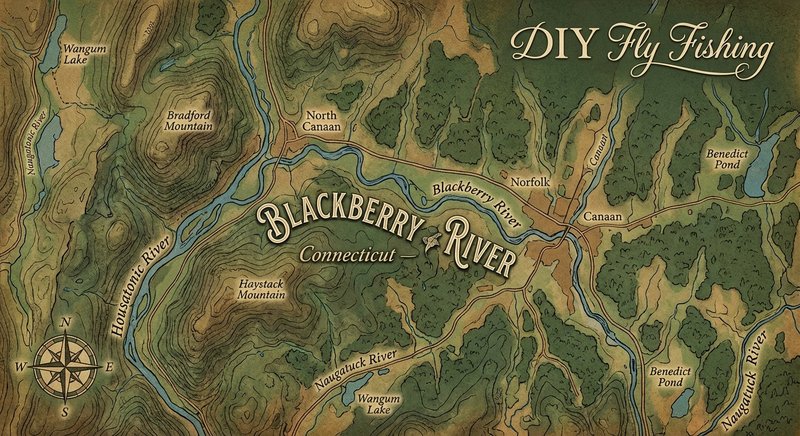
Blackberry River
Fly fishing in Connecticut · Intermediate · Best seasons: Spring, Summer, Fall
Target Species
Brown Trout, Brook Trout
About This Water
Litchfield County stream with wild brown trout. Scenic Norfolk area.
Fishing Recommendations
The Blackberry River in Litchfield County, Connecticut, is one of the state’s most charming and productive "small water" secrets. Flowing through the town of Norfolk and eventually joining the Housatonic River in Canaan, the Blackberry offers a classic New England freestone experience. It is characterized by its cold, oxygenated water, rocky pocket water, and intimate canopy-covered stretches.
🎣 Location Overview
The Blackberry River is a gem for the angler who prefers technical, small-stream fishing over big-river casting. It is a quintessential freestone stream, meaning its flow is dictated by rainfall and snowmelt rather than dam releases.
What makes it special is its thermal stability. Because much of the upper river is spring-fed and shaded by dense forest, it stays cooler than many other Connecticut rivers during the heat of the summer. The river transitions from a tumbling, mountain-style brook in its upper reaches to a more classic "pool-and-run" structure as it approaches the Housatonic. It feels wilder and more secluded than the nearby Farmington River, offering a sense of solitude that is hard to find in Southern New England.
🐟 Target Species & Behavior
- Brown Trout: These are the primary residents. You will find a mix of healthy stockies and a surprising number of "holdover" fish that have survived multiple seasons. They tend to hold in the deeper undercut banks and at the very head of pools where the oxygen is highest.
- Brook Trout: In the upper sections and the small tributaries feeding the Blackberry, you will find wild, native Brookies. They are opportunistic but spooky; they require a stealthy approach and a light touch.
- Feeding Behavior: Because it is a smaller system with less biomass than the Housatonic, these fish are generally less selective about exact patterns and more concerned with presentation. They are "structure-oriented" predators—if you aren't casting near a log, rock, or overhanging limb, you aren't in the game.
📅 Best Times to Fish
- Spring (Mid-April – June): This is the prime window. The Hendrickson hatch in late April and the subsequent Caddis hatches in May bring the larger Browns to the surface. Water levels are usually ideal during this time.
- Summer (July – August): Unlike many CT rivers, the Blackberry remains fishable in many spots due to its canopy. Focus on the early morning (sunrise to 10 AM) and late evening. This is prime terrestrial season.
- Fall (September – November): A spectacular time to be on the water. The Brown trout become aggressive as they prepare to spawn. The foliage is world-class, and the cooling temperatures trigger a final feeding frenzy on Blue Winged Olives (BWO).
🪰 Recommended Flies & Techniques
Top Fly Patterns
- Dries:
- Adams Parachute (Size 14-18): The gold standard for this river.
- Elk Hair Caddis (Size 14-16): Tan or Olive; fish this with a skittering motion.
- Stimulators (Size 12-14): Great for the turbulent pocket water.
- Terrestrials: Black Ants and Foam Beetles (Size 16) are deadly in August.
- Nymphs:
- Pheasant Tail (Size 16-20): Mimics the many mayfly nymphs in the system.
- Prince Nymph (Size 14-16): The extra flash helps in the bubbly pocket water.
- Zebra Midge (Size 18-22): Essential for low-water conditions.
- Streamers:
- Woolly Bugger (Size 8-10) in Olive or Black. Best used during higher water or early morning.
Techniques
- Tight-Line Nymphing: Because the river is narrow with complex currents, a strike indicator often gets dragged. Using a European-style nymphing technique or a very short line allows you to probe the deep pockets behind boulders effectively.
- Dry-Dropper: This is the most effective way to cover the Blackberry. Use a buoyant dry fly (like a Stimulator) and hang a small Pheasant Tail 18 inches below it.
💡 Pro Tips & Local Knowledge
- Stealth is Key: The water is often crystal clear. Wear drab clothing (greens and browns) and avoid "lining" the fish. Approach a pool from downstream and stay low.
- The "Lower" Secret: Many people fish the upper sections near Norfolk. However, the stretch just before it enters the Housatonic can hold much larger "migratory" Browns that move up from the big river seeking cooler water.
- Focus on the Pockets: Don't spend too much time in the long, flat glides unless you see rising fish. The highest concentration of fish is usually in the "pocket water"—the small 2-foot-wide soft spots behind rocks.
- The "Blackberry Special": If things are slow, swing a small wet fly (like a Partridge and Orange) through the tail of a pool. It’s an old-school Connecticut tactic that still slays on this river.
⚠️ Important Information
- Access: Much of the river runs along Route 44. There are various pull-offs between Norfolk and Canaan. Look for DEEP (Department of Energy and Environmental Protection) "Fishing Access" signs.
- Regulations: The Blackberry is generally managed under statewide regulations, but parts of it may have specific stocking schedules. Always check the current CT Fishing Guide for the most up-to-date rules on creel limits and tackle restrictions.
- Private Property: While there is plenty of public access, some stretches are bordered by private backyards. Be respectful, stay in the riverbed (below the high-water mark), and never trespass to enter or exit the water.
- Wading Safety: The rocks in the Blackberry are notorious for being slippery. Felt-soled boots or studs are highly recommended.
Guide’s Final Word: The Blackberry isn't where you go to catch a 24-inch trophy; it’s where you go to sharpen your skills, enjoy the scenery, and appreciate the beauty of a 10-inch wild trout in a mountain stream. Tight lines!
Bug Hatches & Matching Flies
| Hatch | Type | Peak months | Time of day | Hook sizes | Matching flies |
|---|---|---|---|---|---|
| Blue-Winged Olive Baetis spp. | mayfly | April, May, September, October | Midday/Afternoon | #18-22 | BWO Sparkle Dun #18-22, Pheasant Tail Nymph #18-20, RS2 #20-22 |
| Hendrickson Ephemerella subvaria | mayfly | April, May | Afternoon | #12-14 | Hendrickson Pink Lady #12-14, Red Quill #14, Hendrickson Wet Fly #12-14 |
| Sulphur Ephemerella invaria/dorothea | mayfly | May, June | Evening | #14-18 | Sulphur Parachute #16-18, Sulphur CDC Emerger #14-16, Frenchie #16 |
| Tan Caddis Hydropsyche spp. | caddis | May, June, July | Morning/Evening | #14-16 | Elk Hair Caddis #14-16, LaFontaine's Deep Sparkle Pupa #14-16, Holy Grail #16 |
| Light Cahill Stenonema ithaca | mayfly | June, July | Evening | #12-14 | Light Cahill #12-14, Cream Variant #14, Gold Ribbed Hare's Ear #12-14 |
| Slate Drake Isonychia bicolor | mayfly | June, September | Afternoon/Evening | #10-12 | Isonychia Parachute #10-12, Zug Bug #10-12, Prince Nymph #12 |
| Trico Tricorythodes spp. | mayfly | July, August, September | Morning | #22-26 | Trico Spinner #22-24, Drowned Trico Spinner #24 |
| Terrestrials (Ants/Beetles) Formicidae / Coleoptera | terrestrial | July, August, September | All Day | #14-18 | Black Foam Ant #16-18, Crowe Beetle #14-16, Flying Ant #18 |