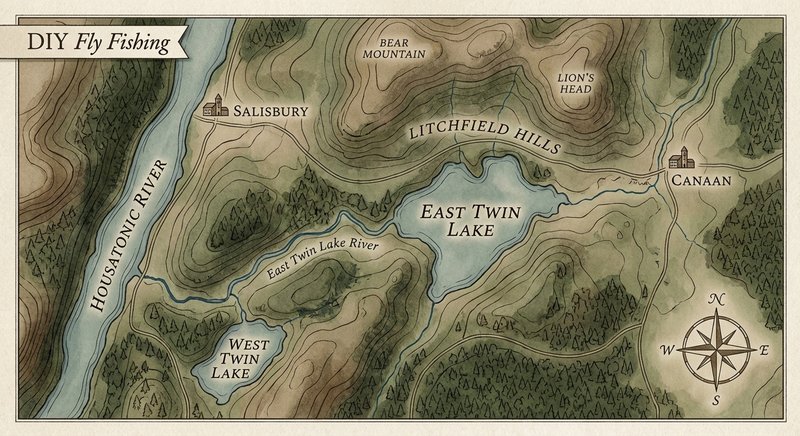
East Twin Lake
Fly fishing in Connecticut · Intermediate · Best seasons: Spring, Summer, Fall
Target Species
Brown Trout, Rainbow Trout
About This Water
Litchfield County lake with trout. Scenic Salisbury area.
Fishing Recommendations
Welcome to one of the crown jewels of Connecticut fly fishing. As your guide, I can tell you that East Twin Lake in Salisbury is unlike most other New England lakes. It is a deep, glacial lake with a unique "limestone" influence, meaning the water is alkaline and highly productive. This chemistry allows for incredible growth rates in trout, making it the premier destination for trophy-sized Brown Trout in the state.
Here is your comprehensive guide to fly fishing East Twin Lake.
🎣 Location Overview
East Twin Lake (562 acres) is a deep, clear, cold-water fishery nestled in the Taconic Mountains. What makes it special is its limestone geology. Most Northeast waters are acidic, but East Twin’s high pH supports a massive biomass of scuds, snails, and baitfish (specifically Alewives).
Anglers love it because it offers a "big water" experience. It reaches depths of over 75 feet, allowing trout to survive the summer heat and grow to massive proportions. It is one of the few places in Connecticut where a 5-to-10-pound Brown Trout is a legitimate possibility on a fly rod.
🐟 Target Species & Behavior
- Brown Trout: The "kings" of the lake. The population is a mix of holdovers and "Trophy Trout" stockings. They are highly piscivorous (fish-eaters). During the day, they hold deep near the thermocline; during low light, they move into the shallows to hunt Alewives.
- Rainbow Trout: Generally more active than Browns during the day. They tend to cruise the upper 15 feet of the water column in spring and fall, often found near the "drop-offs" where the shelf plunges into deep water.
- Forage Base: The primary food source is the Alewife. However, the lake also has a legendary hatch of Hexagenia limbata (Giant Yellow Mayflies) and a massive population of scuds and midges.
📅 Best Times to Fish
- Spring (Mid-April – June): This is the prime window. As the ice leaves and the water warms, trout are found in the top 10–20 feet of water. They will often be right against the shoreline or over the submerged weed beds.
- Summer (July – August): The "Hex" hatch occurs in late June through July. This is the only time the giants consistently feed on the surface at night. Otherwise, you must use heavy sinking lines to reach the thermocline (25–35 feet deep).
- Fall (September – November): As water temperatures drop, Browns become aggressive and move back into the shallows (5–15 feet) to prepare for their "spawn" (though they rarely successfully spawn in the lake, the instinct remains).
- Prime Window: Dawn and Dusk. Because the water is so clear, these trout are notoriously light-sensitive. The "magic hour" before sunrise and the hour after sunset are when the biggest fish are caught.
🪰 Recommended Flies & Techniques
Streamers (The High-Percentage Move)
Since Alewives are the primary forage, you need streamers that shimmer.
- Patterns: Game Changers (White/Silver), Grey Ghosts, Muddy Buddies, or Zonkers in white/olive.
- Technique: Use a Type 3 or Type 5 sinking line. Cast toward the drop-offs, let it sink for a 10-count, and use a "strip-strip-pause" retrieve. The pause is when the hit usually happens.
The "Hex" Hatch (The Summer Special)
- Patterns: Size 6–8 Hexagenia Dry Flies (Yellow/Tan).
- Technique: This is a night game. Listen for the "gulp" of a big trout and cast toward the sound. Use a 3X leader; these fish are big and the weeds are thick.
Nymphing & Midges
- Patterns: Zebra Midges (Size 18–22), Ray Charles Scuds (Grey/Olive, Size 14–16).
- Technique: Using a long leader (12–15 feet) and a strike indicator over the weed edges in 10–12 feet of water can be deadly for Rainbows during the day.
💡 Pro Tips & Local Knowledge
- Find the Shelf: The most productive area is the "ridge" between East and West Twin Lakes and the northern shoreline where the bottom drops from 5 feet to 30 feet abruptly. Fish parallel to this shelf.
- The "Alewife Die-off": In early spring, sudden temperature shifts can kill Alewives. If you see silver fish struggling on the surface, throw a white streamer and just "twitch" it. It’s the easiest fishing of the year.
- Wind is your Friend: A "glassy" surface is your enemy on East Twin. A light chop breaks up the light and makes the trout less spooky. If it’s windy, fish the "windward" shore where the baitfish get pushed.
- Stealth: Because the water is gin-clear, keep your boat/kayak a good distance from where you are casting. Long casts are often necessary.
⚠️ Important Information
- Access: There is a state-owned boat launch on the southern end off Route 44 (Twin Lakes Rd). It is well-maintained but can get crowded with powerboats on summer weekends.
- Zebra Mussel Warning: East Twin is one of the few CT lakes with Zebra Mussels. You must clean, drain, and dry your boat and gear before moving to another body of water. It is a legal requirement.
- Regulations: East Twin is designated as a Trophy Trout Lake.
- Check current CT DEEP regulations for creel limits and minimum lengths (usually 1 fish over 12" or 16" depending on the season).
- A Connecticut Fishing License with a Trout & Salmon Stamp is required.
- Vessel Type: While powerboats are allowed, a kayak or rowboat is superior for fly anglers to maintain stealth. Be wary of wind; the lake can whitecap quickly.
Tight lines! If you hook into one of those 24-inch East Twin Browns, be prepared for a fight—they have the shoulders of a saltwater fish.
Bug Hatches & Matching Flies
| Hatch | Type | Peak months | Time of day | Hook sizes | Matching flies |
|---|---|---|---|---|---|
| Chironomids Chironomidae | midge | April, May, September | All day | #18-24 | Zebra Midge #18-22, Griffith's Gnat #20-24, Ice Bud #18-20 |
| Giant Michigan Mayfly (Hex) Hexagenia limbata | mayfly | June, July | Dusk/Night | #6-10 | Hexagenia Dry #6-8, Hex Emerger #8-10, Burrowing Mayfly Nymph #6-10 |
| Blue Winged Olive Baetis | mayfly | April, May, October | Afternoon | #18-22 | RS2 #20-22, BWO Parachute #18-20, WD-40 #20-22 |
| Light Cahill Stenacron interpunctatum | mayfly | June, July | Evening | #12-16 | Light Cahill Dry #14-16, Hare's Ear Nymph #12-14, Cahill Emerger #14-16 |
| Damselfly Enallagma | terrestrial | June, July, August | Morning/Afternoon | #10-14 | Marabou Damsel Nymph #10-12, Braided Butt Damsel #12-14 |
| Spotted Sedge Hydropsyche | caddis | May, June, July | Evening | #14-18 | Elk Hair Caddis #14-16, LaFontaine's Deep Sparkle Pupa #14-18, Caddis Variant #16 |
| Trico Tricorythodes | mayfly | August, September | Early Morning | #22-26 | Trico Spinner #22-24, Trico Parachute #22-26 |
| Flying Ants Formicidae | terrestrial | August, September | Afternoon | #16-22 | Black Foam Ant #18-20, Cinnamon Flying Ant #16-18 |