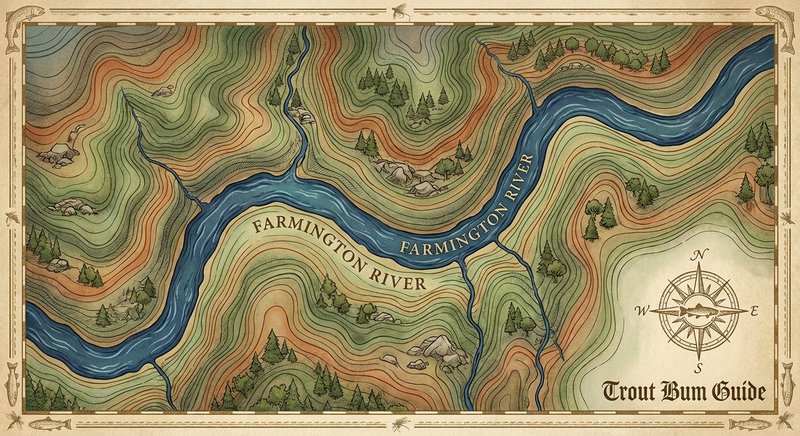
Farmington River
Fly fishing in Connecticut · Intermediate · Best seasons: Spring, Summer, Fall
Target Species
Brown Trout, Rainbow Trout
About This Water
Connecticut's premier trout stream with excellent hatches. Catch-and-release section with wild brown and rainbow trout.
Fishing Recommendations
The Farmington River, particularly the West Branch in Litchfield County, is widely considered the crown jewel of Connecticut fly fishing and one of the premier tailwaters in the entire Eastern United States. As a guide, I view the "Farmy" as a technical but incredibly rewarding river that offers some of the most consistent trout fishing in the country.
🎣 Location Overview
The Farmington is a bottom-release tailwater, meaning the water is drawn from the depths of the Hogback and Goodwin Dams. This provides the river with a "refrigerator effect"—staying ice-cold in the heat of July and remaining fishable even in the dead of winter.
What makes it special is the sheer diversity of the water. Within a single mile, you can find high-gradient pocket water, deep slow-moving pools (like the famous Church Pool), and classic riffle-run-pool sequences. It is a "bug factory" with some of the most prolific and predictable hatches in the Northeast.
🐟 Target Species & Behavior
- Brown Trout: The stars of the show. The Farmington holds a mix of wild browns and "holdover" fish that have survived multiple seasons, growing large, buttery, and incredibly wary. They are notorious for being "PhD fish"—they will inspect your drift and tippet with extreme scrutiny.
- Rainbow Trout: Generally stocked but highly resilient. They tend to hold in faster, oxygenated water compared to the browns.
- Behavior: These fish are highly educated. They hold in classic seams but will move into very shallow tail-outs during heavy hatches. Large "survivor" browns often tuck into undercut banks or deep woody debris during the day, coming out to hunt streamers at dawn, dusk, or during high-water events.
📅 Best Times to Fish
- Spring (April – June): This is "Prime Time." The legendary Hendrickson hatch (mid-April to mid-May) brings anglers from all over the country. The water is warming, and fish are aggressive.
- Summer (July – August): While other rivers are too warm to fish safely, the Farmington thrives. Focus on the Trout Management Area (TMA). Fishing is best in the early morning or late evening during the "spinner fall" (when insects return to the water to die).
- Fall (September – November): My personal favorite. The crowds thin out, the foliage is stunning, and the Isonychia (Iso) hatches provide excellent dry fly action. Large browns become aggressive as they prepare for the spawn.
🪰 Recommended Flies & Techniques
Top Fly Patterns
- Dries: Hendrickson (Size 12-14), BWO (18-24), Tan/Corn-fed Caddis (14-18), Isonychia (10-12), and the "Farmington Ant" or Beatles for summer terrestrials.
- Nymphs: Frenchies, Perdigons (the Farmington is a "Euro-Nymphing" mecca), Pheasant Tails (16-20), and Zebra Midges (20-24).
- Streamers: Wooly Buggers (Olive/Black), Kelly Galloup-style articulated streamers for trophy hunting.
Effective Techniques
- Tight-Line (Euro) Nymphing: This is arguably the most effective way to fish the Farmington’s pocket water. Using thin level lines and weighted nymphs allows you to reach the "feeding zone" without drag.
- Technical Dry Fly: Long leaders (12ft+) and light tippets (6X or 7X) are mandatory for the slow pools. You must master the "reach cast" to avoid micro-drag.
- The "Wet Fly Swing": An old-school but deadly technique on the Farmington, especially during caddis hatches.
💡 Pro Tips & Local Knowledge
- Master the Midge: If there isn't a major hatch happening, the fish are eating midges. If you aren't catching fish, go smaller. A size 22 or 24 midge larva can save a "slow" day.
- The "Survivor" Section: Focus on the 21 miles of the West Branch from Riverton down through New Hartford. The stretch near the Whale Pool and Greenwoods is legendary for a reason.
- Check the Flows: Use the USGS gauge at Riverton. 150 to 400 CFS (Cubic Feet per Second) is the "sweet spot" for wading. If it's over 600 CFS, wading becomes dangerous in many spots, and you should focus on the edges.
- Temperature Matters: Even though it's a tailwater, the water warms as it moves downstream. In August, if the lower river is hitting 68°F, move upstream toward the dam where it stays in the 50s.
⚠️ Important Information
Access & Regulations
- Trout Management Area (TMA): The stretch from the Goodwin Dam down to the Route 219 bridge in New Hartford is Catch and Release Only year-round. This is why the fishing is so good.
- Licensing: You need a Connecticut Fishing License and a Trout & Salmon Stamp. These can be purchased online via the CT DEEP website.
- Wading Safety: The rocks in the Farmington are notoriously "greasy" and slippery. Felt soles (where legal) or studs are highly recommended. A wading staff is a wise investment here.
Special Considerations
- Etiquette: Because the Farmington is popular, please give other anglers space. If someone is fishing a pool, don't "low-hole" them (stepping in just downstream of them).
- Clean Your Gear: To prevent the spread of invasive species like Didymo (rock snot), always clean, drain, and dry your boots and waders after fishing.
The Farmington is a river that rewards patience and precision. If you can catch a wild brown here during a BWO hatch, you can catch a trout anywhere in the world. Tight lines!
Bug Hatches & Matching Flies
| Hatch | Type | Peak months | Time of day | Hook sizes | Matching flies |
|---|---|---|---|---|---|
| Hendrickson Ephemerella subvaria | mayfly | April, May | Afternoon | #12-14 | Red Quill #12-14, Hendrickson Emerger #12-14, Pheasant Tail #12-14 |
| Sulphur Ephemerella invaria/dorothea | mayfly | May, June, July | Late Afternoon/Evening | #14-18 | Sulphur Parachute #14-18, Sulphur Spinner #14-18, Split Case Sulphur #16-18 |
| Blue-Winged Olive (BWO) Baetis spp. | mayfly | April, May, September, October | Late Morning/Afternoon | #18-24 | RS2 #18-22, BWO Sparkle Dun #18-22, WD-40 #18-24 |
| Trico Tricorythodes | mayfly | July, August, September | Early Morning | #22-26 | Trico Spinner #22-26, Trico Drowned Spinner #24-26, Griffith's Gnat #22-24 |
| Winter Stonefly Taeniopteryx/Allocapnia | stonefly | January, February, March | Midday | #14-18 | Black Stonefly #14-18, Early Brown Stone #14-16, Zebra Midge #18-20 |
| Grannom Caddis Brachycentrus | caddis | April, May | Afternoon | #14-16 | Grannom Pupa #14-16, Elk Hair Caddis (Olive/Black) #14-16, Deep Sparkle Pupa #14-16 |
| Isonychia Isonychia bicolor | mayfly | June, August, September | Late Afternoon/Evening | #10-12 | Iso Parachute #10-12, Isonychia Nymph #10-12, Zug Bug #10-14 |
| Tan Caddis Hydropsyche spp. | caddis | June, July, August | Evening/Night | #14-18 | Tan Elk Hair Caddis #14-18, LaFontaine's Emerger #14-16, Hydropsyche Larva #14-18 |