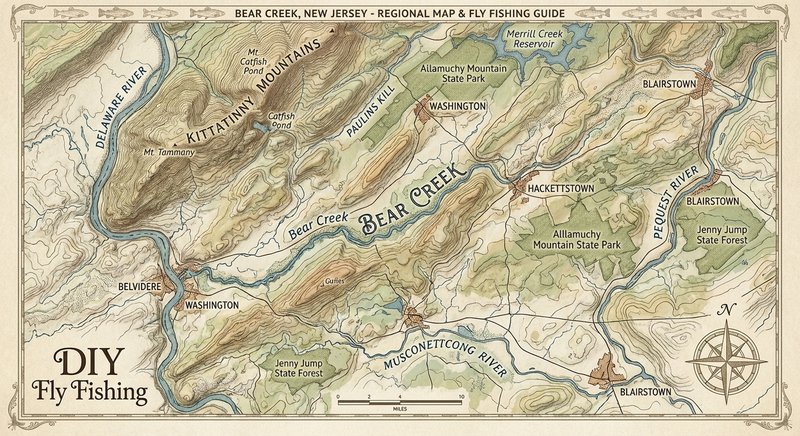
Bear Creek
Fly fishing in New Jersey · intermediate · Best seasons: spring, fall
Target Species
Brook Trout, Brown Trout
About This Water
Warren County tributary with native brook trout. Remote fishing in forested setting.
Fishing Recommendations
Bear Creek in Warren County, New Jersey, is one of the Garden State's hidden gems. While many anglers flock to the larger Musconetcong or the Pequest, Bear Creek offers an intimate, technical, and highly rewarding experience for those who appreciate small-stream tactics and wild fish.
Here is your comprehensive guide to fly fishing Bear Creek, NJ.
🎣 Location Overview
Bear Creek is a spring-fed tributary to the Pequest River, winding through the rolling hills of Frelinghuysen Township. What makes this creek special is its limestone influence. Unlike the freestone streams common in the northern part of the state, Bear Creek benefits from a steady influx of cold, nutrient-rich groundwater.
The water is remarkably clear and remains cooler than many neighboring streams during the summer months. It transitions from tight, brushy corridors to open meadow stretches. It is a "technical" stream—meaning it demands stealth, short casts, and precise presentations. This is classic "Blue Ribbon" style water in a small, New Jersey package.
🐟 Target Species & Behavior
- Wild Brook Trout: Found primarily in the upper reaches and smaller tributaries. They are vibrant, aggressive but extremely spooky. They hold in the darkest shadows and under-cut banks.
- Wild & Resident Brown Trout: The "kings" of Bear Creek. These fish are wary. They often hold in the tail-outs of pools during hatches or deep in the root mats of fallen trees during the day.
- Behavior: Because the water is so clear, the fish have excellent vision. They are easily "put down" by a heavy footfall on the bank or a line splashing over their heads. They feed primarily on scuds, cressbugs (thanks to the limestone), and small aquatic insects.
📅 Best Times to Fish
- Optimal Seasons:
- Spring (April – June): This is the prime window. The aquatic insect life is at its peak, and water levels are usually perfect.
- Fall (Late September – November): As temperatures drop, Brook and Brown trout become aggressive ahead of the spawn. The foliage is beautiful, and the fish are sporting their most vibrant colors.
- Best Times of Day:
- Early Morning: Best for nymphing before the sun hits the water.
- Evening (The "Magic Hour"): Essential for dry fly fishing, especially during the late spring Blue-Winged Olive or Caddis hatches.
- Prime Conditions: Overcast, drizzly days are arguably the best. The low light masks your presence and encourages the larger, more cautious Browns to leave their overhead cover.
🪰 Recommended Flies & Techniques
Top Fly Patterns
- Nymphs:
- Scuds & Cressbugs (Size 16-20): These are staples in limestone-influenced water. Gray or olive.
- Pheasant Tail (Size 18-22): Mimics the small mayflies common here.
- Zebra Midge (Size 20-24): Effective year-round in the deeper slots.
- Dry Flies:
- Elk Hair Caddis (Size 16-18): A great search pattern for the riffles.
- Blue-Winged Olive (Size 20-24): Critical for those drizzly spring and fall afternoons.
- Griffith’s Gnat (Size 20-22): Perfect for the slow, glassy meadow sections.
- Streamers:
- Black or Olive Wooly Buggers (Size 10-12): Best used in higher water or at dusk to find the bigger Browns.
Effective Techniques
- High-Sticking / Tight-Line Nymphing: Because the creek is narrow, you can often stay close to the fish. Minimize fly line on the water to prevent drag.
- The "Bow and Arrow" Cast: You will encounter tight brush. Mastering this cast is essential to getting your fly into the "kitchen" under overhanging branches.
- Upstream Stealth: Always fish moving upstream. Approach pools from behind the fish’s field of vision.
💡 Pro Tips & Local Knowledge
- The "Kneeling" Approach: If you see a fish rising in the meadow sections, drop to your knees 15 feet before you reach the bank. If you can see the fish, it has likely already seen you.
- Focus on the Confluence: The area where Bear Creek meets the Pequest River often holds larger fish that move up from the main river looking for cooler water or spawning gravel.
- Light Tackle is Key: A 2-weight or 3-weight rod (7' to 8' length) is ideal. Use long, fine leaders (9ft 6X or 7X) to avoid spooking fish in the clear water.
- Check the "Bubbles": In the slow meadow sections, look for "bubble lines." Even if you don't see a rise, trout will sit right under the foam waiting for nymphs to drift by.
⚠️ Important Information
- Access: Much of Bear Creek flows through private property or the Bear Creek Preserve (Natural Lands). Always respect "Posted" signs. Public access is available through certain Green Acres parcels and the Natural Lands preserve areas.
- Regulations: Bear Creek is generally governed by New Jersey’s statewide trout regulations, but portions are classified as Trout Production. This means it is highly protected.
- Check the current NJ Freshwater Fishing Digest for updated creel limits and season closures (usually closed for a period in early spring for stocking/protection).
- Catch & Release: While not all of Bear Creek is "Catch and Release Only" by law, experienced local anglers and guides strongly practice it here to protect the fragile wild trout populations.
- Wading: The bottom can be silty in the meadows and slippery in the rocky sections. Felt soles or studs are recommended, but wade quietly to avoid sending vibrations upstream.
Guide’s Final Word: Bear Creek is a "chess match" stream. You won't catch 50 fish a day, but the wild Brookie you catch on a size 22 midge after a 20-minute crawl through the grass will be one of the most rewarding fish of your season.
Bug Hatches & Matching Flies
| Hatch | Type | Peak months | Time of day | Hook sizes | Matching flies |
|---|---|---|---|---|---|
| Blue-Winged Olive Baetis | mayfly | April, May, September, October | Late Morning/Afternoon | #18-22 | BWO Parachute #18-22, RS2 #20-22, Pheasant Tail #18-20 |
| Hendrickson Ephemerella subvaria | mayfly | April, May | Afternoon | #12-14 | Red Quill #12-14, Hendrickson Nymph #12-14, Hare's Ear #14 |
| Tan Caddis Hydropsyche | caddis | May, June | Evening | #14-18 | Elk Hair Caddis #14-16, LaFontaine's Deep Sparkle Pupa #14-16, Holy Grail #16 |
| March Brown Maccaffertium vicarium | mayfly | May, June | Afternoon | #10-14 | March Brown Dry #12, Gold Ribbed Hare's Ear #10-12 |
| Light Cahill Stenonema ithaca | mayfly | June, July | Evening/Dusk | #12-16 | Light Cahill Dry #14-16, Cahill Wet Fly #14 |
| Little Black Stonefly Taeniopterygidae | stonefly | February, March, April | Midday | #16-20 | Early Black Stone #16-18, Copper John (Black) #18 |
| Terrestrials Formicidae / Coleoptera | terrestrial | July, August, September | All Day | #12-20 | Black Foam Ant #16-20, Crowe Beetle #14-16 |
| Midges Chironomidae | midge | January, February, March, December | Anytime | #20-26 | Zebra Midge #20-22, Griffith's Gnat #20-24 |