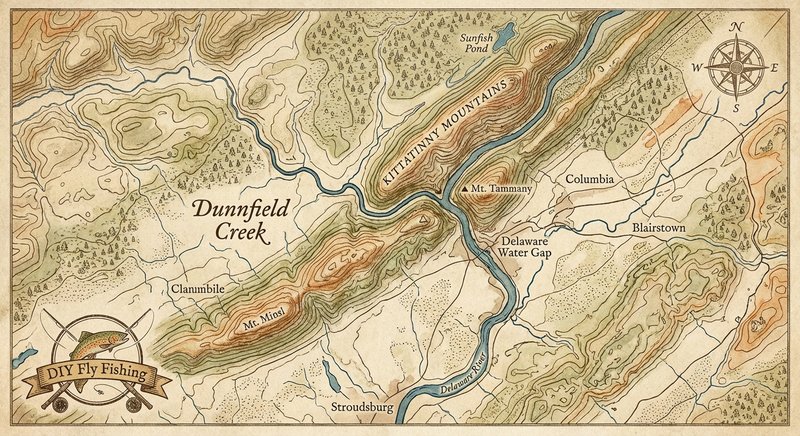
Dunnfield Creek
Fly fishing in New Jersey · intermediate · Best seasons: spring, summer
Target Species
Brook Trout, Brown Trout
About This Water
Appalachian Trail stream at Delaware Water Gap. Wild trout in beautiful mountain setting.
Fishing Recommendations
Dunnfield Creek is one of New Jersey’s hidden gems—a rugged, high-gradient freestone stream tucked into the Delaware Water Gap National Recreation Area. As a guide, I consider this "technical" water, not because the fish are picky, but because the terrain and the tight canopy demand absolute precision and stealth.
Here is your comprehensive guide to fly fishing Dunnfield Creek.
🎣 Location Overview
Dunnfield Creek is a quintessential Appalachian mountain stream. It tumbles down the side of Mount Tammany, carved through a steep hemlock-shaded ravine before emptying into the Delaware River.
What makes it special is its designation as a Wild Trout Stream. Unlike many NJ waters, Dunnfield is not stocked; it relies entirely on natural reproduction. The water is gin-clear, highly oxygenated, and characterized by "pocket water"—a series of small plunge pools, waterfalls, and short runs. Anglers love it because it offers a true wilderness experience just minutes off Interstate 80.
🐟 Target Species & Behavior
The primary residents are Wild Brook Trout and Wild Brown Trout.
- Brook Trout: These are the "jewels" of the creek. They are found throughout the system but dominate the higher elevations. They are opportunistic but extremely "spooky." If they see your shadow or your fly line lands too hard, the pool is "put down" for an hour.
- Brown Trout: Typically found in the middle to lower stretches where the pools are slightly larger and deeper. They are more predatory and will often hold in the dark shadows under undercut banks or large boulders.
- Feeding Behavior: Because this is a nutrient-poor freestone environment, these fish are not "match-the-hatch" snobs. They are opportunistic feeders. If it looks like food and is presented naturally, they will strike.
📅 Best Times to Fish
Optimal Seasons
- Spring (April – June): This is the prime window. Water levels are usually stable, and the aquatic insect activity (Caddis and Mayflies) is at its peak.
- Summer (July – August): While many NJ streams get too warm, the heavy hemlock canopy and spring-fed tributaries keep the upper reaches of Dunnfield cooler. However, you must carry a thermometer; if the water hits 68°F, stop fishing to protect the trout.
Best Times of Day
- Morning: Early light provides the best cover for the angler.
- Evening: During the summer, the "magic hour" before dusk brings out the best dry fly action.
Prime Windows
Fish immediately after a light rain when the water has a slight "tea" stain. This masks your presence and triggers the larger Browns to move out of cover to feed.
🪰 Recommended Flies & Techniques
Top Fly Patterns
- Dry Flies:
- Royal Wulff or Royal Coachman (Size 14-18): These high-visibility attractors are classic for Dunnfield.
- Elk Hair Caddis (Size 16-18): Tan or Olive.
- Stimulators (Size 14-16): Great for imitating stoneflies or grasshoppers.
- Nymphs:
- Pheasant Tail (Size 16-20): A universal representation of mayfly nymphs.
- Bead-head Hare’s Ear (Size 16-18): The extra weight helps get down in the plunge pools.
- Terrestrials (Summer):
- Black Ants or Foam Beetles (Size 16-18): Often more effective than aquatic flies in July and August.
Effective Techniques
- The "Dry-Dropper" Rig: Use a buoyant dry fly (like a Stimulator) and hang a small nymph 12–18 inches below it. This allows you to fish two water columns in the small pools.
- High-Sticking: Because the currents are complex, keep as much fly line off the water as possible to avoid "drag."
- Short Game: You will rarely make a cast longer than 15–20 feet. It’s all about the flick and the dink.
💡 Pro Tips & Local Knowledge
- Stealth is Survival: Wear drab clothing (greens and browns). Move upstream slowly. If you can see the fish, they have almost certainly already seen you and won't eat.
- Hike to Win: Most people fish within 200 yards of the parking lot. If you hike two miles up the Dunnfield Creek Trail (which shares a path with the Appalachian Trail), the fishing pressure drops significantly and the Brookie density increases.
- Gear Selection: Leave the 9-foot 5-weight at home. The ideal rod for Dunnfield is a 7-foot to 7.5-foot 3-weight. A shorter rod is essential for navigating the overhanging branches and tight rhododendron thickets.
- The "Plunge Pool" Trick: Drop your fly right into the "white water" where the waterfall enters the pool. The fish sit right on the edge of the bubbles waiting for food to be washed down.
⚠️ Important Information
Access
- Parking: Use the Dunnfield Creek Trailhead parking lot off I-80 West (last exit in NJ). It fills up very early on weekends with hikers.
- Terrain: The rocks are incredibly slippery. Felt-soled boots or studs are highly recommended.
Regulations
- Wild Trout Stream Regulations: Check the current NJ Fish & Wildlife Digest. Typically, these waters have specific size limits (often 9 inches for Browns) and reduced creel limits, but most serious anglers here practice 100% Catch and Release to preserve the wild genetics.
- Licensing: You need a valid New Jersey Fishing License and a Trout Stamp.
Special Considerations
- Bears: This area has a very high density of Black Bears. They generally avoid people, but keep your food secured and be aware of your surroundings.
- The "Hiker Factor": Dunnfield is a very popular hiking destination. To avoid crowds, fish on weekdays or very early in the morning. Once you get a mile away from the trailhead, the hikers stay on the path and leave the creek to you.
Bug Hatches & Matching Flies
| Hatch | Type | Peak months | Time of day | Hook sizes | Matching flies |
|---|---|---|---|---|---|
| Quill Gordon Epeorus pleuralis | mayfly | April | Afternoon | #12-14 | Quill Gordon Dry #12-14, Gold Ribbed Hare's Ear #12-14 |
| Hendrickson Ephemerella subvaria | mayfly | April, May | Afternoon | #12-14 | Hendrickson Pink Lady #12-14, Pheasant Tail #12-16 |
| Grannom Caddis Brachycentrus | caddis | April, May | Morning/Afternoon | #14-16 | Elk Hair Caddis (Olive) #14-16, LaFontaine's Deep Sparkle Pupa #14-16 |
| March Brown Maccaffertium vicarium | mayfly | May, June | Afternoon/Evening | #10-12 | March Brown American #10-12, Gold Ribbed Hare's Ear #10-12 |
| Sulphur Ephemerella invaria/dorothea | mayfly | May, June | Evening | #14-18 | Sulphur Parachute #14-18, Sulphur CDC Emerger #16-18 |
| Light Cahill Stenacron canadense | mayfly | June, July | Evening | #14-16 | Light Cahill #14-16, Cream Usual #14-16 |
| Blue Winged Olive Baetis | mayfly | April, September, October | Afternoon | #18-22 | BWO Sparkle Dun #18-22, RS2 (Olive) #20-22 |
| Cinnamon Caddis Hydropsyche | caddis | June, July, August | Evening | #14-18 | Tan Elk Hair Caddis #14-18, Peacock Caddis #16-18 |
| Terrestrials (Ants/Beetles) Formicidae / Coleoptera | terrestrial | July, August, September | All Day | #14-20 | Black Foam Ant #16-20, Crowe Beetle #14-16 |