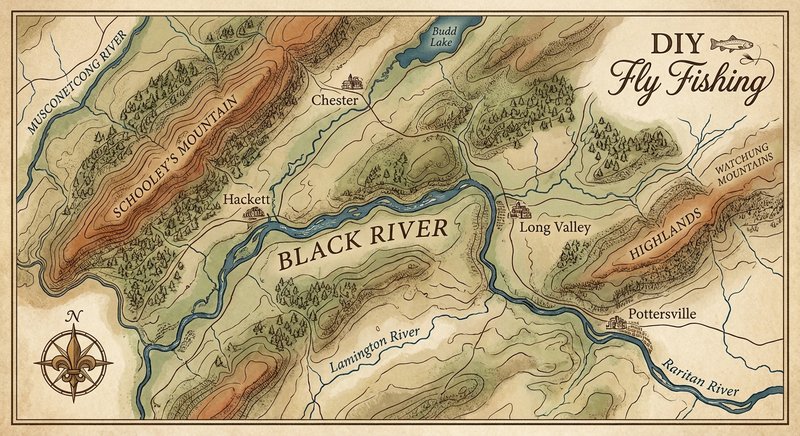
Black River
Fly fishing in New Jersey · intermediate · Best seasons: spring, fall
Target Species
Brown Trout, Brook Trout
About This Water
Chester Township stream with wild brown trout. Gorge section offers challenging fishing in scenic setting.
Fishing Recommendations
As a seasoned guide who has spent many damp mornings navigating the hemlock-lined canyons of the Garden State, I can tell you that the Black River—specifically the stretch flowing through Hacklebarney State Park—is one of New Jersey's true gems. It offers a rugged, "canyon-style" fishing experience that feels more like the Adirondacks or the Smokies than the New York City suburbs.
Here is your comprehensive guide to fly fishing the Black River.
🎣 Location Overview
The Black River is a classic freestone stream characterized by high-gradient pocket water, deep plunge pools, and massive granite boulders. What makes it special is its tannic water—a dark, tea-colored tint derived from the cedar swamps and hemlocks upstream.
Unlike the sprawling, open riffles of the nearby Musconetcong or South Branch of the Raritan, the Black River is intimate and technical. It requires nimble footwork and short, accurate casts. Anglers love it because it offers a sense of wilderness and solitude; once you hike down into the gorge at Hacklebarney, the sounds of civilization disappear, replaced by the roar of the river.
🐟 Target Species & Behavior
The Black River is primarily a Brown Trout and Brook Trout fishery.
- Brown Trout: The river is heavily stocked by the state, but because of the deep, cold plunge pools and excellent overhead cover (boulders and logs), many browns "hold over" and become quite wary. They tend to tuck deep into the shadows of the boulders.
- Brook Trout: You will find stocked brookies in the main stem, but the Black River’s tributaries (and the upper reaches) hold small, vibrant wild brook trout. These are the "jewels" of the river.
- Behavior: Due to the dark water, fish here rely heavily on vibration and silhouette. They are opportunistic but spooky. Because the river is rocky, fish rarely hold in the middle of a "run"—they are almost always tucked right behind a rock or in the "cushion" just in front of one.
📅 Best Times to Fish
Optimal Seasons
- Spring (April – June): This is the prime window. The state stockings are frequent, and the aquatic insect life is at its peak. May is arguably the best month for dry fly action.
- Fall (Late September – November): As the water cools, the resident browns become aggressive ahead of the spawn. The foliage in the gorge is spectacular, and the crowds are thinner than in spring.
Best Times of Day
- Late Morning to Mid-Afternoon: In the spring, wait for the sun to warm the water slightly to trigger insect activity.
- Early Morning/Dusk: In the summer or early fall, low light is crucial for coaxing the larger, "holdover" browns out of their rocky fortresses.
Prime Conditions
- Post-Rain: Because the water is already tannic, a little extra turbidity (cloudiness) from rain actually works in your favor. It masks your approach and encourages fish to feed on nymphs tumbled loose by the current.
🪰 Recommended Flies & Techniques
Top Fly Patterns
- Nymphs:
- Pheasant Tail (Size 14-18): A staple for the Mayfly hatches.
- Gold-Ribbed Hare’s Ear (Size 12-16): Great for the darker, tannic water.
- Pat’s Rubber Leg Stonefly (Size 8-12): Necessary for the deep plunge pools.
- Dry Flies:
- Adams / Parachute Adams (Size 14-18): The best general attractor.
- Elk Hair Caddis (Size 14-16): High visibility is key in the broken pocket water.
- Black Gnat / Ants: Excellent for late summer and fall.
- Streamers:
- Woolly Bugger (Black or Olive, Size 8-12): The dark water calls for dark flies. A black bugger mimics the many crayfish and leeches found here.
Effective Techniques
- High-Stick Nymphing: Given the complex currents and boulders, long casts result in immediate drag. Use a "high-stick" method (holding most of your fly line off the water) to drift nymphs through small pockets.
- The "Dapping" Approach: In the tightest sections of the gorge, you may not even cast. Stealthily approach a pool and drop your fly over a boulder.
- Streamer Jigging: Instead of a traditional cross-stream swing, "jig" a weighted streamer in the deep holes at the base of waterfalls.
💡 Pro Tips & Local Knowledge
- Hacklebarney State Park is the Key: The most productive water is within the park boundaries. Park at the main lot and take the "Main Park Road" (a trail) down to the river. The further you hike away from the picnic tables, the better the fishing gets.
- Watch Your Shadow: Because the river is relatively narrow, your shadow on the water will send every trout to the bottom of the pool. Always fish upstream and keep a low profile.
- Check the Tributaries: Don't overlook the small feeder streams entering the Black River within the park (like Trout Brook). They often hold wild fish and provide a "pure" fly fishing experience for those with 2-weight or 3-weight rods.
- The "Black Water" Secret: Because the water is dark, use fluorocarbon tippet. Even though the water looks tinted, it is often very clear in terms of purity, and the fish can be leader-shy.
⚠️ Important Information
- Access: Hacklebarney State Park (Chester, NJ) is the primary access point. There is no entrance fee, but the park has set hours (usually sunrise to sunset).
- Regulations: The Black River is managed under Statewide General Regulations for trout, but parts of the upper river are classified as Wild Trout Streams. Always check the NJ Fish & Wildlife Digest for current size and creel limits.
- Wading Safety: Exercise extreme caution. The rocks in the Black River are notoriously slippery (covered in "snot" algae) and very unstable. Felt-soled boots or studs are highly recommended, and a wading staff is a life-saver here.
- Permits: You must have a valid New Jersey Fishing License and a Trout Stamp. These can be purchased online or at local bait shops.
The Black River is a physical river—you will hike, you will climb over rocks, and you will likely lose some flies to the hemlocks—but for the angler who seeks beauty and a bit of a challenge, there is no better place in Northern Jersey. Tight lines!
Bug Hatches & Matching Flies
| Hatch | Type | Peak months | Time of day | Hook sizes | Matching flies |
|---|---|---|---|---|---|
| Blue-Winged Olive Baetis / Pseudocloeon | mayfly | March, April, September, October | Afternoon | #18-22 | RS2 #18-22, Blue-Winged Olive Sparkle Dun #18-20, Pheasant Tail Nymph #18-20 |
| Hendrickson Ephemerella subvaria | mayfly | April, May | Afternoon | #12-14 | Red Quill #12-14, Hendrickson Emerger #12-14, Hare's Ear Nymph #12-14 |
| Sulphur Ephemerella invaria / dorothea | mayfly | May, June | Evening | #14-18 | Sulphur Parachute #14-18, Sulphur Cripple #14-16, Pheasant Tail #16-18 |
| Tan Caddis Hydropsyche | caddis | May, June, July | Evening | #14-18 | Elk Hair Caddis (Tan) #14-16, LaFontaine's Deep Sparkle Pupa #14-16, Holy Grail Caddis #14-18 |
| Light Cahill Stenacron interpunctatum | mayfly | June, July | Evening | #12-14 | Light Cahill #12-14, Cream Usual #14 |
| Trico Tricorythodes | mayfly | July, August, September | Morning | #22-24 | Trico Spinner #22-24, Griffith's Gnat #20-22 |
| Grannom Caddis Brachycentrus | caddis | April | Morning/Afternoon | #14-16 | Grannom Pupa #14-16, Peacock Caddis #14-16 |
| Terrestrials (Ants/Beetles) Formicidae / Coleoptera | terrestrial | July, August, September | All Day | #12-18 | Black Foam Ant #16-18, Crowe Beetle #14-16, Chernobyl Ant #12-14 |
| Zebra Midge Chironomidae | midge | January, February, March, December | All Day | #18-24 | Zebra Midge (Black/Silver) #18-22, Griffith's Gnat #20-24 |