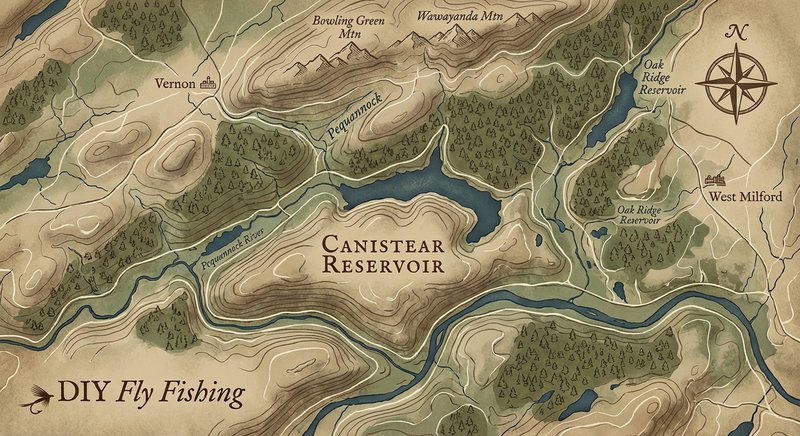
Canistear Reservoir
Fly fishing in New Jersey · intermediate · Best seasons: spring, fall
Target Species
Brown Trout, Rainbow Trout
About This Water
Sussex County reservoir with excellent trout fishing. Protected watershed ensures water quality.
Fishing Recommendations
Greetings, angler. As an expert guide who has spent plenty of time navigating the unique waters of the Highlands in New Jersey, I’m happy to break down Canistear Reservoir for you.
Canistear is part of the Newark Pequannock Watershed, and it offers a distinct "big water" experience that feels more like the Adirondacks than the Garden State. It is a deep, clear, and scenic impoundment that holds some of the best-fed trout in the region.
🎣 Location Overview
Canistear Reservoir is a 350-acre body of water located in the heart of the Vernon Valley/Newark Watershed region. What makes it special is its pristine, high-elevation character. Surrounded by dense forest and rugged rock formations, it lacks the suburban sprawl common to other NJ lakes.
The water is remarkably clear and can be quite deep (up to 70+ feet). For the fly angler, this presents a unique challenge: you aren't fishing a riffle or a run; you are hunting fish that move based on thermoclines and baitfish migrations. It is a "quiet" water—no gas motors are allowed—making it a sanctuary for those who prefer the sound of their line cutting the air over the roar of an engine.
🐟 Target Species & Behavior
While the reservoir holds warm-water species, the Brown and Rainbow Trout are the primary draw for fly rod enthusiasts.
- Brown Trout: These are the "resident" kings of the reservoir. They tend to be more elusive and structure-oriented. They hold near submerged timber, rock ledges, and the old roadbeds that were flooded when the dam was built. They are piscivorous (fish-eaters) and grow quite large by targeting Alewives (landlocked herring).
- Rainbow Trout: These fish are often found cruising the upper water column in the spring and fall. They are more nomadic than the Browns, often following schools of baitfish into the coves.
- Behavior: Because this is a reservoir, the trout are "cruisers." They cover a lot of ground. Unlike a river fish that waits for food to come to them, Canistear trout are active hunters.
📅 Best Times to Fish
Optimal Seasons
- Spring (April – Early June): This is the prime window. As the surface water warms, trout rise from the depths to feed in the shallows. The "ice-out" period can be phenomenal for big Browns.
- Fall (Late September – November): As water temperatures drop, trout return to the shorelines and the surface. This is the best time to target aggressive Browns looking to bulk up for winter.
Best Times of Day
- Dawn and Dusk: Due to the high water clarity, trout are wary of overhead predators. The "Golden Hours" are essential here.
- Overcast Days: A light chop on the water and a grey sky will bring the trout closer to the surface and make them less suspicious of your leader.
🪰 Recommended Flies & Techniques
Top Fly Patterns
- Streamers (The Bread & Butter):
- Black or Olive Woolly Buggers (Size 4-8) - Lead eyes or tungsten beads to get deep.
- Game Changers or Feather Game Changers (White/Silver) - To mimic the Alewives.
- Muddler Minnows - Great for stripping just below the surface during low light.
- Nymphs (Under an Indicator):
- Zebra Midges (Size 18-22) - Vital for early spring.
- Pheasant Tails (Size 14-16) - Classic attractor.
- Dry Flies:
- Ants and Beetles (Summer/Early Fall) - Terrestrials blown off the trees into the water.
Techniques & Presentation
- Intermediate Sinking Lines: This is my #1 recommendation. A full-floating line often keeps the fly too high. An intermediate (1.5–2 ips) line keeps your streamer in the "strike zone" (5-10 feet down) throughout the retrieve.
- The "Count Down": Cast toward the shoreline or submerged structure, count to 10 or 15, and then begin a varied retrieve—short, sharp strips followed by a long pause.
- Float Tubes & Kayaks: Since wading is limited by the steep banks and deep drop-offs, a kayak or float tube is the most effective way to present a fly.
💡 Pro Tips & Local Knowledge
- Focus on the "Points": Look for where the land juts out into the water. Trout use these points as ambush spots to corral baitfish.
- The Inlet Area: In the spring, the northern end where small feeder streams enter can be a hotspot as the moving water brings in oxygen and nutrients.
- Watch the Birds: If you see loons or gulls diving, the Alewives are being pushed to the surface by trout. Get your streamer into that commotion immediately.
- Long Leaders: Because the water is so clear, use a long fluorocarbon leader (9–12 feet) tapering down to 4X or 5X to avoid spooking the fish.
⚠️ Important Information
- Permit Required: This is the most critical piece of info. You must have a Newark Watershed Permit in addition to your NJ Fishing License. These can be purchased at the Watershed Office in Echo Lake. Do not skip this; the area is patrolled.
- Boat Regulations: Only electric motors or rowboats/kayaks/canoes are allowed. Boats must also have a Watershed boat stamp.
- Wading Safety: The banks can be very slippery and drop off steeply. If you are wading from shore, be extremely cautious of your footing.
- Regulations: Always check the current NJ Freshwater Fishing Digest for specific size and creel limits, as they can change seasonally.
Tight lines, and enjoy the solitude of Canistear. It’s one of New Jersey’s true hidden gems for the fly angler!
Bug Hatches & Matching Flies
| Hatch | Type | Peak months | Time of day | Hook sizes | Matching flies |
|---|---|---|---|---|---|
| Chironomids (Midges) Family Chironomidae | midge | April, May, September, October | All Day/Morning | #18-24 | Zebra Midge #18-22, Griffith's Gnat #20-24, Chironomid Pupa #18-20 |
| Blue-Winged Olive Baetis spp. | mayfly | April, May, September, October | Mid-day/Afternoon | #18-22 | RS2 #20-22, BWO Sparkle Dun #18-22, Pheasant Tail Nymph #18-20 |
| Damselfly Enallagma spp. | terrestrial | June, July, August | Morning/Afternoon | #10-14 | Marabou Damselfly Nymph #10-12, Adult Damselfly #12-14 |
| Spotted Sedge Hydropsyche spp. | caddis | May, June, July | Evening | #14-18 | Elk Hair Caddis (Tan) #14-16, LaFontaine's Deep Sparkle Pupa #14-18 |
| White Winged Curse (Trico) Tricorythodes spp. | mayfly | July, August, September | Early Morning | #22-26 | Trico Spinner #22-24, Sunken Trico Spinner #22-26 |
| Great Olive Winged Drake Hexagenia atrocaudata | mayfly | July, August | Late Evening/Night | #6-10 | Hexagenia Spinner #6-8, Burrowing Mayfly Nymph #8-10 |
| Black Carpenter Ant Camponotus spp. | terrestrial | June, July, August | All Day | #12-16 | Black Foam Ant #12-16, Fur Ant #14-18 |
| Scuds Order Amphipoda | terrestrial | April, May, October, November | All Day | #14-18 | Ray Charles #14-18, UV Scud #14-16 |