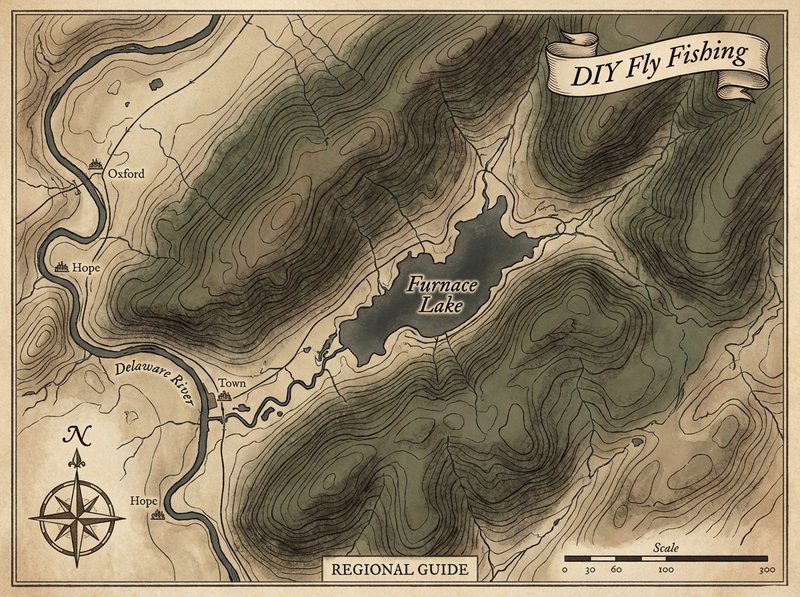
Furnace Lake
Fly fishing in New Jersey · intermediate · Best seasons: spring, fall
Target Species
Brown Trout, Largemouth Bass
About This Water
Hardwick Township lake with wild trout. Jenny Jump State Forest provides access.
Fishing Recommendations
Welcome to the Garden State’s "hidden gem" in the Highlands. As your guide, I’m excited to break down Furnace Lake in Oxford, NJ. While many anglers overlook New Jersey’s lakes in favor of its famous limestone streams, Furnace Lake offers a unique intersection of cold-water trout fishing and warm-water bass action in a scenic, manageable setting.
🎣 Location Overview
Furnace Lake is a roughly 50-acre impoundment nestled in Warren County. What makes it special—and why it supports both trout and bass—is its depth. Reaching depths of nearly 40 feet in spots, it maintains a "two-story" fishery. The upper layers warm up for the bass, while the deeper pockets provide a thermal refuge for stocked trout.
The lake is surrounded by the Oxford Mountain landscape, providing a beautiful backdrop. Anglers love it because it is small enough to fish effectively from the shore or a kayak, yet deep enough to present a real technical challenge for fly fishers looking to pull trout from a stillwater environment.
🐟 Target Species & Behavior
Brown Trout
- Behavior: These are primarily stocked fish, but because of the lake's depth, they tend to become more "educated" than those in shallow ponds. They will cruise the shorelines in the early morning and late evening but retreat to the 15–20 foot depths once the sun hits the water.
- Feeding: They focus on midges, small scuds, and damselfly nymphs. In the fall, they become more aggressive and will chase small baitfish (minnows) and terrestrial insects blown off the banks.
Largemouth Bass
- Behavior: The bass here are structure-oriented. You’ll find them tucked under overhanging trees, patrolling the lily pad edges (in warmer months), and holding near the dam breast.
- Feeding: They are opportunistic. They key in on bluegill fry, crayfish, and—during the spring and fall—large dragonflies and terrestrial beetles.
📅 Best Times to Fish
Optimal Seasons
- Spring (April – June): This is the prime window. NJ Fish & Wildlife stocks heavily in April. The water is cool, and trout are active in the top 10 feet of the water column. Bass begin moving into the shallows to spawn in May.
- Fall (Late September – November): As water temperatures drop, the "turnover" occurs. Trout become active again near the surface, and bass feed heavily to bulk up for winter.
Best Times of Day
- Low Light is Key: The best fishing occurs during the "Golden Hours"—the first two hours of daylight and the last two hours before dark.
- Overcast Days: On cloudy days, Brown Trout will remain in the shallows much longer, providing excellent opportunities for streamers.
🪰 Recommended Flies & Techniques
For Brown Trout
- Nymphing (Under an Indicator): Use a 10–12 foot leader. Hang a Size 16 zebra midge or a Size 14 Pheasant Tail 4 to 7 feet below the indicator.
- Stillwater Stripping: Use an intermediate (slow-sink) line with a Size 10 Woolly Bugger (Black or Olive) or a Size 12 Damsel Nymph. Use a "twitch-twitch-pause" retrieve.
- Dry Flies: During a calm evening, look for midge clusters. Use a Size 18 Griffith’s Gnat or a Size 14 Elk Hair Caddis if there's a breeze.
For Largemouth Bass
- Topwater: A Size 4–6 Popping Bug (Yellow or Green) worked along the lily pads in the evening is exhilarating.
- Subsurface: A Size 4 Gamechanger or a Clouser Minnow (White/Chartreuse) cast toward downed timber.
- The "Jersey Craw": A weighted Size 6 rubber-legged Woolly Bugger (Brown/Orange) bounced along the bottom mimics the local crayfish.
💡 Pro Tips & Local Knowledge
- Focus on the "Shelf": There is a distinct drop-off where the shallow shoreline flats meet the deep basin. If you can find this transition zone (usually 20-30 feet out from the bank), you will find the trout.
- The Dam Breast: The area near the dam is often the deepest and coolest. If the sun is high and the fishing feels "dead," move to the dam and use a sinking line to get your flies down to 15 feet.
- The "Oxford Twitch": Locals know that the trout here can be finicky. If you're using a streamer, try an incredibly slow retrieve—almost a crawl—punctuated by a sudden, sharp 6-inch strip. This often triggers a "reaction strike" from a follower.
- Inflow areas: After a heavy rain, focus on the small inflows at the north end of the lake. These bring in fresh oxygen and washed-in terrestrial food.
⚠️ Important Information
Access
- Furnace Lake Park: Managed by Oxford Township. There is a designated parking area and a boat ramp.
- Boating: Electric motors only. This is a "quiet" lake, making it perfect for fly fishing from a canoe, kayak, or float tube.
Regulations & Permits
- Fishing License: A valid New Jersey Fishing License is required for everyone 16 and older.
- Trout Stamp: Since you are targeting Brown Trout, a Trout Stamp is mandatory.
- Limits: Check the current NJ Freshwater Fishing Digest for seasonal size and creel limits, as these can change annually.
Special Considerations
- Water Clarity: The lake can get a bit murky after heavy rains. If the water is stained, switch to darker, bulkier flies (Black/Purple) to create a stronger silhouette.
- Snags: There is significant woody debris on the bottom. If you are fishing deep, consider using "weed-guard" hooks on your streamers to avoid losing your fly box to the sunken trees.
Tight lines, and enjoy one of Warren County's best-kept secrets!
Bug Hatches & Matching Flies
| Hatch | Type | Peak months | Time of day | Hook sizes | Matching flies |
|---|---|---|---|---|---|
| Chironomids (Midges) Chironomidae | midge | March, April, May, September, October | All Day | #18-24 | Zebra Midge #18-22, Griffith's Gnat #20-22, Palomino Midge #18-20 |
| Speckled Spinner (Callibaetis) Callibaetis | mayfly | May, June, September | Morning/Afternoon | #14-16 | Callibaetis Nymph #14-16, Parachute Adams #14-16, Hares Ear Nymph #14-16 |
| Blue-Winged Olive Baetis | mayfly | April, May, September, October | Afternoon | #18-22 | BWO Sparkle Dun #18-22, RS2 #20-22, Pheasant Tail Nymph #18-20 |
| Cinnamon Sedge Hydropsyche | caddis | May, June, July | Evening | #14-18 | Elk Hair Caddis (Tan) #14-16, LaFontaine's Deep Pupa #14-18, X-Caddis #16-18 |
| Damselfly Enallagma | terrestrial | June, July, August | Afternoon | #10-14 | Marabou Damsel Nymph #10-12, Adult Damsel #12-14 |
| Giant Michigan Mayfly (Hex) Hexagenia limbata | mayfly | June, July | Late Evening/Night | #6-10 | Hexagenia Dun #6-8, Hex Nymph #8-10 |
| Black Ants Formicidae | terrestrial | July, August, September | Afternoon | #16-20 | Black Foam Ant #16-20, Fur Ant #18-20 |
| Japanese Beetle Popillia japonica | terrestrial | July, August | Mid-day | #10-14 | Foam Beetle #12-14, Coffee's Sparkle Beetle #10-14 |
| Green Drake Ephemera guttulata | mayfly | May, June | Evening | #8-12 | Green Drake Dun #10-12, Coffey's Green Drake #10-12 |
| White Miller Ephoron leukon | mayfly | August | Late Evening | #12-14 | White Wulff #12-14, White Miller Spinner #12-14 |