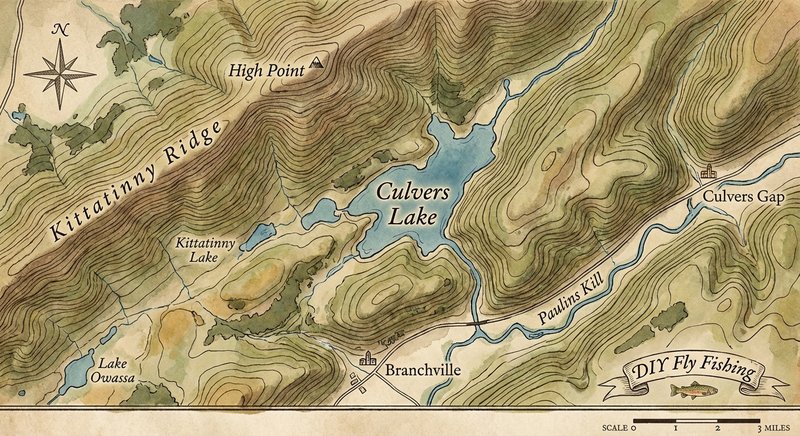
Culvers Lake
Fly fishing in New Jersey · beginner · Best seasons: spring
Target Species
Rainbow Trout, Brown Trout
About This Water
Sussex County lake with good trout fishing. Spring stocking provides excellent early season action.
Fishing Recommendations
As an expert guide who has spent years navigating the diverse waters of the Garden State, I can tell you that Culvers Lake (often referred to locally as Culver Lake) in Sussex County is a unique gem. While New Jersey is famous for its limestone streams, Culvers offers a "big water" glacial lake experience that can be incredibly rewarding for fly anglers who know how to transition from moving water to stillwater tactics.
Here is the comprehensive guide to fly fishing Culvers Lake during the prime spring season.
🎣 Location Overview
Culvers Lake is a 490-acre natural glacial lake nestled at the base of the Kittatinny Ridge. It is one of the largest natural lakes in New Jersey and is characterized by its remarkable clarity and significant depth (reaching nearly 50 feet).
What makes it special is the thermal refuge it provides. Because it is deep and spring-fed, it holds oxygenated cold water longer than many other NJ lakes. While much of the shoreline is private and developed with homes, the state maintains a robust stocking program and a public access point. For the fly angler, the draw is the "Lake Trout" feel in a suburban-accessible setting—targeting aggressive, well-fed rainbows and browns in clear water where you can often see the fish before they strike.
🐟 Target Species & Behavior
- Rainbow Trout: These are the most active feeders in the spring. Following the state stocking (usually starting in April), rainbows will cruise the upper 5–10 feet of the water column. They are "roamers" and often travel in small pods along the shoreline drop-offs.
- Brown Trout: The browns in Culvers are more calculated. They tend to hold slightly deeper than the rainbows and are often found near structure—docks, submerged timber, or where the rocky shelf drops into the deep basin.
- Feeding Habits: In the spring, these trout are keyed into two things: Midges (which hatch in massive clouds) and Alewives/Small Baitfish. As the water warms toward May, they will also aggressively target terrestrial insects blown off the surrounding trees.
📅 Best Times to Fish
- The Spring Window: Mid-April through early June is the "Golden Era." Before April, the water is often too cold for consistent fly activity; after mid-June, the trout retreat to the deep "holes" where fly lines struggle to reach.
- Time of Day:
- Dawn and Dusk: This is non-negotiable for stillwater fly fishing. The "evening rise" on Culvers can be spectacular as midges emerge.
- Overcast Days: Because the water is so clear, bright sun pushes the fish deep and makes them "leader shy." A gray, drizzly May morning is your best chance for a trophy Brown.
- The "Wind Feed": If there is a light breeze, fish the "leeward" shore where the wind is blowing toward. This pushes plankton and surface film insects into the bank, and the trout follow the food.
🪰 Recommended Flies & Techniques
Top Fly Patterns
- Streamers (The Producers):
- Woolly Bugger: Size 8–10 in Olive, Black, or White (to mimic Alewives).
- Zonkers: Silver or Pearl to imitate the shimmering baitfish.
- Nymphs & Midges:
- Zebra Midge: Size 18–22 in Black/Silver or Red.
- Chironomids: Long-tapered patterns in olive or brown.
- Dry Flies:
- Griffith’s Gnat: Size 20 (perfect for midge clusters).
- Elk Hair Caddis: Size 16 (for late spring evenings).
Effective Techniques
- The "Stillwater Strip": Use an intermediate (slow-sink) fly line. Cast your streamer toward the docks or drop-offs, let it sink for 5–10 seconds, and use a "twitch-twitch-pause" retrieve. Most strikes happen on the pause.
- Indicator Midge Fishing: If the fish are rising but ignoring streamers, hang a Zebra Midge 4 to 6 feet under a small indicator. Keep it perfectly still. In the clear water of Culvers, trout will cruise by and sip it delicately.
- Float Tube/Kayak Stealth: Because the shoreline is mostly private, a kayak or float tube is your best tool. Approach the "drop-off" zones quietly; trout in clear lakes are very sensitive to hull slaps and vibrations.
💡 Pro Tips & Local Knowledge
- Focus on the "Shelf": Use a topographical map or fish finder to locate where the water drops from 5 feet to 15 feet. This transition zone is the "highway" for trout.
- The "Causeway" Area: The area near the Route 206 bridge and the northern inlets often sees higher oxygen levels and concentrates fish after a spring rain.
- Match the Clarity: Because the water is so clear, ditch the 3X tippet. Move down to 5X or 6X Fluorocarbon. Fluorocarbon is essential here as it disappears in the water and sinks faster than nylon.
- Watch the Birds: If you see gulls diving on a specific part of the lake, they are likely over a school of Alewives being pushed to the surface by trout. Get there immediately.
⚠️ Important Information
- Access: Public access is primarily through the NJ Division of Fish & Wildlife boat ramp located off Route 206. There is very little "wading" room; this is truly a vessel-based fishery for fly anglers.
- Regulations: You must have a valid New Jersey Fishing License and a Trout Stamp.
- Vessel Rules: Culvers Lake allows motors, but it is a private residential lake with specific rules for guests. If you are using the public ramp, ensure your boat/kayak is clean to prevent the spread of invasive species (like Zebra Mussels), which is a major concern in Sussex County.
- Safety: In early spring, the water is cold enough to cause hypothermia quickly. If you are in a float tube or kayak, wear a PFD and dress in layers (neoprene waders are recommended).
Tight lines! If you time the midge hatch right as the sun sets behind the Kittatinny Ridge, you’ll see why this lake is a legendary North Jersey destination.
Bug Hatches & Matching Flies
| Hatch | Type | Peak months | Time of day | Hook sizes | Matching flies |
|---|---|---|---|---|---|
| The Hex (Giant Michigan Mayfly) Hexagenia limbata | mayfly | June, July | Dusk and Night | #4-8 | Hexagenia Dry #6-8, Hex Nymph #4-8, Hex Emerger #6 |
| Midges (Chironomids) Chironomidae | midge | April, May, September, October | All Day | #18-24 | Zebra Midge #18-22, Griffith's Gnat #20-24, Chironomid Pupa #16-20 |
| Spotted Sedge Hydropsyche | caddis | May, June | Evening | #14-18 | Elk Hair Caddis #14-16, LaFontaine's Deep Sparkle Pupa #14-16, Caddis Larva #14-18 |
| Tricos Tricorythodes | mayfly | July, August, September | Early Morning | #20-24 | Trico Spinner #22-24, RS2 #20-22 |
| Light Cahill Stenonema ithaca | mayfly | June, July | Evening | #12-14 | Light Cahill #12-14, Hare's Ear Nymph #12-14 |
| Blue Winged Olive Baetis | mayfly | April, May, September, October | Afternoon | #18-22 | BWO Sparkle Dun #18-20, Pheasant Tail Nymph #18-22, BWO Emerger #20 |
| Angler's Curse Caenis | mayfly | July, August | Dawn/Dusk | #24-28 | Caenis Female Spinner #24-26, Micro Midge #24 |
| Terrestrials (Ants and Beetles) Formicidae / Coleoptera | terrestrial | July, August, September | Mid-day | #12-18 | Black Foam Ant #14-18, Flying Ant #16-18, Coffee's Sparkle Beetle #12-16 |