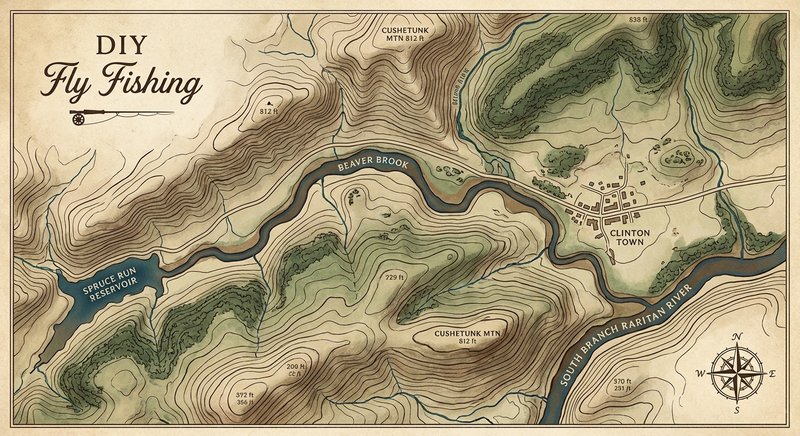
Beaver Brook
Fly fishing in New Jersey · advanced · Best seasons: spring, summer
Target Species
Brook Trout
About This Water
Sussex County headwater stream with wild brook trout. Small stream tactics required.
Fishing Recommendations
Beaver Brook in Warren County, New Jersey, is one of the state's hidden gems for the fly angler seeking a more intimate, technical, and rewarding experience. While many flock to the larger Musconetcong or Pequest nearby, Beaver Brook offers a classic "small stream" experience characterized by wild residents and beautiful scenery.
🎣 Location Overview
Beaver Brook is a spring-fed freestone stream that winds through the rolling hills of Warren County before joining the Pequest River near Belvidere. What makes this water special is its transition from a tiny, rhododendron-choked headwater stream to a mid-sized creek with classic pool-and-riffle architecture.
The Beaver Brook Wildlife Management Area (WMA) is the crown jewel of this system. Here, the water is cool, well-oxygenated, and protected by a dense canopy. Anglers love it because it feels like a piece of the Adirondacks dropped into Northern New Jersey. It is a "high-gradient" stream for the region, meaning you’ll find plenty of oxygen-rich pocket water and small plunges.
🐟 Target Species & Behavior
While the state stocks Rainbow and Brown Trout in the lower reaches, the primary draw for the purist is the Wild Brook Trout.
- Behavior: These are "opportunistic survivors." Because the stream is nutrient-poor compared to big limestone rivers, the fish aren't always picky, but they are incredibly spooky. A shadow or a heavy footstep will send them darting under a rock for an hour.
- Holding Zones: Look for "the kitchen"—the head of the pool where the fast water brings food. In the heat of summer, they will hug the deepest undercut banks or hover near cold-water springs entering the main stem.
- Diet: Their diet consists mainly of small aquatic insects (Baetis and Caddis), but they are famous for their love of terrestrials in the summer months.
📅 Best Times to Fish
- Spring (April – Early June): This is the prime window. The water levels are stable, and the major hatches occur. Late April and May provide the most consistent dry fly action.
- Summer (June – August): Focus on the upper reaches within the WMA. The dense canopy keeps water temperatures trout-friendly. This is the season of the "stealth angler."
- Time of Day:
- Spring: Mid-day (11:00 AM – 3:00 PM) when the water warms slightly and triggers hatches.
- Summer: Early morning or the final "magic hour" before dusk.
- Prime Conditions: A "cloudy day with a light drizzle" is perfect for Beaver Brook. The low light masks your approach and often triggers a Blue-Winged Olive hatch.
🪰 Recommended Flies & Techniques
Since this is small water, leave the 6-weight rod at home. A 2-weight to 4-weight rod (7’6” to 8’6”) is ideal for navigating the tight brush.
Top Fly Patterns
- Dry Flies:
- Adams (Para or Traditional) size 16-20: The gold standard for this brook.
- Elk Hair Caddis (Tan/Olive) size 14-18: Excellent for skating across riffles.
- Royal Wulff size 14-16: A high-visibility attractor for broken water.
- Nymphs:
- Pheasant Tail size 18-20: Mimics almost any small mayfly nymph.
- Zebra Midge (Black/Silver) size 20-22: Essential for low, clear water.
- Terrestrials (Summer):
- Black Foam Ants size 18: If you aren't catching fish in July, tie on a small ant.
- Dave’s Hopper size 12-14: For the larger pools near the meadow sections.
Effective Techniques
- The "Bow and Arrow" Cast: You will often find yourself surrounded by trees. Mastering this cast is essential for hitting tight pockets under overhanging branches.
- High-Sticking: Use a short line and keep as much fly line off the water as possible to avoid "drag" caused by the complex currents of the pocket water.
- Dry-Dropper: A buoyant dry fly (like a Stimulator) with a tiny midge nymph dropped 12 inches below is a deadly "search and destroy" rig here.
💡 Pro Tips & Local Knowledge
- Work Upstream: Always fish moving upstream. Brook trout face into the current; if you approach from behind, you stay out of their field of vision.
- Dress in Stealth: Avoid bright colors. Wear greens, browns, or camo to blend into the forest backdrop.
- The "One-Cast" Rule: In these small pools, your first cast is your best chance. If you botch the presentation, move to the next pocket rather than thrashing the water.
- Focus on the WMA: The stretch through the Beaver Brook WMA (Hope, NJ) offers the most consistent habitat for wild fish. The section near the Swayze Mill Park also offers good access but can see more foot traffic.
⚠️ Important Information
- Access: Access is excellent through the Beaver Brook Wildlife Management Area. There are several dirt pull-offs along Route 519 and local township roads.
- Regulations: Beaver Brook is subject to New Jersey's general trout regulations. A NJ Freshwater Fishing License and a Trout Stamp are mandatory for anyone 16 or older.
- Catch & Release: While some sections allow harvesting, I strongly recommend Catch and Release for all wild Brook Trout. These populations are fragile and represent the heritage of New Jersey's cold-water fisheries.
- Wading Safety: The rocks can be incredibly slick. Felt-soled boots or studs are highly recommended, even though the water is rarely deep.
Guide’s Final Thought: Beaver Brook rewards the patient angler. Don't measure success by the size of the fish—a 7-inch wild Brookie in full spawning colors is a far greater trophy here than a 14-inch stocked rainbow. Enjoy the solitude!
Bug Hatches & Matching Flies
| Hatch | Type | Peak months | Time of day | Hook sizes | Matching flies |
|---|---|---|---|---|---|
| Blue Winged Olive Baetis / Drunella | mayfly | April, May, September, October | Midday | #18-22 | RS2 #20-22, BWO Sparkle Dun #18-20, Pheasant Tail #18-22 |
| Hendrickson Ephemerella subvaria | mayfly | April | Afternoon | #12-14 | Hendrickson Dark #12-14, Red Quill #14, Hendrickson Emerger #12-14 |
| Sulphur Ephemerella invaria/dorothea | mayfly | May, June | Evening | #14-18 | Sulphur Parachute #14-18, Comparadun Sulphur #16-18, Pupa-style Sulphur Nymph #16 |
| Grannom Caddis Brachycentrus | caddis | April, May | Morning/Afternoon | #14-16 | Elk Hair Caddis (Dark) #14-16, LaFontaine's Deep Sparkle Pupa #14-16, Peacock Caddis #16 |
| Light Cahill Stenonema / Stenacron | mayfly | June, July | Evening | #12-14 | Light Cahill #12-14, Hare's Ear Nymph #12-14 |
| Cinnamon Caddis Hydropsyche | caddis | June, July, August | Evening | #14-18 | Tan Elk Hair Caddis #14-18, Caddis Larva (Tan/Green) #14-16, Soft Hackle Hare's Ear #14-16 |
| Trico Tricorythodes | mayfly | July, August, September | Early Morning | #22-26 | Trico Spinner #22-24, Griffith's Gnat #20-24 |
| Terrestrials (Ants/Beetles) Formicidae / Coleoptera | terrestrial | July, August, September | All Day | #12-18 | Black Foam Ant #16-18, Crowe Beetle #14-16, Chernobyl Ant #12-14 |