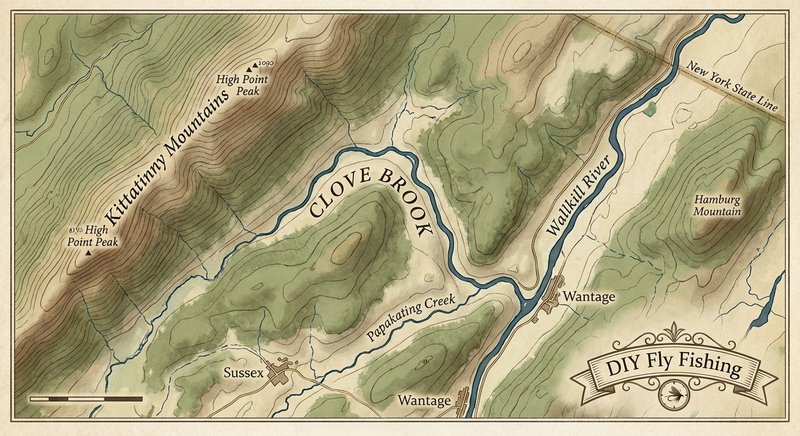
Clove Brook
Fly fishing in New Jersey · advanced · Best seasons: spring, summer
Target Species
Brook Trout
About This Water
Sussex County mountain stream with wild brook trout. High gradient offers pocket water fishing.
Fishing Recommendations
Clove Brook, located in the far northwestern corner of New Jersey within Sussex County, is one of the state's true hidden gems. As a guide, I consider this water a "time machine"—it offers a glimpse into what Appalachian fly fishing looked like a century ago.
Here are my comprehensive recommendations for fishing Clove Brook.
🎣 Location Overview
Clove Brook is a quintessential freestone stream flowing through the rugged, scenic terrain of High Point State Park and the Kittatinny Mountains. What makes it special is its designation as "Trout Production" water, meaning it supports a self-sustaining population of wild fish.
The water characteristics vary from high-gradient plunges and tight pocket water in the upper reaches to meandering runs with undercut banks as it flows toward the Wallkill River valley. It is characterized by cold, gin-clear water, moss-covered boulders, and a dense hemlock canopy that keeps the water temperatures significantly lower than other New Jersey streams. Anglers love it because it rewards stealth and precision rather than long-distance casting.
🐟 Target Species & Behavior
The primary draw here is the Wild Brook Trout. While the state occasionally stocks the lower reaches, the upper sections are the stronghold of New Jersey’s state fish.
- Behavior: These are wild, opportunistic feeders. Because the nutrient density in high-gradient mountain streams is lower than in limestone creeks, these fish aren't usually "picky," but they are incredibly skittish.
- Holding Patterns: Look for them in the "cushion" in front of boulders, the tail-outs of small pools at dusk, and deep under rhododendron overhangs during the heat of the day.
- Diet: Their diet consists mainly of small stoneflies, caddis larvae, and terrestrial insects that fall from the dense overhead canopy.
📅 Best Times to Fish
Optimal Seasons
- Spring (April – June): This is the prime window. The water levels are high enough to provide cover for the fish, and the first major hatches (Quill Gordons and Hendrickson’s) occur.
- Summer (July – Early September): Unlike many NJ streams that get too warm, the upper Clove remains fishable due to elevation and shade. However, you must move stealthily as the water becomes crystal clear and low.
Best Times of Day
- Spring: Mid-day (11:00 AM – 3:00 PM) when the sun warms the water just enough to trigger insect activity.
- Summer: Early morning (dawn until 10:00 AM) or the "magic hour" before dark.
🪰 Recommended Flies & Techniques
Top Fly Patterns
- Dry Flies:
- Royal Wulff or Royal Coachman (Size 14-16): Excellent high-visibility attractor.
- Elk Hair Caddis (Size 16-18): A staple for the constant caddis activity.
- Black Gnat or Ants (Size 18-22): Deadly in mid-to-late summer.
- Nymphs:
- Pheasant Tail (Size 16-20): Mimics almost any mayfly nymph in the system.
- Gold-Ribbed Hare’s Ear (Size 14-16): Great for the "buggy" look in pocket water.
- Streamers:
- Black Ghost or small Woolly Bugger (Size 10-12): Use these only in the larger pools after a rain.
Techniques & Presentation
- The "Bow and Arrow" Cast: The canopy is tight. You will rarely make a traditional overhead cast. Master the bow-and-arrow cast to get your fly under low-hanging branches.
- Dry-Dropper: This is the most effective way to fish Clove Brook. Use a buoyant dry fly (like a Stimulator) and hang a small unweighted Pheasant Tail nymph about 12–18 inches below it.
- Stealth: Always fish upstream. If you walk downstream, the silt and the fish's natural orientation will alert every trout to your presence before you even cast.
💡 Pro Tips & Local Knowledge
- Focus on the State Park: The sections within High Point State Park offer the best wild brook trout habitat. The further you hike away from the road crossings, the better the fishing gets.
- Dress in Camo: Avoid bright white or "fishing blue" shirts. Earth tones (greens, browns, greys) are essential here. If you can see the fish, they have likely already seen you.
- Short Rods are King: Leave your 9-foot 5-weight at home. A 7-foot to 7.5-foot 3-weight or even a fiberglass rod is the perfect tool for these tight quarters.
- Check the Gauge: Clove Brook can drop quickly in a drought. If the water looks exceptionally low, give the fish a break to avoid stressing them.
⚠️ Important Information
Access
- Access is primarily through High Point State Park and Stokes State Forest areas.
- Parking can be found off Route 23 and various fire roads. Be prepared for some light hiking/bushwhacking.
Regulations
- License: A New Jersey Fishing License and a Trout Stamp are required for anyone age 16-69.
- Wild Trout Streams: Parts of Clove Brook may fall under "Wild Trout Stream" regulations, which often require catch and release only or restricted creel limits, and artificial lures/flies only. Always check the current NJ Fish & Wildlife Digest before heading out.
Special Considerations
- Bears: This area has one of the highest black bear densities in New Jersey. Carry bear spray and make noise while hiking in.
- Ticks: This is prime tick country (Lyme disease risk). Use Permethrin on your gear and do a thorough check after your trip.
Bug Hatches & Matching Flies
| Hatch | Type | Peak months | Time of day | Hook sizes | Matching flies |
|---|---|---|---|---|---|
| Blue Winged Olive Baetis | mayfly | April, May, September, October | Midday | #18-22 | BWO Sparkle Dun #18-20, Pheasant Tail #18-22, RS2 #20 |
| Quill Gordon Epeorus pleuralis | mayfly | April | Midday | #12-14 | Quill Gordon #12-14, Hare's Ear Nymph #12-14 |
| Hendrickson Ephemerella subvaria | mayfly | April, May | Afternoon | #12-14 | Red Quill #12-14, Hendrickson Emerger #14, Frenchie #14 |
| Grannom Caddis Brachycentrus | caddis | April, May | Morning/Evening | #14-16 | Elk Hair Caddis (Green Body) #14-16, LaFontaine's Deep Sparkle Pupa #14-16 |
| March Brown Maccaffertium vicarium | mayfly | May, June | Afternoon | #10-12 | March Brown American #10-12, Gold Ribbed Hare's Ear #10-12 |
| Light Cahill Stenonema/Stenacron | mayfly | June, July | Evening | #12-16 | Light Cahill #12-16, Cream Usual #14-16 |
| Golden Stonefly Acroneuria | stonefly | June, July | Morning/Night | #8-12 | Pats Rubber Legs #8-12, Golden Stimulator #10-12 |
| Tan Caddis Hydropsyche | caddis | June, July, August, September | Evening | #14-18 | Tan Elk Hair Caddis #14-18, Holy Grail #16 |
| Terrestrials (Ants/Beetles) Formicidae/Coleoptera | terrestrial | July, August, September | All Day | #14-20 | Black Foam Ant #16-20, Japanese Beetle #14 |