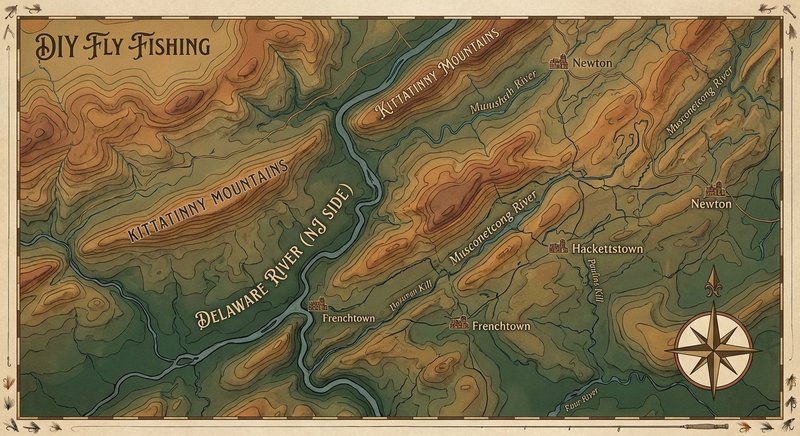
Delaware River (NJ Side)
Fly fishing in New Jersey · intermediate · Best seasons: spring, summer, fall
Target Species
Rainbow Trout, Brown Trout, American Shad
About This Water
Main stem Delaware with excellent shad and trout. Wild rainbow trout fishery developing below dams.
Fishing Recommendations
Welcome to the "Big D." As a guide, I consider the Delaware River one of the most rewarding yet challenging technical tailwaters in the Eastern United States. While many people associate the Delaware with New York, the New Jersey side offers incredible access to the Main Stem—a wide, powerful river known for wild, selective trout and the legendary spring migration of American Shad.
Here is your comprehensive guide to fly fishing the New Jersey side of the Delaware River.
🎣 Location Overview
The Main Stem of the Delaware (forming the border between NJ and PA) is a massive, complex river system. Unlike the smaller, intimate freestone streams found elsewhere in New Jersey, the Delaware is "big water." It is primarily fed by the cold-water releases from the Cannonsville and Pepacton reservoirs in New York.
What makes it special is the wildness of the fish. These are not freshly stocked hatchery fish; they are born in the river or its tributaries, making them incredibly strong, savvy, and "bug-educated." The riverbed is a mix of freestone cobble, deep ledge pools, and massive riffles. It is often called the "East Coast’s Madison River" due to its size and the quality of its dry-fly fishing.
🐟 Target Species & Behavior
Brown Trout
The "kings" of the river. Delaware Browns are notoriously picky. They often hold in the "foam lines" or very close to the banks under overhanging brush. During a hatch, they will move into the glassy tails of pools to sip duns with nearly invisible rises.
- Behavior: Highly selective to fly size and silhouette. They have PhDs in detecting leader drag.
Rainbow Trout
These are pure silver bullets. Unlike the browns, Delaware Rainbows love oxygenated water. You’ll find them in the heavy riffles, "slick" water just above a drop-off, and fast runs.
- Behavior: They are much more acrobatic than browns and will often peel backing off your reel instantly.
American Shad
Known as the "Poor Man's Salmon," these anadromous fish enter the river in spring to spawn. They don't feed once they enter freshwater, but they strike out of aggression or instinct.
- Behavior: They travel in "schools" along specific deep-water channels (the Shad Highway). They prefer the "seams" between fast and slow water.
📅 Best Times to Fish
- Spring (Mid-April – June): This is the "Holy Grail" window.
- April/May: The American Shad run peaks.
- May/June: The best dry fly fishing in the country occurs here with the Hendrickson, March Brown, and Sulfur hatches.
- Summer (July – August): Focus on the Upper Main Stem (above Narrowsburg) where the water stays cooler.
- Time of Day: Early morning and "The Last Hour" (dusk) are critical. Look for the massive Trico hatches at sunrise and Sulfur/Sedge hatches at sunset.
- Fall (September – October): The crowds thin out. This is the time for Isonychia hatches and aggressive Brown Trout hitting streamers as they prepare for the spawn.
🪰 Recommended Flies & Techniques
Dry Fly Fishing (The Main Event)
Precision is everything. You need long leaders (12–15 feet) tapered down to 5X or 6X fluorocarbon.
- Patterns:
- Hendrickson (Red Quill) Dark & Light: #12-14
- Sulfur Comparadun: #16-20 (A must-have for June)
- Isonychia Parachute: #10-12 (Great for the faster riffles)
- Rusty Spinner: #14-18 (Essential for evening falls)
Nymphing
When there are no bugs on the surface, go deep. High-sticking or European Nymphing is effective in the riffles.
- Patterns: Pheasant Tails (#14-18), Zebra Midges (#18-22), and heavy Stonefly patterns (#8-12).
Shad Techniques
You need to get the fly down to the fish's level. Use a sink-tip line or a long leader with split shot.
- Patterns: Shad Darts, "Shad Flies" (bright oranges, pinks, and chartreuse with bead heads).
- Technique: Cast quartering downstream, let it sink, and allow the fly to "swing" through the current.
💡 Pro Tips & Local Knowledge
- The "Micro-Drag" Killer: The Delaware has complex micro-currents. Even if your fly looks like it’s floating naturally to you, it might be dragging slightly. Always use a reach cast to set your line upstream of your leader.
- The Shad Highway: If you catch one shad, stay put. They travel in pods. If you aren't getting hits, move 10 feet toward the center of the river or 10 feet toward the bank. Once you find the "lane," you’ll have a career day.
- River Left vs. River Right: From a New Jersey perspective, you are on "River Left" (looking downstream). The NJ side has some of the best deep-holding water near the Delaware Water Gap and the Worthington State Forest stretches.
- Temperature Management: In the summer, carry a thermometer. If the water hits 68°F, stop fishing for trout. It is lethal to them. Move further north toward Lordville or switch to fishing for Smallmouth Bass.
⚠️ Important Information
- Regulations & Permits: Thanks to a long-standing interstate agreement, you can fish the Delaware River Main Stem from either the NJ or PA shore (or from a boat) with a valid fishing license from either state.
- Access Points (NJ Side):
- Columbia WMA: Great for Shad and Smallmouth.
- Worthington State Forest: Excellent wading access.
- Kittatinny Point: Near the I-80 bridge.
- Wading Safety: The Delaware is powerful and the rocks are notoriously slippery (covered in "didymo" or rock snot). Studded wading boots and a wading staff are non-negotiable. Do not underestimate the current; if the water is above your waist, you are in a dangerous position.
- Check the Gauges: Always check the USGS water gauges at Montague or Riegelsville before heading out. High water (over 8-9 feet at Montague) makes wading nearly impossible and dangerous.
Tight lines, and remember: on the Delaware, a single wild trout earned on a dry fly is worth twenty caught elsewhere!
Bug Hatches & Matching Flies
| Hatch | Type | Peak months | Time of day | Hook sizes | Matching flies |
|---|---|---|---|---|---|
| Hendrickson Ephemerella subvariabilis | mayfly | April, May | Afternoon | #12-14 | Red Quill #12-14, Hendrickson Emerger #14, Pheasant Tail Nymph #12-14 |
| Sulphur Ephemerella invaria/dorothea | mayfly | May, June | Late Afternoon/Evening | #14-18 | Sulphur Parachute #14-18, Snowshoe Rabbit Foot Emerger #16-18, Sulphur CDC Spinner #14-18 |
| Blue-Winged Olive (BWO) Baetis / Pseudocloeon | mayfly | April, May, September, October | Midday/Afternoon | #18-24 | RS2 #18-22, BWO Sparkle Dun #18-22, Blue Wing Olive Parachute #18-24 |
| Green Drake Ephemera guttulata | mayfly | May, June | Evening | #8-10 | Coffin Fly #8-10, Green Drake Cripple #8-10, Green Drake Nymph #8-10 |
| Grannom Caddis Brachycentrus | caddis | April, May | Morning/Afternoon | #14-16 | Elk Hair Caddis (Green Body) #14-16, LaFontaine's Deep Sparkle Pupa #14-16, Holy Grail Caddis #14-16 |
| March Brown Maccaffertium vicarium | mayfly | May | Midday | #10-12 | March Brown Parachute #10-12, March Brown Wet Fly #12, Hare's Ear Nymph #10-12 |
| Isonychia (Slate Drake) Isonychia bicolor | mayfly | June, July, August, September | Late Afternoon/Evening | #10-12 | Iso Parachute #10-12, Isonychia Nymph (Zug Bug style) #10-12, Iso Spinner #10-12 |
| Trico Tricorythodes | mayfly | July, August, September | Early Morning | #20-24 | Trico Spinner #22-24, Trico Drowned Spinner #22-24, Trico Parachute #20-22 |