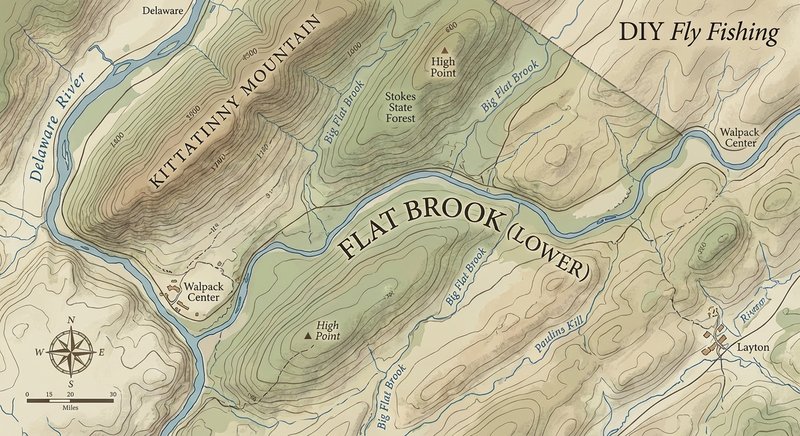
Flat Brook (Lower)
Fly fishing in New Jersey · beginner · Best seasons: spring, fall
Target Species
Brown Trout, Rainbow Trout
About This Water
Lower section near Delaware River confluence. Good access and mixed wild and stocked trout.
Fishing Recommendations
The Lower Flat Brook in Sussex County, New Jersey, is often whispered about in the same breath as legendary Catskill rivers. As it flows through the Delaware Water Gap National Recreation Area, it offers a wilderness experience that feels worlds away from the suburban sprawl of the Garden State.
As your guide, here is the comprehensive breakdown for tackling this classic freestone stream.
🎣 Location Overview
The Flat Brook is widely considered the crown jewel of New Jersey fly fishing. While the "Big Flat Brook" is the upper fly-fishing-only stretch, the Lower Flat Brook (stretching from the confluence of the Big and Little Flat Brooks down to the Delaware River) offers a more rugged, diverse, and often less-pressured experience.
The water here is a classic Appalachian freestone: a mix of deep, swirling pools, long riffles, and "pocket water" created by glacial boulders. What makes it special is the scenery; because much of it sits on federal and state land, you are surrounded by hemlocks, hardwoods, and rock outcroppings rather than backyards and bridges.
🐟 Target Species & Behavior
The Lower Flat Brook is primarily a Brown and Rainbow Trout fishery.
- Rainbow Trout: These are mostly stocked fish, but the Lower Flat Brook’s oxygenated riffles keep them active. They tend to hold in the faster water at the heads of pools and in the "bubbles" behind submerged rocks.
- Brown Trout: You will find a mix of fresh stockies and "holdovers"—fish that have survived a season or more and become wary. These bigger Browns are nocturnal and structure-oriented. Look for them in the "guts" of deep pools, under undercut banks, or beneath fallen timber.
- Behavior: In the spring, fish are opportunistic and hungry. In the fall, Browns become aggressive as they prepare for the spawn, often hitting larger streamers out of territorial aggression rather than hunger.
📅 Best Times to Fish
Optimal Seasons
- Spring (Mid-April to June): This is the prime window. The water temperatures are ideal (50°F–60°F), and the major hatches occur.
- Fall (Late September to November): The crowds disappear, the foliage is stunning, and the Brook is restocked. Cooling water temperatures trigger a secondary feeding frenzy.
Best Times of Day
- Spring: Late morning through late afternoon. You want the sun to warm the water just enough to trigger insect activity.
- Fall: Mid-day is most productive, though early mornings can see great streamer action if there is a bit of overcast.
Prime Windows
The "Hendrickson Hatch" (late April) and the "March Brown Hatch" (mid-May) are the two most important windows for the dry-fly enthusiast on the Flat Brook.
🪰 Recommended Flies & Techniques
Top Fly Patterns
- Dry Flies:
- Hendrickson (Dark & Light): Size 12-14.
- Elk Hair Caddis: Size 14-16 (Tan or Olive).
- Adams Parachute: Size 14-18 (The ultimate "searching" pattern here).
- Nymphs:
- Pheasant Tail: Size 14-18 (Bead-head).
- Hare’s Ear: Size 12-16.
- Prince Nymph: Size 14.
- Streamers:
- Woolly Bugger: Size 6-10 (Black or Olive).
- Muddler Minnow: Size 8-12.
Effective Techniques
- High-Stick Nymphing: Because the Lower Flat Brook has many "seams" created by boulders, a short-line nymphing technique (without a strike indicator) is deadly in the pocket water.
- The "Dry-Dropper": In the late spring, use a buoyant Elk Hair Caddis as your "indicator" with a small Pheasant Tail nymph tied 18 inches below it. This covers two zones at once.
- Swing the Streamer: Especially in the fall, cast a Woolly Bugger 45 degrees downstream and let it swing through the deep runs, giving it slight twitches.
💡 Pro Tips & Local Knowledge
- The "Blewett Tract": Focus your efforts around the areas known as the Blewett Tract. It offers excellent access and some of the most consistent pool-and-riffle structures on the lower river.
- Go Small in the Fall: While the fish are aggressive, the water is often lower and clearer in autumn. Switch to longer, thinner leaders (5x or 6x) to avoid spooking the holdovers.
- Watch the Tributaries: After a heavy rain, the main stem might get muddy. Check the mouths of the smaller tributaries; they clear up faster and often hold fish looking for a "clean" oxygen source.
- Wading Safety: The rocks in the Flat Brook are notoriously "greasy" with algae. Felt-soled boots or studs are highly recommended, as the current in the lower section can be deceptively strong.
⚠️ Important Information
- Access: Much of the Lower Flat Brook is within the Delaware Water Gap National Recreation Area. Access points are found along Route 615 and Flatbrook Road. Look for the NPS or NJ Fish & Wildlife parking pull-offs.
- Regulations:
- A NJ Fishing License and Trout Stamp are required for all anglers 16 and older.
- Note that while the Big Flat Brook has a "Fly Fishing Only" stretch, the Lower Flat Brook is generally open to all lures/baits. However, most local conservationists encourage "Catch and Release" to preserve the holdover population.
- Special Considerations: This is bear country. While they generally avoid humans, be "Bear Aware." Keep food secured and give wildlife plenty of space.
- Cell Service: It is notoriously spotty in the Flat Brook valley. Download your maps for offline use before you head into the Gap.
Guide’s Final Word: “The Flat Brook doesn’t give up its secrets easily. If the main pools are crowded, walk a half-mile downstream. You’ll find a piece of water all to yourself, and that’s usually where the best fish are hiding.”
Bug Hatches & Matching Flies
| Hatch | Type | Peak months | Time of day | Hook sizes | Matching flies |
|---|---|---|---|---|---|
| Quill Gordon Epeorus pleuralis | mayfly | April | Midday | #12-14 | Quill Gordon Dry #12-14, Hare's Ear #12-14 |
| Hendrickson Ephemerella subvaria | mayfly | April, May | Afternoon | #12-14 | Hendrickson Pink Lady #12-14, Red Quill #14, Hendrickson Emerger #12-14 |
| Grannom Caddis Brachycentrus | caddis | April, May | All day | #14-16 | Elk Hair Caddis (Olive/Tan) #14-16, Holy Grail #14-16, Peacock Caddis Larva #14-16 |
| March Brown Maccaffertium vicarium | mayfly | May | Afternoon | #10-12 | March Brown American #10-12, Pheasant Tail #10-12 |
| Sulphur Ephemerella invaria/dorothea | mayfly | May, June | Evening | #14-18 | Sulphur Parachute #14-18, Sulphur CDC Comparadun #16-18, Sulphur Soft Hackle #16 |
| Light Cahill Stenacron interpunctatum | mayfly | June, July | Evening | #12-14 | Light Cahill Dry #12-14, Gold Ribbed Hare's Ear #14 |
| Isonychia Isonychia bicolor | mayfly | June, September | Late Afternoon | #10-12 | Iso Parachute #10-12, Prince Nymph #10-12, Zug Bug #10-12 |
| Blue-Winged Olive Baetis | mayfly | April, September, October | Midday/Afternoon | #18-22 | BWO Sparkle Dun #18-22, RS2 (Olive) #20-22, WD-40 #20-22 |
| Ants and Beetles Formicidae / Coleoptera | terrestrial | July, August, September | Midday | #12-18 | Black Foam Ant #14-18, Cinnamon Ant #16-18, Crowe Beetle #12-16 |