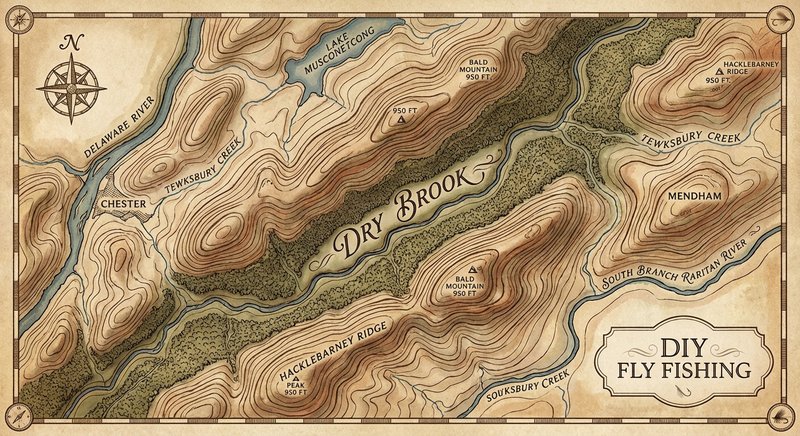
Dry Brook
Fly fishing in New Jersey · intermediate · Best seasons: spring, fall
Target Species
Brook Trout, Brown Trout
About This Water
Sussex County tributary with native trout. Despite name, flows year-round with good habitat.
Fishing Recommendations
Dry Brook, located in the scenic Kittatinny Valley of Sussex County, New Jersey, is a hidden gem for the discerning angler. As a tributary to the Paulins Kill, it represents some of the most intimate and rewarding small-stream fly fishing in the Garden State.
Here is your comprehensive guide to fly fishing Dry Brook.
🎣 Location Overview
Dry Brook is a classic Northeast "freestone-influenced" stream with significant limestone characteristics. Unlike the wider, more famous rivers like the Musconetcong or the Big Flat Brook, Dry Brook is tight, brushy, and incredibly private-feeling.
What makes it special is its wild trout potential. While many NJ streams suffer from thermal stress in the summer, Dry Brook benefits from cold-water springs and heavy canopy cover. The water is characterized by deep undercut banks, plunges into small pools, and "pocket water" created by glacial boulders. Anglers love it because it rewards stealth and precision over long-distance casting.
🐟 Target Species & Behavior
The brook holds a mix of resident wild fish and occasional migrants from the Paulins Kill.
- Wild Brown Trout: These are the "kings" of Dry Brook. They are notoriously wary and possess a golden-buttery hue. They hold in the darkest shadows, particularly under overhanging roots and fallen timber.
- Brook Trout: You will find the "Salvelinus fontinalis" primarily in the upper reaches and cooler feeder trickles. They are opportunistic but easily spooked by heavy footsteps.
- Behavior: These fish are "structured-oriented." They rarely sit in the middle of a sunlit riffle. Instead, they wait in the "cushion" in front of rocks or in the deep tail-outs of pools during the evening rise.
📅 Best Times to Fish
Optimal Seasons
- Spring (April – June): This is the prime window. The water levels are stable, and the major hatches occur. The "Green-Up" in the valley brings the stream to life.
- Fall (Late September – November): This is the best time for trophy wild Browns. As they prepare for the spawn, they become aggressive and territorial. The foliage provides excellent cover for the angler.
Best Times of Day
- Spring: 10:00 AM to 3:00 PM (when the water warms slightly and triggers bug activity).
- Fall: Dawn and dusk. The low light levels encourage larger fish to leave their overhead cover.
Prime Conditions
Cloudy, drizzly days are the "secret sauce" for Dry Brook. The lack of shadows on the water makes the wild trout feel secure, often leading to spectacular dry fly action mid-day.
🪰 Recommended Flies & Techniques
Due to the tight quarters, you aren't making 50-foot casts here. This is short-game territory.
Top Fly Patterns
- Dry Flies:
- Elk Hair Caddis (Size 14-18) – The most consistent producer.
- Adams Parachute (Size 16-20) – Perfect for the slow-moving pools.
- Light Cahills (Size 14-16) – Essential for late May evenings.
- Nymphs:
- Pheasant Tail (Size 16-18) – Imitates the small mayflies common here.
- Hare's Ear (Size 14-16) – Great for the "buggy" look in riffles.
- Scuds/Cressbugs (Size 16-18) – Because of the limestone influence, these are vital "bread and butter" flies year-round.
- Streamers:
- Black Wooly Bugger (Size 10-12) – Drag these through the deep undercut banks during high water.
Presentation Tips
- The Bow-and-Arrow Cast: You will need this to get your fly under the rhododendrons and overhanging branches.
- High-Sticking: Use a long rod (even a 7'6" or 8'0" 3-weight) to keep as much line off the water as possible to avoid "drag" in the complex currents.
💡 Pro Tips & Local Knowledge
- Stealth is Paramount: If you can see the fish, they have likely already seen you. Wear earthy tones (greens/browns) and move upstream slowly. Avoid "crunching" the gravel as you walk; vibrations travel through the water.
- The "Limestone Secret": Because Sussex County has limestone geology, the pH of Dry Brook is slightly higher than pure freestone streams. This means there are more crustaceans. If the fish aren't hitting mayfly nymphs, switch to a Grey Scud—it is often the "X-factor."
- Focus on the Confluence: The area where Dry Brook meets the Paulins Kill can hold surprisingly large Brown trout that move into the cooler tributary water during the shoulder seasons.
- Short Leaders: In the tight brush, a 9-foot leader is often a liability. Scale down to a 7.5-foot leader tapered to 5X or 6X for better accuracy in the "tunnels" of trees.
⚠️ Important Information
Access
Access can be tricky as Dry Brook flows through a mix of public and private land.
- Look for bridge crossings and check the NJ Department of Environmental Protection (DEP) maps for the Paulins Kill Wildlife Management Area (WMA), which includes sections of its tributaries.
- Always respect "Posted" signs. Gaining permission from a local landowner can often grant you access to "virgin" water that hasn't seen a fly in months.
Regulations
- A valid New Jersey Fishing License and Trout Stamp are required for all anglers 16 and older.
- Be aware of "Wild Trout Stream" designations which may have specific creel limits or "Catch and Release Only" sections. Check the current NJ Freshwater Fishing Digest.
Special Considerations
- Ticks: This area of Sussex County is prime habitat for deer ticks. Use permethrin-treated clothing and do a thorough check after your session.
- Water Levels: Dry Brook is small. In the heat of July and August, the water can get dangerously low and warm for trout. If the water temp exceeds 68°F, please stop fishing to protect the wild population.
Bug Hatches & Matching Flies
| Hatch | Type | Peak months | Time of day | Hook sizes | Matching flies |
|---|---|---|---|---|---|
| Blue-Winged Olive (BWO) Baetis | mayfly | March, April, October, November | Afternoon | #18-22 | RS2 #20-22, Parachute BWO #18-20, Pheasant Tail #18-20 |
| Hendrickson Ephemerella subvaria | mayfly | April, May | Afternoon | #12-14 | Red Quill #12-14, Hendrickson Nymph #12-14, Snowshoe Rabbit Emerger #14 |
| Grannom Caddis Brachycentrus | caddis | April, May | Late Morning/Afternoon | #14-16 | Elk Hair Caddis (Olive) #14-16, LaFontaine Pupa #14-16, Peacock Caddis #16 |
| Sulphur Ephemerella invaria/dorothea | mayfly | May, June | Evening | #14-18 | Sulphur Parachute #14-18, Sulphur Comparadun #16-18, Sulphur Cripple #16 |
| Light Cahill Stenonema ithaca | mayfly | June, July | Evening | #12-14 | Light Cahill Dry #12-14, Cream Usual #14, Gold Ribbed Hare's Ear #12-14 |
| Trico Tricorythodes | mayfly | July, August, September | Early Morning | #20-26 | Trico Spinner #22-26, Zebra Midge #20-22, Trico Dun #22-24 |
| Tan Caddis Hydropsyche | caddis | May, June, July, August | Morning/Evening | #14-18 | Tan Elk Hair Caddis #14-18, Holy Grail Caddis #16, Hydropsyche Larva #14-16 |
| Terrestrials (Ants and Beetles) Formicidae / Coleoptera | terrestrial | July, August, September | Mid-day/Afternoon | #14-20 | Black Foam Ant #16-20, Cinnamon Ant #18, Japanese Beetle #14 |