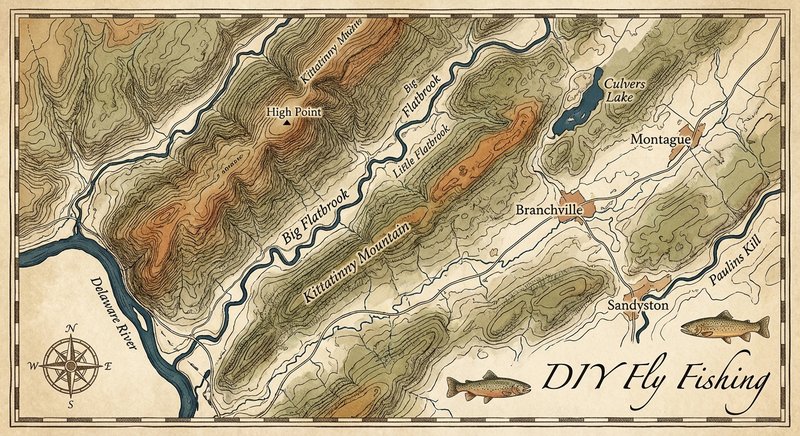
Big Flatbrook
Fly fishing in New Jersey · intermediate · Best seasons: spring, fall
Target Species
Brown Trout, Brook Trout, Rainbow Trout
About This Water
Northwestern New Jersey's finest trout stream in the Delaware Water Gap. Wild trout section offers challenging fishing in pristine setting.
Fishing Recommendations
Welcome to the Big Flatbrook, widely considered the "Crown Jewel" of New Jersey trout fishing. Located in the rugged northwest corner of the state within Sussex County, this freestone stream offers a classic Catskill-style experience without the two-hour drive further north.
As your guide, here is the comprehensive breakdown for fishing this storied water.
🎣 Location Overview
The Big Flatbrook flows through the Flatbrook-Roy Wildlife Management Area and Stokes State Forest. What makes it special is its pristine, undeveloped setting. Unlike many NJ streams that flow through backyards, the Flatbrook is surrounded by forest, offering a sense of wilderness.
The water is a classic freestone characterized by a mix of heavy pocket water, long glassy glides, and deep, ledge-lined pools. It is a "Trout Conservation Area" (TCA), meaning it is managed for high-quality fishing and holdover potential. The stream is highly reactive to rainfall; it clears quickly but can become quite low and technical during summer droughts.
🐟 Target Species & Behavior
- Rainbow Trout: These are the most common residents, especially following the heavy spring stockings. They tend to hold in the faster "bubble line" water and riffles. They are aggressive and often the first to rise to a hatch.
- Brown Trout: The Flatbrook has a legendary reputation for holdover browns. These fish are much more wary. They hold in the undercut banks, beneath submerged logs, and in the dark shadows of the deeper pools (like those near the Three Bridges area).
- Brook Trout: While some are stocked, you will find wild "salters" in the upper reaches and small tributaries. They are opportunistic but require stealthy approaches in thin water.
Feeding Behavior: In the spring, these fish are insect-focused. In the fall, browns become territorial and aggressive as they prepare for the spawn, making them more likely to chase larger streamers.
📅 Best Times to Fish
Spring (April – June)
- The Prime Window: Late April through May is the pinnacle. This coincides with the major mayfly hatches.
- Conditions: Look for water temperatures hitting the 55°F–62°F mark.
- Time of Day: Early spring fishing is best from 11:00 AM to 4:00 PM when the sun warms the water. By June, transition to early mornings and the "magic hour" at dusk.
Fall (September – November)
- The Prime Window: October is spectacular. The foliage is world-class, and the crowds have vanished.
- Conditions: Lower, clearer water requires 6x or 7x tippets.
- Time of Day: Mid-day remains productive as the sun keeps the aquatic insects active.
🪰 Recommended Flies & Techniques
Dry Flies (The Flatbrook's Specialty)
The Flatbrook is a dry-fly angler's dream during a hatch.
- Hendrickson (April): Size 12-14 Red Quills or Dark Blue Dun.
- March Brown (May): Size 10-12. These are big bugs; use a larger profile fly.
- Light Cahill (June): Size 14-16. Essential for the evening "white fly" activity.
- Elk Hair Caddis: Size 14-18 (Tan or Olive). A year-round staple for the pocket water.
Nymphing
- Patterns: Pheasant Tail (14-18), Hare's Ear (12-16), and the Zebra Midge (18-22) for technical winter/fall days.
- Technique: "High-sticking" or Euro-nymphing is incredibly effective in the bouldery stretches of the Flatbrook-Roy WMA.
Streamers
- Patterns: Woolly Buggers (Olive or Black, size 6-10) and Black Ghosts.
- Technique: Swing streamers through the deep holes at the base of riffles, especially in the fall or after a rain event when the water has a slight "tea" stain.
💡 Pro Tips & Local Knowledge
- The "Fly Fishing Only" Stretch: There is a famous 4-mile stretch (starting from the Route 206 bridge downstream) that is historically significant. While regulations have evolved, this area remains the "soul" of the river with the best structure.
- The Three Bridges Area: This is a classic spot for a reason. It offers deep water that holds fish even in the heat of summer. However, it gets pressured—fish the "in-between" water between the main parking lots to find unpressured trout.
- Stealth is Key: Because the water is often crystal clear, your shadow will spook fish 20 feet away. Always wade upstream, stay low, and wear earthy colors (olive/khaki/camo).
- Check the USGS Gauge: Look for the "Flatbrook at Flatbrookville" gauge. Ideal flows for wading are between 100cfs and 250cfs. Anything over 400cfs becomes dangerous and difficult to fish.
⚠️ Important Information
- Regulations: New Jersey has specific "Trout Conservation Area" (TCA) rules for parts of the Flatbrook. This typically includes a 15-inch minimum size limit and a one-fish creel limit, with gear restricted to artificial lures/flies only. Always check the current NJ Fish & Wildlife Digest.
- Access: Access is excellent. Look for the white and green "Wildlife Management Area" signs. Parking is available along Route 615 and various dirt pull-offs in Stokes State Forest.
- Wading Safety: The Flatbrook has very slippery, "bowling ball" rocks. Studded wading boots are highly recommended. A wading staff is a smart move if you plan to fish the heavier pocket water.
- Licensing: You must have a valid NJ Fishing License and a Trout Stamp. These can be purchased online via the NJ Fish & Wildlife website.
The Big Flatbrook is a place of tradition. Treat the water with respect, practice Catch & Release whenever possible, and enjoy one of the finest trout streams the East Coast has to offer. Tight lines!
Bug Hatches & Matching Flies
| Hatch | Type | Peak months | Time of day | Hook sizes | Matching flies |
|---|---|---|---|---|---|
| Blue-Winged Olive (BWO) Baetis / Acerpenna | mayfly | April, October, November | Midday | #18-22 | RS2 #18-22, BWO Sparkle Dun #18-20, Pheasant Tail #18-22 |
| Hendrickson Ephemerella subvariabilis | mayfly | April, May | Afternoon | #12-14 | Hendrickson Parachute #12-14, Red Quill #14, Hendrickson Emerger #12-14 |
| Grannom Caddis Brachycentrus | caddis | April | Morning/Afternoon | #14-16 | LaFontaine's Deep Sparkle Pupa #14-16, Elk Hair Caddis (Olive/Grey) #14-16, Holy Grail #14-16 |
| Sulphur Ephemerella invaria / dorothea | mayfly | May, June | Late Afternoon/Evening | #14-18 | Sulphur Parachute #14-18, Sulphur Snowshoe Emerger #14-16, Sulphur Spinner #14-18 |
| March Brown Maccaffertium vicarium | mayfly | May | Afternoon | #10-12 | March Brown Western Style #10-12, Gold Ribbed Hare's Ear #10-12, March Brown Wet #12 |
| Slate Drake (Iso) Isonychia bicolor | mayfly | June, September, October | Afternoon/Evening | #10-12 | Isonychia Parachute #10-12, Zug Bug #10-12, Prince Nymph #10-14 |
| Light Cahill Stenacron / Stenonema | mayfly | June, July | Evening | #12-14 | Light Cahill #12-14, Cream Usual #14, Light Cahill Wet Fly #12-14 |
| Trico Tricorythodes | mayfly | July, August, September | Early Morning | #22-26 | Trico Spinner (Female) #22-24, Trico Parachute #22-24, Zebra Midge #20-24 |
| Tan Caddis Hydropsyche | caddis | June, July, August | Evening | #14-16 | Tan Elk Hair Caddis #14-16, Pupa (Tan) #14-16, Iris Caddis #14-16 |
| Terrestrials Formicidae / Coleoptera | terrestrial | July, August, September | All Day | #12-18 | Cinnamon Ant #16-18, Foam Beetle #12-16, Cricket #10-12 |