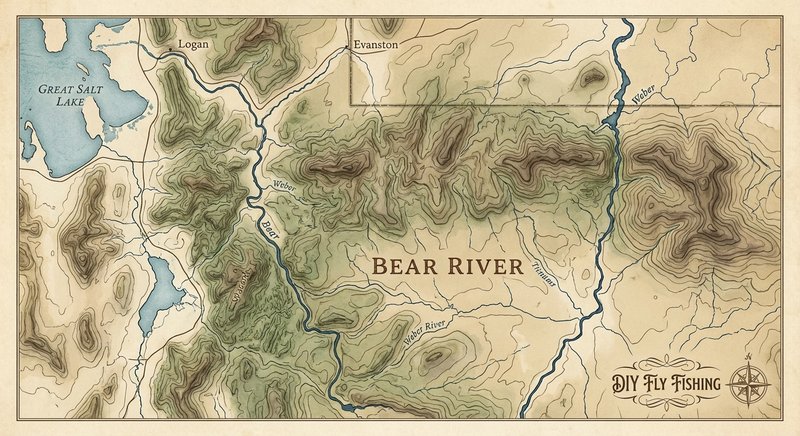
Bear River
Fly fishing in Utah · Beginner · Best seasons: Summer, Fall
Target Species
Brown Trout, Cutthroat Trout
About This Water
Northern Utah river with brown and cutthroat trout. Good access near Evanston.
Fishing Recommendations
The Bear River is a unique and rugged gem in the American West. Flowing from the Uinta Mountains, it makes a massive "U-turn" through Wyoming and Idaho before returning to Utah to empty into the Great Salt Lake. For the fly angler, the most productive and scenic sections reside in the upper reaches near the Utah/Wyoming border and the tailwater sections below the various impoundments.
Here is your comprehensive guide to fly fishing the Bear River in Utah.
🎣 Location Overview
The Bear River is the longest river in North America that does not reach an ocean. In Utah, it offers two distinct experiences:
- The Upper Bear (Uinta Mountains): High-gradient, freestone water surrounded by meadows and pine forests. This is classic "Blue Ribbon" pocket water and meadow meandering.
- The Lower/Middle Bear: Larger, more powerful water that can be murky at times but holds much larger fish.
What makes it special is the lack of crowds compared to the nearby Provo or Weber Rivers. It feels wilder, more remote, and offers a chance at the Bonneville Cutthroat Trout in their native drainage.
🐟 Target Species & Behavior
- Bonneville Cutthroat Trout: The crown jewel of the Bear. They are opportunistic, often colorful, and thrive in the colder, oxygenated stretches. They hold in slower seams, behind boulders, and under undercut banks.
- Brown Trout: Found primarily in the middle and lower stretches. These fish are aggressive and predatory. They tend to hold in deeper pools, under heavy woody debris, and near the banks during low light.
- Mountain Whitefish: Plentiful throughout the system. They fight hard and provide great action when the trout are being finicky.
Feeding Behavior: In the summer, these fish are "dry fly greedy," looking for terrestrials and stoneflies. In the fall, Browns become territorial and aggressive as they prepare for the spawn, while Cutthroats focus on high-calorie nymphs to bulk up for winter.
📅 Best Times to Fish
Optimal Seasons
- Summer (July - August): This is the prime window. Runoff typically subsides by late June. The water is clear, and the dry fly fishing is world-class.
- Fall (September - October): My personal favorite. The cottonwoods turn gold, the crowds vanish, and the Brown Trout are on the move. Streamer fishing is peak during this window.
Best Times of Day
- Summer: Morning (until 11:00 AM) and "the magic hour" (last two hours of light). Mid-day can be slow unless there is a terrestrial breeze.
- Fall: Mid-day is actually best. As the water warms slightly from 11:00 AM to 4:00 PM, the insects become active.
🪰 Recommended Flies & Techniques
Top Fly Patterns
- Dries: Chubby Chernobyl (Size 8-12, Orange or Royal), Stimulators, Parachute Adams (Size 14-18), and Hoppers (Dave’s or Pink Pookie).
- Nymphs: Pat’s Rubber Legs (Coffee/Black), Zebra Midges (Red or Black, Size 18-20), and Pheasant Tails (Flashback).
- Streamers: Gold or Black Sculpzilla, Wooly Buggers (Olive), and Sex Dungeon (for the big Browns).
Techniques
- The "Hopper-Dropper": This is the bread and butter of the Bear River. Use a buoyant Chubby Chernobyl as your indicator and hang a Beadhead Pheasant Tail or Hare's Ear 18–24 inches below it.
- High-Sticking/Euro Nymphing: In the pocket water of the Upper Bear, keeping your line off the conflicting currents is key to a natural drift.
- Stripping Streamers: In the fall, cast tight to the banks and use a "twitch-twitch-pause" retrieve to trigger the predatory instinct of the Browns.
💡 Pro Tips & Local Knowledge
- Focus on the High Country: The stretch near Whitney Reservoir and the Stillwater Fork offers some of the purest Cutthroat fishing in the state. It’s high elevation, so bring a jacket even in July.
- The "Undercut" Strategy: The Bear River meanders through many cattle ranches. The fish love to sit deep under the grassy undercut banks. If you aren't casting within 3 inches of the grass, you’re missing the fish.
- Watch the Flow: The Bear is heavily diverted for irrigation. Check USGS gauges before you go. If the water looks like "chocolate milk," head further upstream toward the headwaters where the water clears faster.
⚠️ Important Information
Access
- Public vs. Private: Much of the Bear River flows through private ranch land. In Utah, the law regarding stream access is currently in flux, but generally, you must stay within the "ordinary high water mark" if you accessed via a public point. Always respect "No Trespassing" signs.
- Key Access Points: Uinta National Forest (Upper Bear), and various BLM or DWR access points near Woodruff and Randolph.
Regulations & Permits
- License: A valid Utah Fishing License is required.
- Limits: Check the current Utah Big Game & Fishing Proclamation. Some sections have specific "Artificial Fly/Lure Only" rules or restricted harvest limits for Cutthroat Trout.
Special Considerations
- Wildlife: This is moose and bear country. Keep your eyes peeled, especially when walking through thick willows.
- Wading: The Upper Bear is easy wading, but the middle sections can have "slippery bowling ball" rocks. Wading boots with studs and a staff are highly recommended.
Guide’s Final Word: The Bear River isn't as famous as the Green or the Provo, and that is its greatest strength. If you want a day of solitude with native trout that have rarely seen a fly, this is your river. Tight lines!
Bug Hatches & Matching Flies
| Hatch | Type | Peak months | Time of day | Hook sizes | Matching flies |
|---|---|---|---|---|---|
| Blue Winged Olive Baetis spp. | mayfly | April, May, September, October | Late Morning/Afternoon | #18-22 | RS2 #18-22, Parachute Adams #18-22, Pheasant Tail #18-20 |
| Salmonfly Pteronarcys californica | stonefly | June | All Day | #4-8 | Rogue River Stone #4-8, Pats Rubber Legs #6-8, Chubby Chernobyl #6-10 |
| Pale Morning Dun Ephemerella excrucians | mayfly | June, July | Late Morning | #14-18 | PMD Sparkle Dun #16-18, Split Case PMD #16-18, Trigger Finger PMD #16-18 |
| Golden Stonefly Hesperoperla pacifica | stonefly | June, July | Morning/Evening | #8-12 | Golden Chubby Chernobyl #8-12, Iron Lotus #12-14, Halfback #10-12 |
| Mother's Day Caddis Brachycentrus occidentalis | caddis | May | Late Afternoon/Evening | #14-16 | Peacock Caddis #14-16, LaFontaine's Deep Sparkle Pupa #14-16, Elk Hair Caddis #14-16 |
| Trico Tricorythodes | mayfly | August, September | Early Morning | #20-24 | Trico Spinner #20-24, Griffith's Gnat #20-22, Sunken Trico Spinner #20-22 |
| Grasshoppers Orthoptera | terrestrial | July, August, September | Mid-day/Afternoon | #8-12 | Morrish Hopper #8-12, Parachute Hopper #10-12, Thunder Thighs Hopper #10 |
| Zebra Midge Chironomidae | midge | January, February, March, December | All Day | #18-24 | Zebra Midge #18-22, Palomino Midge #20-22, Mercury Midge #20-24 |