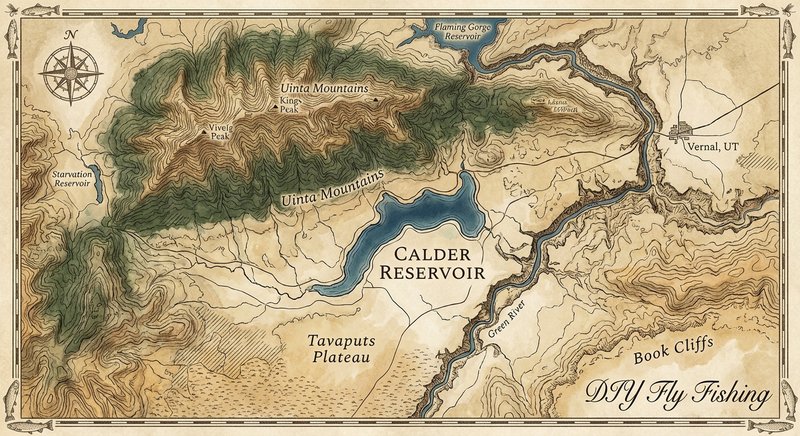
Calder Reservoir
Fly fishing in Utah · Beginner · Best seasons: Summer, Fall
Target Species
Tiger Trout, Rainbow Trout
About This Water
Remote northeast Utah reservoir. Tiger trout and rainbow fishing.
Fishing Recommendations
Calder Reservoir is one of Utah’s premier trophy stillwater destinations. Tucked away on the Diamond Mountain plateau north of Vernal, this high-country reservoir is managed specifically to produce large, aggressive trout. It is not a place for high catch volumes; rather, it is a place where you hunt for the fish of a lifetime.
🎣 Location Overview
Calder Reservoir is a high-elevation impoundment (approx. 8,000 ft) characterized by its remote, windswept beauty. What makes Calder special is its Trophy Management. The Utah Division of Wildlife Resources (UDWR) manages this water with restrictive regulations to ensure trout reach impressive sizes.
The water is generally clear but rich in nutrients, leading to heavy weed growth by mid-summer. This creates a massive biomass of insects and scuds, allowing fish to grow at a staggering rate. Anglers love Calder for the "stalking" nature of the fishing—often sighting large cruisers along the weed lines or watching a massive Tiger Trout shadow a streamer.
🐟 Target Species & Behavior
- Tiger Trout: These sterile hybrids (Brown Trout x Brook Trout) are the kings of Calder. They are highly predatory and aggressive. They tend to patrol the edges of weed beds and rock piles, looking for smaller fish or large leeches. They are known for their spectacular markings and their "slash and grab" strike.
- Rainbow Trout: The rainbows here are thick-bodied and powerful. Unlike the Tigers, which focus on meat, the Rainbows often key in on the massive populations of scuds (freshwater shrimp) and midges. They can be found cruising the shallow flats in the morning and retreating to deeper water near the dam as the sun rises.
📅 Best Times to Fish
- Summer (Late June – August): This is the prime time for insect activity. Damselfly migrations in July are legendary here. However, be prepared for afternoon winds and the "summer doldrums" during mid-day heat.
- Fall (September – October): This is arguably the best time for Trophy Tigers. As water temperatures drop, Tiger Trout become exceptionally aggressive, preparing for a "spawn" they can’t actually complete. They move into shallower water and hit streamers with reckless abandon.
- Prime Windows: Low light is your best friend. The first two hours of daylight and the "magic hour" before sunset are when the largest fish move into the shallows (within 10 feet of the bank) to feed.
🪰 Recommended Flies & Techniques
Techniques
- Indicator Nymphing: Suspend flies 12–18 inches above the weed tops. This is the most effective way to target Rainbows.
- The "Slow Strip": Using an intermediate (slow-sink) line to pull streamers or damselfly nymphs just above the vegetation.
- Sight Casting: On calm mornings, walk the banks and look for cruising fish. Lead them by 5-10 feet with a soft presentation.
Top Fly Patterns
- Streamers:
- Balanced Leeches (Black, Olive, or Wine) – deadly under an indicator.
- Baby Trout/Chub imitations (Size 4-8) – for the big Tigers.
- Woolly Buggers (Olive/Orange or White) – classic and effective.
- Nymphs:
- Scuds (Size 12-16) in Olive, Pink, or Orange. The fish here are "scud-fed" and fat.
- Zebra Midges (Size 16-20) in Red or Black.
- Damselfly Nymphs (Size 10-14) – long, olive, and wiggly.
- Dry Flies:
- Chubby Chernobyls (Size 10-12) – work well in the fall as terrestrials.
- Griffith’s Gnat – for midge clusters on calm evenings.
💡 Pro Tips & Local Knowledge
- The Weed Edge is the Kitchen: Don’t just cast into the middle of the lake. The "transition zone" where the bottom drops from 4 feet to 10 feet (usually marked by the end of the visible weeds) is where the fish live.
- The "Diamond Mountain Twitch": When fishing a damselfly nymph, use very short, 1-inch erratic strips. Damselflies swim with a rhythmic side-to-side wiggle that trout recognize instantly.
- Stealth Matters: Because the water is clear and the fish are large (and therefore older/wiser), use long leaders. A 12-foot 4x leader is a good starting point. Avoid wearing bright colors while walking the banks.
- Wind is Your Friend: A "Chop" on the water breaks up the surface and makes the fish less spooky. If it’s dead calm, fishing becomes much more difficult.
⚠️ Important Information
- Regulations: Calder is a Trophy Water. Currently, the limit is 1 trout over 22 inches. All trout under 22 inches must be immediately released.
- Gear Restrictions: Artificial flies and lures only. No bait (corn, worms, PowerBait) is allowed.
- Access: The road to Calder (Diamond Mountain Rd) is gravel. It is generally well-maintained but can become a muddy mess after heavy rain or early spring snowmelt. A high-clearance vehicle is recommended but not always required in dry weather.
- Facilities: This is a primitive area. There are vault toilets, but no running water or trash service. Pack out what you pack in.
- Weather: Diamond Mountain is notorious for sudden thunderstorms. If you see lightning or the wind kicks up violently, get off the water immediately.
Always check the current Utah Fishing Guidebook before your trip, as regulations can change annually.
Bug Hatches & Matching Flies
| Hatch | Type | Peak months | Time of day | Hook sizes | Matching flies |
|---|---|---|---|---|---|
| Chironomid Chironomidae | midge | May, June, September | All Day | #12-20 | Chironobone #14-18, Zebra Midge #16-20, Snowcone Midge #12-16 |
| Callibaetis Callibaetis | mayfly | June, July, August | Morning/Afternoon | #12-16 | Parachute Adams #14-16, Callibaetis Nymph #14-16, RS2 #16 |
| Damselfly Enallagma | other | June, July | Morning/Afternoon | #10-14 | Marabou Damsel #10-12, Adult Damsel #12-14 |
| Scud Gammarus | other | April, May, October | All Day | #12-16 | Ray Charles #14-16, Orange Scud #12-14 |
| Traveling Sedge Hesperophylax | caddis | July, August | Evening | #8-12 | Goddard Caddis #10-12, Mikulak Sedge #8-10 |
| Water Boatman Corixidae | other | September, October | Afternoon | #14-16 | Water Boatman #14-16, Prince Nymph #14-16 |
| Dragonfly Anisoptera | other | July, August | Afternoon | #4-8 | Dragonfly Nymph #6-10, Woolly Bugger (Olive) #6-10 |
| Terrestrials Formicidae/Gryllidae | terrestrial | August, September | Afternoon | #10-16 | Chernobyl Ant #10-12, Black Foam Ant #14-16, Dave's Hopper #10-12 |