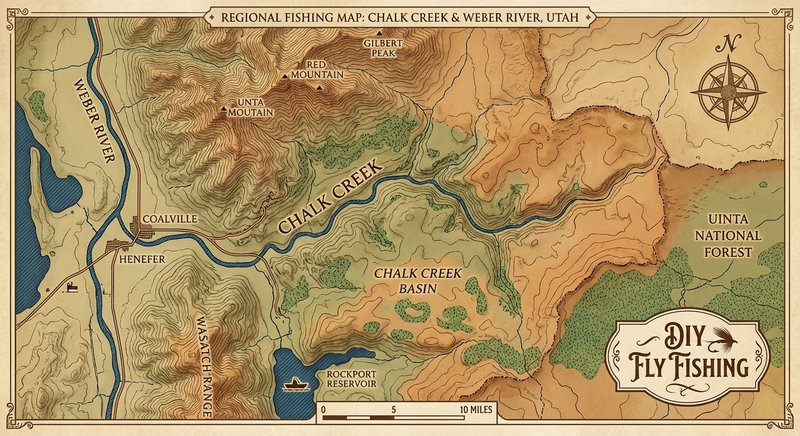
Chalk Creek
Fly fishing in Utah · Beginner · Best seasons: Summer, Fall
Target Species
Brown Trout, Cutthroat Trout
About This Water
Northern Utah stream near Coalville. Wild brown trout in scenic canyon.
Fishing Recommendations
Chalk Creek is one of Northern Utah’s most underrated gems—a classic, small-to-medium-sized mountain stream that offers intimate fishing and surprisingly aggressive trout. Flowing from the high Uinta Mountains down through the red-rock canyons of Summit County before joining the Weber River at Echo Reservoir, it is a quintessential Western freestone experience.
Here is your comprehensive guide to fishing Chalk Creek, Utah.
🎣 Location Overview
Chalk Creek is a high-gradient stream characterized by a mix of pocket water, deep undercut banks, and classic riffle-run-pool sequences. What makes it special is its wild character. Unlike the highly pressured tailwaters of the nearby Provo or Weber rivers, Chalk Creek offers a more "rustic" experience where the fish are opportunistic and the scenery is spectacular.
The water is generally clear but can carry a slight milky tint (hence the name "Chalk") due to the geological formations it carves through. Anglers love it because it rewards stealth and accurate casting rather than complex technical midge fishing. It is a place where a well-placed dry fly is almost always rewarded.
🐟 Target Species & Behavior
- Brown Trout: These are the kings of the lower and middle sections. They are opportunistic but wary. They favor the deep undercut banks and the "dark water" beneath overhanging willows.
- Cutthroat Trout (Bonneville): Found more frequently in the middle and upper reaches. These are the native stars of the system. They are often found in the faster "bubble lines" and at the heads of pools.
- Behavior: Because the creek is relatively small, these fish are "spooky." They have a high metabolism due to the cold, moving water, meaning they feed aggressively during hatches. However, a heavy footfall on the bank will send them scurrying for cover.
📅 Best Times to Fish
Optimal Seasons
- Summer (July – August): This is the prime window. Once the spring runoff subsides (usually by late June), the creek settles into a perfect flow. This is the era of the Hopper-Dropper.
- Fall (September – October): My personal favorite. The Brown trout begin moving and become highly territorial ahead of the spawn. The cottonwoods turn gold, and the Blue Winged Olive (BWO) hatches can be prolific.
Best Times of Day
- Summer: Early morning (6 AM – 10 AM) and late evening (6 PM – Dark). The midday sun can push fish into the deeper shadows.
- Fall: Mid-morning to mid-afternoon. As the water cools, the "bankers hours" (10 AM – 3 PM) provide the best insect activity.
🪰 Recommended Flies & Techniques
Top Fly Patterns
- Dry Flies:
- Terrestrials: Fat Albert (Size 10-14), Amy’s Ant, or Dave’s Hopper.
- Attractors: Royal Wulff, Stimulator (Orange or Yellow), and Humpy.
- Mayflies: Parachute Adams (14-18) and Elk Hair Caddis (14-16).
- Nymphs:
- Attractors: Prince Nymph (14-16), Pheasant Tail (16-18), and Zebra Midge (18-20) in red or black.
- Droppers: Copper John (16) or a simple Pat’s Rubber Legs for the deeper holes.
- Streamers:
- Small Wooly Buggers (Olive or Black) or a Thin Mint.
Techniques
- The Hopper-Dropper: This is the bread and butter of Chalk Creek. Use a buoyant foam hopper as your indicator and hang a bead-head nymph 18–24 inches below it.
- Dapping & Tight-Lining: Because of the heavy willow brush, you often won't have room for a backcast. Use a "bow and arrow" cast or simply drop the fly over the bushes into the pocket water.
- Stealth Approach: Fish upstream. If you walk downstream, the fish will see you long before you see them.
💡 Pro Tips & Local Knowledge
- The "Undercut" Strategy: The biggest Browns in Chalk Creek live under the banks. Don't just fish the middle of the stream. Cast your fly so it drifts within an inch of the grassy bank.
- Watch the Silt: The bottom can be silty in some stretches. If you wade clumsily, you’ll send a plume of mud downstream that alerts every fish in the pool below you. Move slowly and stay on the gravel when possible.
- Target the "Soft Spots": In the faster canyon sections, look for the "soft" water behind large boulders. One or two casts is usually all it takes to see if a Cutthroat is home.
- Equipment: A 7.5-foot to 8.5-foot 4-weight rod is ideal. Anything longer will get tangled in the willows; anything heavier is overkill for these fish.
⚠️ Important Information
Access (Crucial!)
The biggest challenge on Chalk Creek is Private Property. Much of the land surrounding the creek is owned by long-standing ranching families.
- Public Access: There are several UDWR Walk-In Access (WIA) areas. You must check the Utah DNR WIA website for current maps and to print your (free) seasonal WIA authorization.
- Bridge Access: In Utah, you can fish private land if you stay "within the ordinary high-water mark," but getting to the water often requires crossing private land. Stick to public bridges or WIA areas to avoid trespassing issues.
Regulations
- A valid Utah Fishing License is required.
- Check current UDWR proclamations, as some sections may have specific limit restrictions (though most anglers choose Catch & Release here to preserve the wild populations).
- Pack it in, pack it out: This area is sensitive ranch land; please respect the locals by leaving no trace.
Special Considerations
- Moose & Cattle: You are likely to encounter both. Give moose a very wide berth—they are more dangerous than bears. If cattle are grazing near the banks, try to move around them quietly to keep the landowners happy.
Bug Hatches & Matching Flies
| Hatch | Type | Peak months | Time of day | Hook sizes | Matching flies |
|---|---|---|---|---|---|
| Blue Winged Olive (BWO) Baetis spp. | mayfly | April, May, September, October | Mid-day/Afternoon | #18-22 | Parachute Adams #18-22, RS2 #20-22, Pheasant Tail Nymph #18-20 |
| Western March Brown Rhithrogena morrisoni | mayfly | April, May | Afternoon | #12-14 | March Brown Dun #12-14, Gold Ribbed Hare's Ear #12-14 |
| Mother's Day Caddis Brachycentrus occidentalis | caddis | May | Morning/Afternoon | #14-16 | Elk Hair Caddis (Peacock body) #14-16, LaFontaine's Deep Sparkle Pupa #14-16 |
| Pale Morning Dun (PMD) Ephemerella excrucians | mayfly | June, July | Morning/Early Afternoon | #16-18 | PMD Sparkle Dun #16-18, Split Case PMD #16-18, Trigger Finger PMD #16-18 |
| Golden Stonefly Hesperoperla pacifica | stonefly | June, July | Morning/Evening | #8-12 | Chubby Chernobyl (Gold) #8-12, Pat's Rubber Leg Stone #8-12, Rogue River Stone #10-12 |
| Yellow Sally Isoperla spp. | stonefly | June, July, August | Afternoon/Evening | #14-16 | Yellow Sally Stone #14-16, Iron Lotus (Yellow) #14-16 |
| Grasshoppers Orthoptera | terrestrial | July, August, September | Mid-day/Afternoon | #8-14 | Parachute Hopper #10-14, Morrish Hopper #8-12 |
| Midges Chironomidae | midge | January, February, March, December | Mid-day | #20-24 | Zebra Midge #20-22, Griffith's Gnat #20-22, Morgan's Midge #22-24 |
| Spotted Sedge Hydropsyche spp. | caddis | July, August | Evening | #14-18 | Elk Hair Caddis (Tan) #14-18, Holy Grail Caddis #16-18 |