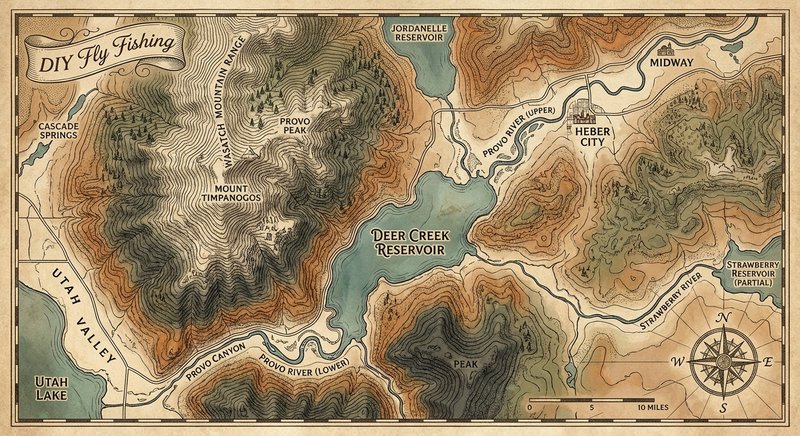
Deer Creek Reservoir
Fly fishing in Utah · Beginner · Best seasons: Spring, Summer, Fall, Winter
Target Species
Rainbow Trout, Smallmouth Bass, Walleye
About This Water
Popular front range reservoir with rainbow trout and bass. Good ice fishing.
Fishing Recommendations
Deer Creek Reservoir is one of Utah’s most versatile and popular fisheries. Tucked into the beautiful Heber Valley with the stunning backdrop of Mount Timpanogos, it serves as a massive holding tank between the Upper and Middle sections of the Provo River. For the fly angler, it offers a "choose your own adventure" experience ranging from technical midge sipping to aggressive predator hunts.
🎣 Location Overview
Deer Creek is a mid-elevation reservoir (approx. 5,400 ft) characterized by its steep rocky shorelines on the west, sprawling mudflats near the Charleston inlet to the north, and deep, cool waters near the dam. What makes it special is the interplay between the Provo River and the lake.
While many view it as a "boater's lake," fly anglers find success by targeting the transition zones where the river enters and the rocky points where the structure holds heat and baitfish. It is notorious for its afternoon winds—the "Deer Creek Breeze"—which can be a challenge for casting but often triggers a feeding frenzy by pushing plankton and baitfish toward the windward shores.
🐟 Target Species & Behavior
Rainbow Trout
- Behavior: Mostly stocked, but they grow quickly. In the spring, they cruise the shorelines in 5–15 feet of water. As the water warms in summer, they retreat to the thermocline (20–30 feet deep).
- Feed: Chironomids (midges), callibaetis, and small perch fry.
Smallmouth Bass
- Behavior: The "rock stars" of Deer Creek. They hug the rip-rap near the dam and the rocky points throughout the main body. They become highly aggressive when the water hits 55°F.
- Feed: Crayfish are the primary forage, followed by Utah Chubs and young-of-the-year perch.
Walleye
- Behavior: The most elusive target on a fly. They are light-sensitive and stay deep during the day. They move into the shallows (under 10 feet) during the "magic hour" of dusk and dawn to hunt.
- Feed: Heavily piscivorous (fish-eaters). They focus on perch, chubs, and even small trout.
📅 Best Times to Fish
- Spring (March – May): Prime Time for Trout. Post-ice-off is incredible for Rainbows and the occasional large Brown Trout near the Charleston inlet. Late spring (May) is the best window for Smallmouth as they move shallow to spawn.
- Summer (June – August): Best for Smallmouth Bass. Fly fishing is most productive from sunrise until 10:00 AM. After that, the sun and boat traffic push fish deep. Use sinking lines to reach the 15–25 foot range.
- Fall (September – November): The Trophy Window. As water temperatures drop, Walleye and Bass move shallow again. This is the best time to throw large streamers for "the big one."
- Winter (December – February): Mostly an ice-fishing destination. However, the open water near the Provo River inlet (Charleston) can be fished with nymphs if the ice hasn't closed it in.
🪰 Recommended Flies & Techniques
For Rainbow Trout
- Patterns: Zebra Midges (#18–22), Iron Lotus (#16–18), Balanced Leeches (Black or Olive), and Pheasant Tails.
- Technique: Static Nymphing. Use a long leader (12–15 feet) under a slip-indicator or a "midge tip" fly line. Hang a midge or leech 6–10 feet down and let the wave action provide the movement.
For Smallmouth Bass
- Patterns: Clouser Minnows (Chartreuse/White), Near Nuff Crayfish, Boogle Bugs (Poppers) for low light, and Complex Twist Buggers.
- Technique: Stripping Streamers. Use an Intermediate or Type 3 sinking line. Cast toward rocky points, let the fly sink to the bottom, and use erratic, short strips to mimic a fleeing crawfish.
For Walleye
- Patterns: Game Changers (White), Bunny Leeches (Large), and Murdich Minnows.
- Technique: Night Tactics. Use a heavy sink-tip line. You must get the fly near the bottom. Slow, steady strips are more effective for Walleye than the fast, erratic strips used for bass.
💡 Pro Tips & Local Knowledge
- The Charleston Flats: The northern end where the Provo River enters is a biological engine. In early spring, look for "cruising" trout in water as shallow as 3 feet. Stealth is key here; use a long leader to avoid lining the fish.
- The Wind is Your Friend: When the afternoon wind kicks up, don't head for the ramp immediately. The "chop" oxygenates the water and hides your profile. Focus on the shores where the wind is blowing toward the land; trout will often be right in the surf eating disoriented insects.
- The Island & Walls: The "Island" area and the steep western cliffs are Smallmouth havens. If you aren't getting hits, you aren't deep enough. Switch to a faster sinking line (Type 5 or 6) to stay in the strike zone.
- Color Palette: In Deer Creek, White and Chartreuse are the "money" colors for baitfish imitations, while Orange and Rusty Brown are essential for crayfish patterns.
⚠️ Important Information
- Access: Deer Creek State Park provides the best access but requires a daily vehicle fee. The Charleston Bridge area offers walk-in access to the northern flats.
- Regulations: A valid Utah Fishing License is required. Deer Creek is generally open to bait, so be aware of gear anglers. Check the current Utah Fishing Guidebook for specific limit changes.
- Invasive Species (AIS): Deer Creek is a known Quagga Mussel water. If you are using a float tube, pontoon, or boat, you must follow decontamination protocols (Clean, Drain, Dry) to prevent spreading them to other Utah waters like the Jordanelle or Strawberry.
- Safety: The reservoir is popular with kite-surfers and wakeboarders. For a peaceful fly fishing experience, aim to be off the main water by 11:00 AM during summer weekends.
Bug Hatches & Matching Flies
| Hatch | Type | Peak months | Time of day | Hook sizes | Matching flies |
|---|---|---|---|---|---|
| Chironomids Chironomidae | midge | April, May, September, October | All Day | #12-22 | Zebra Midge #16-20, Ice Cream Cone #12-16, Griffith's Gnat #18-22 |
| Callibaetis Callibaetis nigritus | mayfly | June, July, August | Morning/Afternoon | #12-16 | Callibaetis Spinner #14-16, Hare's Ear Nymph #12-16, RS2 #14-16 |
| Damselfly Enallagma | terrestrial | June, July | Morning/Afternoon | #10-14 | Marabou Damsel #10-12, Adult Damsel #12-14, Swimming Damsel Nymph #10-14 |
| Traveling Sedge Hesperophylax | caddis | July, August | Evening | #8-12 | Elk Hair Caddis #10-14, Goddard Caddis #8-12, Soft Hackle #12-14 |
| Water Boatman Corixidae | terrestrial | September, October | Afternoon | #14-18 | Water Boatman #14-16, Prince Nymph #14-18, Backswimmer #12-14 |
| Scud Gammarus | terrestrial | March, April, October, November | All Day | #12-18 | Ray Charles #14-18, Rainbow Scud #12-16, Orange Scud #14-16 |
| Terrestrials Formicidae / Gryllidae | terrestrial | July, August, September | Afternoon | #8-16 | Parachute Hopper #8-12, Black Foam Ant #14-16, Chernobyl Ant #8-12 |
| Daphnia Daphnia pulex | terrestrial | May, June | All Day | #16-20 | Orange Blob #14-16, Daphnia Cluster #16-20, Egg Pattern #16-18 |