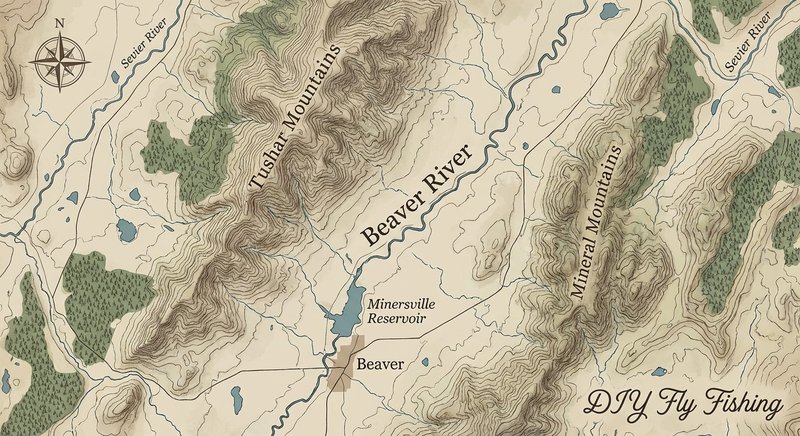
Beaver River
Fly fishing in Utah · Beginner · Best seasons: Summer, Fall
Target Species
Brown Trout, Rainbow Trout
About This Water
Southern Utah stream with wild brown trout. Beaver Canyon offers good access.
Fishing Recommendations
🎣 Fly Fishing Guide: The Beaver River, Utah
The Beaver River is one of Southern Utah’s best-kept secrets. Flowing out of the Tushar Mountains—Utah’s third-highest range—this river offers a diverse experience, from high-gradient mountain pocket water to meadow-style meandering runs. Unlike the crowded banks of the Provo or Green Rivers, the Beaver offers solitude, stunning scenery, and eager trout.
🎣 Location Overview
The Beaver River is characterized by two distinct sections: the Upper Beaver (above the town of Beaver) and the Lower Beaver (below the Minersville Reservoir).
- The Upper Section: This is classic freestone mountain water. It’s rugged, fast, and rocky. The river is relatively small here, shaded by willows, cottonwoods, and ponderosa pines. Anglers love it for the "wild" feel and the high density of fish.
- The Tailwater (Lower): Below Minersville Reservoir, the river becomes more of a desert tailwater. While flow-dependent, this section can produce larger fish but is more susceptible to irrigation demands.
What makes it special is the accessibility combined with the lack of pressure. You can fish right off Highway 153 (the Beaver Canyon Scenic Byway) but still feel miles away from civilization.
🐟 Target Species & Behavior
The Beaver River is primarily a Brown Trout and Rainbow Trout fishery.
- Brown Trout: These are the kings of the Beaver. In the upper sections, they hide in the deep undercut banks and behind large boulders. They are opportunistic but can be spooky in the clearer, slower meadow sections.
- Rainbow Trout: Frequently stocked in the canyon reaches to supplement the wild population. They tend to hold in the faster riffles and at the heads of pools.
- Behavior: These fish are generally "active" feeders. Because the growing season is shorter at high elevations, they rarely pass up a well-presented meal. They hold tightly to structure—if you aren't casting near the wood or the rocks, you're missing the fish.
📅 Best Times to Fish
Optimal Seasons
- Summer (Late June – August): This is the prime window. As the snowpack in the Tushars melts off (usually by late June), the river settles into a perfect flow. This is peak dry-fly season.
- Fall (September – October): My personal favorite. The Brown trout become aggressive as they prepare to spawn. The water is low and clear, and the canyon colors are spectacular.
Best Times of Day
- Summer: Early morning (6:00 AM – 10:00 AM) and "the magic hour" before dusk. Mid-day can be productive with terrestrials.
- Fall: The window shifts to mid-morning through late afternoon as the water warms up.
🪰 Recommended Flies & Techniques
Top Fly Patterns
- Dry Flies:
- Stimulators (Orange or Yellow, size 12-16) – Perfect for the fast pocket water.
- Parachute Adams (size 14-18) – The gold standard for any Utah water.
- Elk Hair Caddis (size 14-16) – Essential for evening hatches.
- Hopper Patterns (Morrish Hopper, size 10-12) – Deadly in August and September.
- Nymphs:
- Beaded Zebra Midge (Red or Black, size 18-22).
- Pheasant Tail (size 16-18) – Works year-round.
- Gold-Ribbed Hare's Ear (size 14-16).
- Streamers:
- Woolly Buggers (Olive or Black, size 8-12) – Great for the deeper pools in the canyon.
Effective Techniques
- Dry-Dropper: This is the most effective way to fish the Beaver. Use a buoyant Stimulator or Hopper as your "indicator" and hang a Pheasant Tail or Zebra Midge 18-24 inches below it.
- High-Sticking (Euro-style lite): In the rocky canyon sections, use a short line to keep your nymphs bouncing along the bottom of the pockets without your fly line getting caught in the conflicting currents.
- The "Plop" Presentation: When fishing terrestrials (hoppers) near the banks, don't be afraid to let the fly land with a little "splat." It gets the attention of the Browns.
💡 Pro Tips & Local Knowledge
- Stay Mobile: Don't spend two hours in one hole. The Beaver is a "cover water" river. Fish a spot, catch the one or two active fish, and move upstream.
- The "Secret" Stretches: Check the areas around Little Cottonwood Campground and Little Reservoir. While these areas get some camping pressure, the river stretches between the established campgrounds often see very few flies.
- Watch the Stealth: Because the water is clear and often small, your shadow is your worst enemy. Fish upstream, stay low, and wear drab-colored clothing.
- Bridge Pools: Every bridge crossing on Highway 153 has a decent pool beneath it. These are easy access but often hold surprisingly good fish that feed on whatever falls off the road.
⚠️ Important Information
Access
- Highway 153: Most of the upper river is within the Fishlake National Forest, providing excellent public access. There are numerous pull-offs and campgrounds.
- Private Property: Be mindful of the lower sections near the town of Beaver; much of the river flows through private agricultural land. Always look for "Walk-in Access" signs provided by the Utah DWR.
Regulations
- Licensing: You must have a valid Utah Fishing License.
- General Rules: Most of the upper Beaver follows general state regulations (4 fish limit), but always check the current Utah Big Game and Fishing Proclamation, as some specific stretches or nearby reservoirs (like Minersville) have special tackle restrictions (artificial fly/lure only) and size limits.
Special Considerations
- Wildlife: This is high country. Be aware of moose and black bears.
- Wading: The rocks in the Beaver are notoriously "greasy." Felt soles or studs are highly recommended to avoid a dunking.
- Hydration: Beaver sits at a high elevation. Drink more water than you think you need.
Bug Hatches & Matching Flies
| Hatch | Type | Peak months | Time of day | Hook sizes | Matching flies |
|---|---|---|---|---|---|
| Blue Winged Olive Baetis spp. | mayfly | March, April, October, November | Midday | #18-22 | RS2 #18-22, Parachute Adams #18-22, Pheasant Tail Nymph #18-20 |
| Pale Morning Dun Ephemerella excrucians | mayfly | June, July | Late Morning to Afternoon | #16-18 | PMD Sparkle Dun #16-18, Split Case PMD #16-18, Trigger Finger PMD #16 |
| Western Green Drake Drunella doddsii | mayfly | July | Afternoon | #10-12 | Green Drake Hairwing #10-12, Drake Cripple #10-12, 20 Incher Stone #10-12 |
| Spotted Sedge / Tan Caddis Hydropsyche spp. | caddis | June, July, August | Evening | #14-18 | Elk Hair Caddis #14-18, LaFontaine's Deep Sparkle Pupa #14-16, Goddard Caddis #14-16 |
| Yellow Sally Isoperla spp. | stonefly | June, July | Late Afternoon/Evening | #14-16 | Yellow Sally Foam Dry #14-16, Iron Lotus #16, Jim's Yellow Sally #14 |
| Chironomids Chironomidae | midge | January, February, March, December | All Day | #18-24 | Zebra Midge #18-22, Griffith's Gnat #20-22, Morgan's Midge #20-22 |
| Trico Tricorythodes spp. | mayfly | August, September | Early Morning | #20-24 | Trico Spinner #20-24, Trico Dun #20-22 |
| Terrestrials (Grasshoppers/Ants) Orthoptera/Formicidae | terrestrial | July, August, September | Midday | #8-16 | Dave's Hopper #8-12, Parachute Ant #14-16, Chernobyl Ant #10-12 |