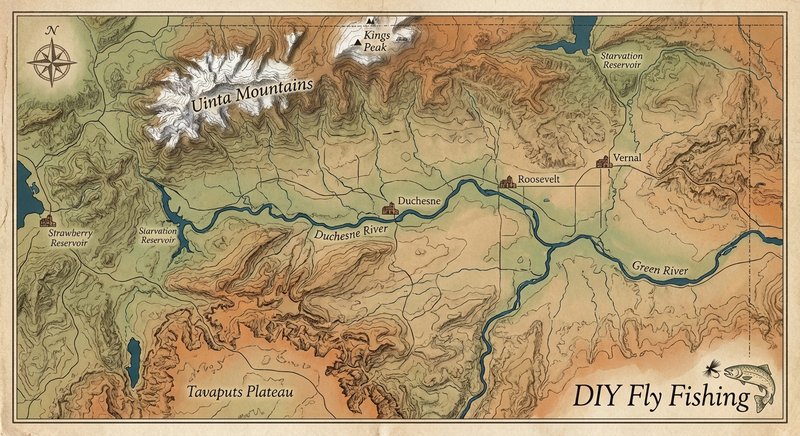
Duchesne River
Fly fishing in Utah · Beginner · Best seasons: Summer, Fall
Target Species
Brown Trout, Cutthroat Trout
About This Water
Uinta Basin stream with wild trout. Good fishing in upper reaches.
Fishing Recommendations
The Duchesne River is one of Utah’s premier blue-ribbon fisheries, offering a classic Rocky Mountain freestone experience. Tucked into the southern slopes of the Uinta Mountains, it provides a diverse range of water—from high-alpine meadows to rugged canyons—making it a favorite for anglers who appreciate wild fish and stunning scenery.
🎣 Location Overview
The Duchesne River is a gem of the Uinta Basin. What makes it special is its dual personality: the Upper Duchesne (above the town of Hanna) is a high-gradient mountain stream characterized by pocket water, plunge pools, and crystalline runs. As it moves toward Tabiona and the lower canyon, it matures into a larger, more technical fishery with deeper holes and undercut banks.
Anglers love it because it feels "wilder" than the crowded Provo or Green Rivers. It is a freestone river, meaning it is largely dependent on snowpack and natural runoff, leading to a dynamic environment where the riverbed and fishing conditions can change from year to year.
🐟 Target Species & Behavior
- Brown Trout: The stars of the lower reaches. These fish are predatory and territorial. They favor the deeper pools, undercut banks, and the shadows of large boulders. In the fall, they become aggressive and can be enticed by large streamers.
- Cutthroat Trout (Bear Lake & Colorado River strains): Primarily found in the upper reaches and the North Fork. These are opportunistic feeders. They hold in the "soft" water—the seams between fast and slow current—and are famous for rising to large, high-visibility dry flies.
- Mountain Whitefish: Often found in the deeper runs; they are strong fighters and a common "bonus" catch when nymphing.
📅 Best Times to Fish
Optimal Seasons
- Summer (Late June – August): This is the prime window for dry fly fishing. Once the spring runoff subsides (usually by late June), the river becomes clear and the insect activity explodes.
- Fall (September – October): My personal favorite. The crowds vanish, the Cottonwoods turn gold, and the Brown Trout begin their pre-spawn aggression. The water levels are low and technical, requiring a stealthy approach.
Best Times of Day
- Summer: Early morning (6 AM – 10 AM) for nymphing; late evening for the "evening rise" (Caddis hatches).
- Fall: Mid-day is best. As the water warms slightly under the afternoon sun, the fish become more active.
Prime Windows
The "Hopper-Dropper" window (August) is legendary here. When the mountain meadows dry out, grasshoppers become a primary food source, leading to some of the most exciting surface takes in the state.
🪰 Recommended Flies & Techniques
Top Fly Patterns
- Dry Flies: Stimulators (Orange/Yellow #10-14), Parachute Adams (#14-18), Elk Hair Caddis (#14-16), and the Chernobyl Ant or various foam hoppers in late summer.
- Nymphs: Zebra Midges (#18-22), Copper Johns (#14-16), and Prince Nymphs (#12-16). For the lower river, use a Sow Bug or Scud pattern.
- Streamers: Woolly Buggers (Olive or Black), Gold Ribbed Hare’s Ear streamers, or small articulated patterns like the "Baby Gonga" for bigger Browns.
Techniques
- Pocket Water Picking: In the upper sections, use a short line and "dap" your dry fly into small pockets behind rocks.
- Hopper-Dropper: A high-floating foam hopper with a 24-inch dropper to a bead-head nymph is the most effective way to cover water in July and August.
- Swing and Strip: In the lower canyon, swing streamers through deep runs or strip them tight against undercut banks.
💡 Pro Tips & Local Knowledge
- The "Stealth" Factor: Because the water is often crystal clear, the fish are spooky. Wear earthy tones, stay low to the bank, and try not to shadow the water.
- Focus on the Confluence: The area where the North Fork and West Fork meet is high-protein water. There is a lot of food moving through here, and the fish are often larger than average.
- Ignore the "Boring" Water at your Peril: On the Duchesne, some of the biggest Browns sit in shallow, unremarkable-looking riffles right above a deep hole.
- Check the Flows: Being a freestone, if there’s a heavy rain in the Uintas, the river can "blow out" (turn muddy) quickly. Always check the USGS gauges before driving out.
⚠️ Important Information
Access Information
- Upper River: Much of the upper river is within the Ashley National Forest, offering excellent public access.
- Lower River (Tabiona/Hanna): Be very careful here. Large sections of the river flow through private ranch land. Utah’s stream access laws can be complicated; always look for "Walk-In Access" (WIA) signs provided by the DWR, and when in doubt, stay in the riverbed or ask permission.
Regulations & Permits
- A valid Utah Fishing License is required.
- Check the current Utah Fishing Guidebook for specific bag limits. While some sections allow harvest, most serious fly anglers practice Catch and Release to preserve the wild trout populations.
- Be aware of the Uintah and Ouray Indian Reservation boundaries. If you cross onto tribal lands further downstream, a separate tribal fishing permit is required.
Special Considerations
- Wildlife: This is moose and bear country. Keep your eyes peeled, especially when hiking through thick willows.
- Wading: The rocks can be incredibly slick. Felt-soled boots or studs are highly recommended.
Bug Hatches & Matching Flies
| Hatch | Type | Peak months | Time of day | Hook sizes | Matching flies |
|---|---|---|---|---|---|
| Blue Winged Olive (BWO) Baetis | mayfly | March, April, September, October | Late Morning/Afternoon | #18-22 | Parachute Adams #18-22, RS2 #20-22, Pheasant Tail Nymph #18-20 |
| Mother's Day Caddis Brachycentrus occidentalis | caddis | May | Mid-day/Afternoon | #14-16 | Elk Hair Caddis #14-16, Peacock Caddis #16, LaFontaine's Deep Sparkle Pupa #14-16 |
| Pale Morning Dun (PMD) Ephemerella excrucians | mayfly | June, July, August | Late Morning/Afternoon | #16-18 | PMD Sparkle Dun #16-18, Split Case PMD #16-18, Quill Gordon #16 |
| Golden Stonefly Hesperoperla pacifica | stonefly | June, July | All Day/Evening | #8-12 | Chubby Chernobyl (Gold) #8-12, Pat's Rubber Leg #8-12, Golden Stone Nymph #10 |
| Yellow Sally Isoperla | stonefly | June, July | Late Afternoon/Evening | #14-16 | Yellow Sally Stimulator #14-16, Little Yellow Sloan #16, Iron Lotus #16 |
| Trico Tricorythodes | mayfly | August, September | Early Morning | #20-24 | Trico Spinner #20-24, Sunken Trico Spinner #22, Drowned Trico #22 |
| Grasshoppers Orthoptera | terrestrial | August, September | Mid-day/Afternoon | #8-14 | Parachute Hopper #10-12, Dave's Hopper #8-12, Morrish Hopper #10-14 |
| Midges Chironomidae | midge | January, February, March, December | Morning/Afternoon | #18-24 | Zebra Midge #18-22, Griffith's Gnat #20-22, Mercury Midge #20-24 |