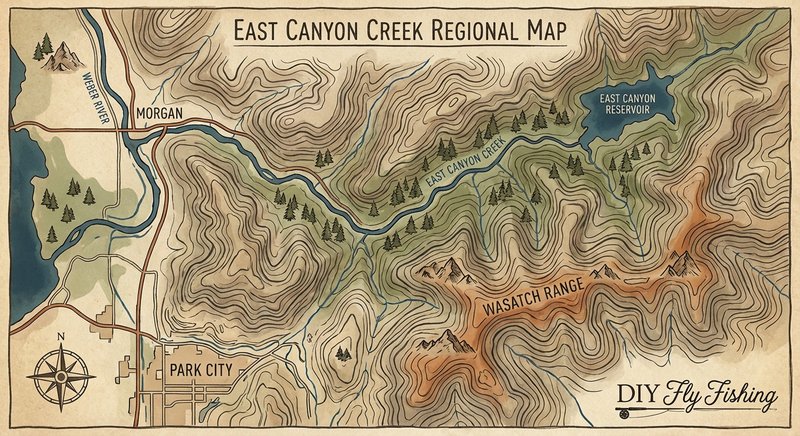
East Canyon Creek
Fly fishing in Utah · Beginner · Best seasons: Summer, Fall
Target Species
Brown Trout, Rainbow Trout
About This Water
Brown trout stream near Park City. Good fall fishing when browns spawn.
Fishing Recommendations
East Canyon Creek is a hidden gem tucked away in the Wasatch Mountains near Park City. While the nearby Provo and Weber Rivers get the lion’s share of the glory, East Canyon offers a more intimate, technical, and rewarding experience for the angler who enjoys small-stream tactics and stunning alpine scenery.
🎣 Location Overview
East Canyon Creek is a classic high-mountain tailwater and freestone hybrid. It flows from the mountains near Park City, meanders through high-country meadows, and eventually empties into East Canyon Reservoir.
What makes this water special is its character variety. The upper reaches near Jeremy Ranch are characterized by tight oxbow bends, deep undercut banks, and willow-lined shores. Below the reservoir, the canyon tightens into a rugged, boulder-strewn gorge. It is a "technical" fishery; the creek is relatively narrow (15–30 feet wide), meaning stealth and precise casting are more important than long-distance bombs. Anglers love it because it feels like a "wild" experience despite being only 30 minutes from Salt Lake City.
🐟 Target Species & Behavior
- Brown Trout: The dominant species in the creek. They are wild, wary, and highly territorial. You’ll find them tucked tight against undercut banks or hiding beneath overhanging willow branches. They are notorious for "sulking" during mid-day but become aggressive predators during low light.
- Rainbow Trout: Found more frequently in the stretches closer to the reservoir or in the faster, oxygenated riffles. They tend to be more opportunistic than the Browns and will often move into the center of the current to feed during a hatch.
- Behavior: Because the creek is small, the fish are incredibly spooky. A shadow on the water or a heavy footstep on the bank will send them scurrying. They feed heavily on midges in the morning, mayflies in the afternoon, and terrestrials in the heat of summer.
📅 Best Times to Fish
While you can fish it year-round, the windows you requested are when the creek truly shines:
- Summer (July – August): This is the season of the Terrestrial. As the surrounding hay fields and meadows dry out, grasshoppers, ants, and beetles become the primary protein source.
- Time of Day: Early morning (6 AM – 10 AM) for nymphing and Trico hatches; Late afternoon for hoppers.
- Fall (September – October): This is arguably the best time to be on the water. The Brown trout begin their pre-spawn aggression, and the Blue Winged Olive (BWO) hatches can be prolific on overcast days.
- Time of Day: 11 AM – 4 PM. The water needs to warm up slightly to trigger insect activity.
- Prime Window: The "Golden Hour" just before sunset in late August is legendary for "sippers" taking small dry flies in the flat water of the meadow stretches.
🪰 Recommended Flies & Techniques
Top Fly Patterns
- Dry Flies:
- Terrestrials: Fat Albert (size 10-14), Dave’s Hopper (size 12), and Black Foam Ants (size 16-18).
- Mayflies: Parachute Adams (size 16-20), RS2 (Grey or Olive, size 18-22), and Sparkle Duns.
- Nymphs:
- Zebra Midge (Red or Black, size 18-22).
- Pheasant Tail (Flashback, size 16-20).
- Frenchie or Perdigon (size 16-18) for the faster pocket water.
- Streamers:
- Wooly Buggers (Olive or Black, size 8-12).
- Near Nuff Sculpin (the creek has a high sculpin population).
Techniques & Presentation
- The "Hopper-Dropper": In the summer, run a buoyant hopper pattern with a small Pheasant Tail or Zebra Midge dropped 18-24 inches below it. This allows you to cover two zones and acts as a strike indicator.
- Stealth Approach: Stay low. Kneel if you have to. Cast upstream and keep your shadow off the pools.
- The "Reach Cast": Because the creek has complex currents and many bends, mastering the reach cast is essential to get a drag-free drift before your line gets pulled by the faster center current.
💡 Pro Tips & Local Knowledge
- The Willow Gap: Many anglers skip the thick willow sections because they are hard to cast in. This is a mistake. If you can master the "bow and arrow" cast, you will find the largest Browns in these "un-fishable" holes that never see a fly.
- Focus on the Under-Cuts: East Canyon Creek is deep on the bends. The fish aren't always in the middle; they are often literally under your feet beneath the sod banks.
- Flow Rates: Always check the USGS gauges. If the flow is below 15-20 CFS, the fish become extremely stressed and spooky. The "sweet spot" for fishing is usually between 30 and 60 CFS.
- Color Palette: In the fall, switch to orange or yellow streamers. The Browns become highly territorial and will strike out of aggression rather than hunger.
⚠️ Important Information
- Access:
- Upper Creek: Much of the meadow water near Jeremy Ranch is private, but there are several designated public access points (look for the "Walk-in Access" signs provided by the Utah DWR).
- Lower Creek: Below the East Canyon Reservoir dam, there is public access through the canyon, though the terrain is much steeper and more rugged.
- Regulations:
- A valid Utah Fishing License is required.
- Check current DWR proclamations, as some stretches may have specific bait or harvest restrictions depending on the time of year.
- Special Considerations:
- Moose Warning: This area is prime moose habitat. They are frequently in the willows and can be aggressive. Give them a wide berth.
- Temperature: During late July and August, water temperatures can spike. If the water hits 68°F (20°C), stop fishing to protect the trout from exhaustion-related mortality.
Bug Hatches & Matching Flies
| Hatch | Type | Peak months | Time of day | Hook sizes | Matching flies |
|---|---|---|---|---|---|
| Blue Winged Olive (BWO) Baetis tricaudatus | mayfly | March, April, September, October | Mid-day | #18-22 | RS2 #18-22, Parachute Adams #18-22, Pheasant Tail #18-20 |
| Midges Chironomidae | midge | January, February, March, December | Morning/Late Afternoon | #20-24 | Zebra Midge #20-24, Griffith's Gnat #20-22, Mother's Day Midge #22 |
| Pale Morning Dun (PMD) Ephemerella excrucians | mayfly | June, July | Late Morning/Afternoon | #16-18 | PMD Sparkle Dun #16-18, Split Case PMD #16-18, Quigley Cripple #16-18 |
| Mother's Day Caddis Brachycentrus occidentalis | caddis | May | Afternoon | #14-16 | Peacock Caddis #14-16, Graphic Caddis #14-16, Elk Hair Caddis (Olive) #14-16 |
| Spotted Sedge Hydropsyche | caddis | July, August | Evening | #14-18 | LaFontaine's Deep Sparkle Pupa #14-16, Godzilla Caddis #14-16, Soft Hackle Hare's Ear #14-18 |
| Trico Tricorythodes | mayfly | August, September | Early Morning | #20-24 | Trico Spinner #20-24, Sunken Trico Spinner #20-22 |
| Golden Stonefly Hesperoperla pacifica | stonefly | June, July | Morning/Evening | #8-12 | Pat's Rubber Legs #8-12, Chubby Chernobyl (Gold) #10-12 |
| Grasshoppers Orthoptera | terrestrial | July, August, September | Late Morning/Afternoon | #10-14 | Morrish Hopper #10-12, Joe's Hopper #12-14, Thunder Thighs Hopper #12 |
| Ants and Beetles Formicidae / Coleoptera | terrestrial | July, August | All Day | #14-18 | Cinnamon Ant #16-18, Black Foam Beetle #14-16 |