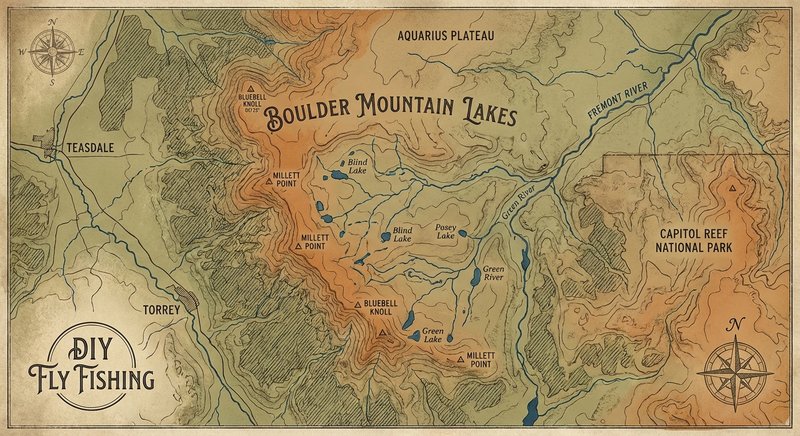
Boulder Mountain Lakes
Fly fishing in Utah · Intermediate · Best seasons: Summer, Fall
Target Species
Brook Trout, Cutthroat Trout, Tiger Trout
About This Water
Over 80 high mountain lakes with brook and cutthroat trout. Remote backcountry fishing.
Fishing Recommendations
Welcome to the "Land of the Giants." As your guide, I can tell you that Boulder Mountain (the Aquarius Plateau) is one of the most unique stillwater fisheries in the lower 48. This is high-altitude fishing at its finest, where the air is thin, the scenery is rugged, and the trout grow surprisingly large.
Here is your comprehensive guide to fly fishing the lakes of Boulder Mountain, Utah.
🎣 Location Overview
Boulder Mountain is a massive, high-elevation plateau in South-Central Utah, rising to over 11,000 feet. It stands in stark contrast to the red-rock deserts of nearby Capitol Reef and Escalante.
The "mountain" is home to over 80 fishable lakes, ranging from roadside ponds to remote "hike-in" alpine gems. Most of these lakes are "alkaline," meaning they are incredibly rich in nutrients. This creates a massive biomass of scuds and insects, allowing fish—particularly Brook Trout—to reach trophy proportions. The water is generally crystal clear, and the shorelines are often littered with volcanic basalt boulders and downed timber, providing world-class structure for ambush predators.
🐟 Target Species & Behavior
- Brook Trout: Boulder Mountain is famous for its "trophy" Brookies. These aren't your typical 6-inch creek fish; 3-to-5-pound fish are caught every season. They are highly reliant on scuds (freshwater shrimp). In the fall, they become aggressive and stunningly colorful as they prepare to spawn.
- Tiger Trout: A sterile hybrid of a Brown and Brook trout. They are the "wolves" of the mountain. Tigers are highly piscivorous (fish-eating) and patrol the shorelines and drop-offs looking for smaller trout or chubs.
- Cutthroat Trout: Primarily Colorado River and Bonneville varieties. They are often found in the higher, more remote lakes and are generally the most willing to rise to a dry fly.
📅 Best Times to Fish
The fishing window is short due to the extreme elevation.
- Summer (Late June – August): This is the prime time for accessibility. Most lakes are ice-free by late June. You’ll see active midge hatches in the mornings and "flying ant" falls in the afternoons.
- Fall (September – October): This is the trophy window. As temperatures drop, Brook Trout move into the shallows to spawn, and Tiger Trout go on a feeding frenzy to bulk up for winter. The colors of the fish and the turning aspen trees make this the most scenic time to be on the mountain.
- Prime Fishing Windows:
- First Light: Best for calm water and midge activity.
- The "Golden Hour": The last two hours of light are legendary for large fish moving from the deeps into the shallows to hunt.
🪰 Recommended Flies & Techniques
Top Fly Patterns
- Scuds (The Staple): Sizes 12–16. Colors: Olive, Orange, and "Dead" Grey.
- Leeches: Pine Squirrel Leeches or Balanced Leeches in black, olive, or wine.
- Terrestrials: Chubby Chernobyls, Black Ants, and Beetles (Late Summer).
- Nymphs: Prince Nymphs, Hare’s Ears, and Zebra Midges (Size 18–22).
- Streamers: Marabou Maddness, Woolly Buggers, or any pattern mimicking a small Brookie or Chub.
Effective Techniques
- The "Indicator Rig": Suspend a scud or a balanced leech 4–8 feet below an indicator. Give it occasional tiny twitches. This is deadly for Brookies along drop-offs.
- The "Slow Strip": Using an intermediate sinking line, cast a leech or streamer parallel to the shoreline or timber. Use a very slow "figure-eight" retrieve or short, erratic pulses.
- The Dry-Dropper: In the summer, a hopper or Chubby Chernobyl with a small unweighted scud 2 feet behind it is the most effective way to cover water.
💡 Pro Tips & Local Knowledge
- The "Boulder Crawl": Because the water is so clear, the fish are incredibly spooky. Do not walk right up to the water’s edge. Stay 5–10 feet back, use the boulders for cover, and observe the water for 5 minutes before casting.
- Target the "Ledge": Most Boulder Mountain lakes have a shallow shelf that drops off into deep blue water. Fish don't live in the middle of the lake; they cruise right along that transition line.
- Structure is King: If you see a sunken log or a cluster of large underwater boulders, there is almost certainly a large Tiger or Brook Trout living underneath it.
- The "Ant Fall": If you see a sudden flurry of surface activity on a windy August afternoon, it’s likely a flying ant fall. Switch to a size 16 black ant pattern immediately.
⚠️ Important Information
Access & Navigation
- Vehicle: High-clearance 4WD is non-negotiable for most of the mountain (especially the North Slope and the "Top"). Many roads are impassable when wet.
- Physicality: You are at 10,000+ feet. Hydrate aggressively and be prepared for "mountain weather"—it can snow in July and lightning storms move in fast.
Regulations & Permits
- Licenses: You need a valid Utah Fishing License.
- Special Rules: Several lakes have specific limits (e.g., "Limit 2 trout under 14 inches"). This is designed to keep the population in check so the remaining fish grow larger. Check the current Utah Fishing Guidebook for the specific lake you are visiting.
- Leave No Trace: The alpine tundra is extremely fragile. Stay on trails where possible and pack out every bit of trash.
Gear Recommendation
- Rod: A 9ft 5-weight or 6-weight is perfect. The 6-weight helps punch through the frequent mountain winds.
- Line: Bring both a Weight Forward Floating line and an Intermediate (Slow-Sink) line. The sinking line is often the difference between a skunk and a trophy day.
Bug Hatches & Matching Flies
| Hatch | Type | Peak months | Time of day | Hook sizes | Matching flies |
|---|---|---|---|---|---|
| Chironomids Chironomidae | midge | June, July, August, September | All Day | #12-20 | Zebra Midge #16-20, Ice Cream Cone #12-16, Griffith's Gnat #18-22 |
| Callibaetis (Speckled Duns) Callibaetis ferrugineus | mayfly | July, August | Morning/Afternoon | #12-16 | Parachute Adams #14-16, Callibaetis Spinner #14-16, Hare's Ear Nymph #12-16 |
| Damselfly Enallagma civile | terrestrial | July, August | Afternoon | #10-14 | Marabou Damsel #10-14, Braided Butt Damsel #12-14 |
| Traveling Sedge Hesperophylax | caddis | July, August | Evening | #8-12 | Mikulak Sedge #8-10, Goddard Caddis #10-12 |
| Carpenter Ants Camponotus | terrestrial | June, July | Afternoon | #10-14 | Black Foam Ant #10-14, Chernobyl Ant #8-12 |
| Cinnamon Ants Formica | terrestrial | August, September | Afternoon | #14-18 | Cinnamon Foam Ant #14-18, Fur Ant #16-18 |
| Water Boatman Corixidae | terrestrial | September, October | All Day | #14-18 | Water Boatman #14-16, Prince Nymph #14-18 |
| Grasshoppers Melanoplus | terrestrial | August, September | Afternoon | #8-12 | Parachute Hopper #10-12, Morrish Hopper #8-12 |