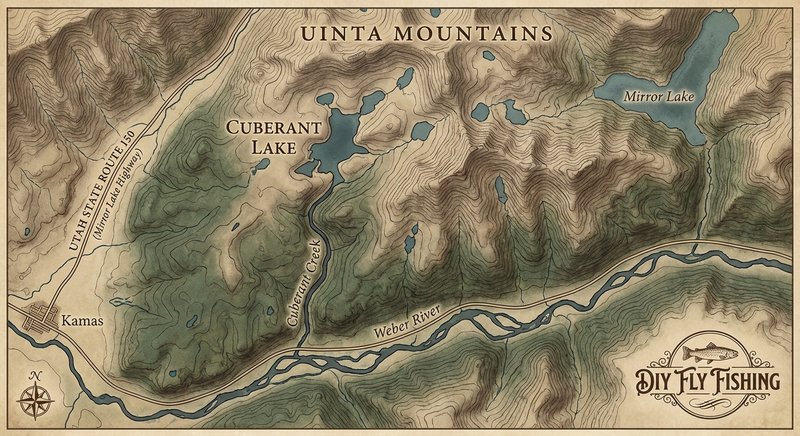
Cuberant Lake
Fly fishing in Utah · Intermediate · Best seasons: Summer, Fall
Target Species
Cutthroat Trout
About This Water
High Uinta lake with cutthroat trout. Scenic backcountry destination.
Fishing Recommendations
Nestled deep within the High Uinta Wilderness of the Wasatch-Cache National Forest, the Cuberant Lake basin is a high-altitude gem. As your guide, I can tell you that this isn't just a fishing trip; it’s a rugged alpine experience. Cuberant (a Ute word meaning "long") is actually a chain of several lakes, though the largest and deepest of the group is the primary destination for fly anglers seeking quality water and solitude.
🎣 Location Overview
Cuberant Lake sits at an elevation of approximately 10,400 feet, tucked into a dramatic glacial cirque beneath Mount Marsell. What makes this area special is its classic "Uinta" character: crystal-clear alpine water, granite boulder fields, and dense stands of Engelmann spruce.
Anglers love Cuberant because it offers a higher average fish size than many of the overpopulated "brookie ponds" nearby. The main lake is deep enough to prevent frequent winter kills, allowing fish to reach respectable sizes for an alpine environment. The water is gin-clear, making for world-class sight-fishing opportunities when the wind is calm.
🐟 Target Species & Behavior
The primary prize here is the Colorado River Cutthroat Trout.
- Behavior: These fish are opportunistic but can be surprisingly "looky" due to the water clarity. Unlike valley fish, they have a short growing season and must eat aggressively.
- Holding Patterns: In the early morning, you’ll find them cruising the shallow flats and "drop-offs" near the shoreline. As the sun gets high, they move toward the deeper center of the lake or hover near the shadows of large submerged boulders.
- Feeding: Their diet consists mainly of midges, scuds (freshwater shrimp), callibaetis mayflies, and terrestrial insects (ants, beetles, grasshoppers) blown in from the surrounding meadows.
📅 Best Times to Fish
Due to the high elevation, the window for Cuberant is relatively narrow.
- Summer (July – August): This is prime time. The ice usually clears by late June or early July. This is when the insect biomass is at its peak.
- Fall (September – early October): My personal favorite. The crowds vanish, and the Cutthroats begin feeding heavily to prepare for winter. The males take on brilliant orange and crimson spawning colors (even though they spawn in spring, they retain high color in fall).
- Time of Day:
- Morning (9 AM – 11 AM): As the water warms, the first hatches begin.
- Evening (6 PM – Dusk): The "evening rise" at Cuberant can be legendary, with fish dimpling the surface across the entire lake.
🪰 Recommended Flies & Techniques
In these clear waters, a 9-foot 4-weight or 5-weight rod with a supple 5X or 6X leader is your best tool.
Top Fly Patterns
- Dry Flies:
- Parachute Adams (Size 14-18) – The universal Uinta fly.
- Elk Hair Caddis (Size 14-16) – Great for when the wind puts a ripple on the water.
- Black Ants or Foam Beetles (Size 14-16) – Essential for summer afternoons.
- Nymphs/Sub-surface:
- Olive or Orange Scuds (Size 14-16) – The "bread and butter" of Uinta lakes.
- Pheasant Tail Nymph (Size 16-18) – Mimics the resident Mayflies.
- Zebra Midge (Size 18-20) – Effective when fished under a small indicator or as a dropper.
- Streamers:
- Pine Squirrel Leech or Wooly Bugger (Black or Olive, Size 10-12).
Techniques
- The "Dry-Dropper": Fish a foam ant on top with a weighted scud hanging 18-24 inches below it. This covers two zones of the water column.
- Sight Casting: If the water is calm, don't blind cast. Stand back from the bank, spot a cruising fish, and lead it by 3 feet with a soft presentation.
- The Slow Strip: If using a leech, cast out, let it sink for 10 seconds, and use very slow, 2-inch strips to mimic a swimming leech.
💡 Pro Tips & Local Knowledge
- The "Far Side" Secret: Most hikers stop at the first easy-access points on the eastern shore. If you have the energy, rock-hop around to the talus slopes on the western/southwestern side. The water drops off faster here, and larger fish often patrol these ledges.
- Mind the Shadow: Because the water is so clear, these fish are "line shy" and "shadow shy." Keep a low profile. If you stand on a high rock silhouetted against the sky, the fish will see you long before you see them.
- The Wind is Your Friend: A light "Uinta ripple" on the water breaks up the surface tension, making the fish less spooky and hiding your leader. When it’s dead calm, you must be surgical with your casts.
⚠️ Important Information
- Access: The trailhead is located at Lofty Lake/Pass Lake Trailhead off the Mirror Lake Highway (UT-150). It is a moderately strenuous hike (approx. 2.5 miles one way with significant elevation gain).
- Regulations: A valid Utah Fishing License is required. Cuberant is within a Wilderness Area, so "Leave No Trace" principles are strictly enforced. Check the current Utah Fishing Guidebook for any specific harvest limits (though catch and release is highly encouraged to preserve this fragile fishery).
- Weather: Alpine weather changes in minutes. Afternoon thunderstorms are common and dangerous above the tree line. Bring a high-quality rain shell and be prepared to descend if you see lightning.
- Gear Note: Bring plenty of mosquito repellent for July trips—the "Uinta Air Force" (mosquitoes) can be relentless near the marshy sections of the trail.
Guide’s Final Word: Cuberant isn't the easiest lake to reach, but for the angler who wants to earn their fish in a cathedral of granite, there is nowhere better. Tight lines!
Bug Hatches & Matching Flies
| Hatch | Type | Peak months | Time of day | Hook sizes | Matching flies |
|---|---|---|---|---|---|
| Chironomids Chironomidae | midge | July, August | All Day | #18-24 | Zebra Midge #18-22, Griffith's Gnat #20-22, Chironobunny #14-16 |
| Speckled Duns Callibaetis | mayfly | July, August | Late Morning | #12-16 | Callibaetis Spinner #14-16, Hare's Ear Nymph #12-16, Parachute Adams #14-16 |
| Spotted Sedge Hydropsyche | caddis | August, September | Evening | #14-18 | Elk Hair Caddis #14-16, LaFontaine's Deep Sparkle Pupa #14-18 |
| Little Yellow Sallies Isoperla | stonefly | July | Afternoon | #14-16 | Yellow Stimulator #14-16, Little Yellow Sally #16 |
| Terrestrial Ants Formicidae | terrestrial | August, September | Afternoon | #12-18 | Cinnamon Ant #14-18, Black Foam Ant #12-16 |
| High Alpine Mosquitoes Aedes communis | midge | July | All Day | #12-16 | Mosquito #12-16, Royal Wulff #14-16 |
| Black Beetles Coleoptera | terrestrial | August, September | Afternoon | #12-16 | Fat Albert #12-14, Foam Beetle #14-16 |
| Damselflies Enallagma | terrestrial | July, August | Morning/Afternoon | #10-14 | Marabou Damsel Nymph #10-12, Adult Damsel #12-14 |