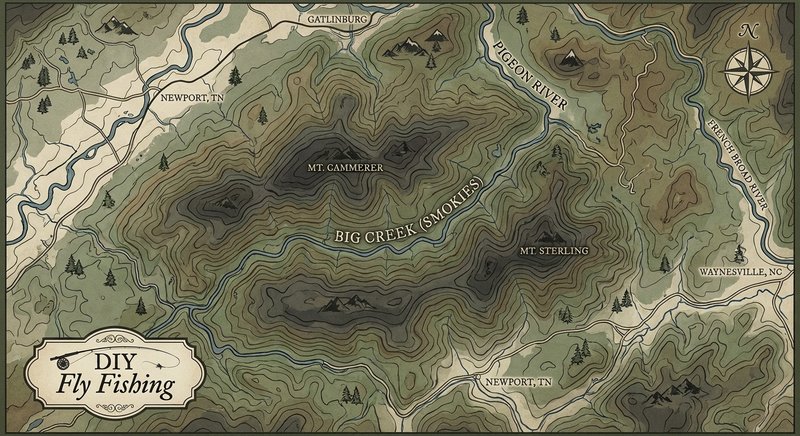
Big Creek (Smokies)
Fly fishing in North Carolina · Intermediate · Best seasons: Spring, Summer, Fall
Target Species
Rainbow Trout, Brown Trout
About This Water
Remote Great Smoky Mountains stream. Wild trout in wilderness setting.
Fishing Recommendations
As an expert guide who has spent countless hours navigating the slick boulders of the Great Smoky Mountains National Park (GSMNP), I can tell you that Big Creek is one of the most rugged, beautiful, and rewarding freestone streams in the Southeast. Located in the northeastern corner of the park near the Tennessee/North Carolina border, it is famous for its crystal-clear water, massive "house-sized" boulders, and wild, spirited trout.
🎣 Location Overview
Big Creek is a classic high-gradient mountain stream. Unlike some of the lower-elevation rivers in the Smokies, Big Creek feels "big" even when the flow is moderate. It is characterized by deep, emerald-green plunge pools, turbulent cascades, and short, fast pocket water.
What makes it special is its clarity and substrate. The water is filtered by the high-elevation wilderness, making it some of the purest in the park. Anglers love it because it offers a true backcountry experience without requiring a ten-mile hike. However, it is physically demanding; the "Big Creek shuffle" over slippery rocks is a workout for even the fittest anglers.
🐟 Target Species & Behavior
The stream is primarily home to Wild Rainbow Trout, with Wild Brown Trout holding in the deeper, more secluded pools.
- Wild Rainbows: These are the primary residents. They are opportunistic, aggressive, and incredibly fast. They typically hold in the "cushion" in front of rocks, in the seams next to fast water, and at the heads of pools where oxygen levels are highest.
- Wild Browns: These are the "ghosts" of Big Creek. They tend to be more nocturnal and secretive, holding under undercut banks, deep ledges, or at the very tail-outs of pools during low light.
- Behavior: These fish are wild, not stocked. They have high metabolisms due to the cold, sterile water, but they are extremely "spooky." If they see your shadow or your fly line lands too heavily, the pool is "done" for the next hour.
📅 Best Times to Fish
Spring (Late March – May)
This is the prime window. As water temperatures climb into the 50s, the aquatic insect activity explodes. This is the best time for dry fly fishing.
- Prime Window: 11:00 AM – 4:00 PM (as the sun warms the water).
Summer (June – August)
While other low-elevation streams get too warm, Big Creek stays cool due to its canopy cover and elevation. This is "Terrestrial Season."
- Prime Window: Early morning and late evening. Avoid the bright midday sun when fish retreat under boulders.
Fall (September – November)
The water levels are often at their lowest, requiring a stealthy approach. The Brown Trout become more aggressive as they prepare to spawn in late autumn.
- Prime Window: All day, but focus on the deeper pools.
🪰 Recommended Flies & Techniques
Top Fly Patterns
- Dry Flies:
- Spring: Yellow Stimulator (#14-16), Parachute Adams (#14-18), Quill Gordon (#12-14).
- Summer: High-vis Foam Beetles, Chimney Sweeps (Ants), and the Yellow Neversink Caddis (a local staple for its buoyancy).
- Nymphs:
- Pheasant Tail (#16-18), Prince Nymph (#14-16), and the Yellow Sally Nymph (#16).
- Streamers:
- Small Wooly Buggers in Olive or Black—best used during higher water or early morning for trophy Browns.
Effective Techniques
- Dry-Dropper: This is the "bread and butter" of Big Creek. Use a buoyant dry fly (like a Stimulator) and hang a weighted nymph 18–24 inches below it.
- High-Sticking: Because of the complex currents, you must keep as much fly line off the water as possible to avoid drag.
- Short Casts: Most fish are caught within 15–20 feet. Accuracy and stealth are more important than distance.
💡 Pro Tips & Local Knowledge
- The "Midnight Hole": About 1.5 miles up the trail, you’ll find this famous deep pool. It’s popular with swimmers in the summer, so fish it very early in the morning before the crowds arrive.
- Fish the "Pocket Water": Many anglers walk past the small pockets between the big pools. Some of the biggest Rainbows hide in pockets no larger than a bathtub.
- Stealth is Mandatory: Wear drab clothing (greens/browns) to blend into the forest. Approach pools from downstream and stay low. If you can see the fish, they have likely already seen you.
- Wading Safety: The rocks here are notoriously "greasy." Aluminum barred boots or felt (where legal) with studs are highly recommended. A wading staff is not a luxury here; it's a necessity.
⚠️ Important Information
- Access: Access is via the Big Creek Campground area off I-40 (Exit 451 in NC). The Big Creek Trail runs parallel to the stream for several miles, allowing you to hike in as far as you like.
- Regulations:
- A valid North Carolina or Tennessee fishing license is required (reciprocal agreement within Park boundaries).
- Artificial Lures Only: No bait is allowed.
- Single Hook Only: Dropper rigs are legal, but each fly must have only one hook.
- Check the GSMNP official website for current size and creel limits.
- Cell Service: Virtually non-existent. Tell someone your plan before you head in.
- Bears: This is active black bear country. Store any food in bear-proof containers or your vehicle.
Guide's Final Word: Big Creek isn't about catching the most fish or the biggest fish; it's about the technical challenge of the "perfect drift" in one of the most ruggedly beautiful settings in the Eastern United States. Tight lines!
Bug Hatches & Matching Flies
| Hatch | Type | Peak months | Time of day | Hook sizes | Matching flies |
|---|---|---|---|---|---|
| Quill Gordon Epeorus pleuralis | mayfly | March, April | Afternoon | #12-14 | Quill Gordon Dry #12-14, Quill Gordon Nymph #12-14 |
| Blue Quill Paraleptophlebia adoptiva | mayfly | March, April | Late Morning/Afternoon | #16-18 | Blue Quill Dry #16-18, Pheasant Tail #16-20 |
| Yellow Sally Isoperla spp. | stonefly | May, June, July | Late Afternoon/Evening | #14-16 | Yellow Stimulator #14-16, Iron Lotus (Yellow) #14-16 |
| Golden Stonefly Acroneuria lycorias | stonefly | May, June, July | Morning/Evening | #6-10 | Pat's Rubber Legs #8-10, Golden Stone #8-10 |
| Light Cahill Stenacron interpunctatum | mayfly | May, June, July | Evening | #12-16 | Light Cahill Dry #12-16, Gold Ribbed Hare's Ear #14-16 |
| Green Drake Ephemera guttulata | mayfly | May, June | Evening | #8-12 | Green Drake Cripple #10-12, Green Drake Paradox #10-12 |
| Blue Winged Olive Baetis spp. | mayfly | February, March, October, November | Afternoon | #18-22 | Parachute Adams #18-22, RS2 (Olive) #20-22 |
| Terrestrials Formicidae/Coleoptera | terrestrial | July, August, September | All Day | #12-18 | Parachute Ant #14-18, Green Weenie #12-14, Black Foam Beetle #14-16 |