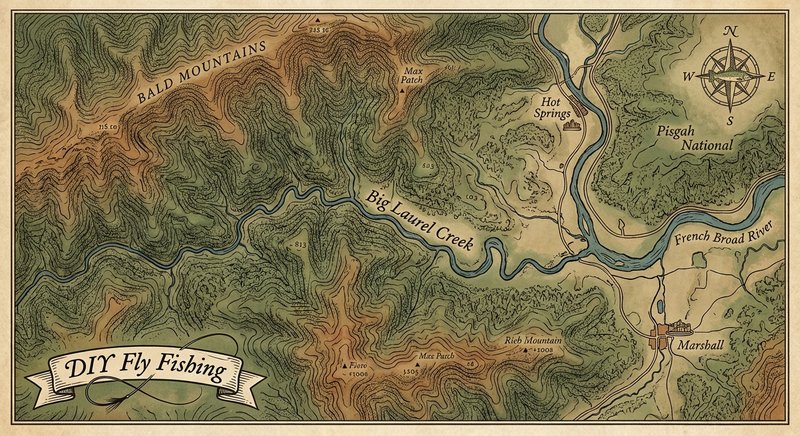
Big Laurel Creek
Fly fishing in North Carolina · Intermediate · Best seasons: Spring, Summer, Fall
Target Species
Rainbow Trout, Brown Trout, Brook Trout
About This Water
Wild stream in Madison County with native brook trout in headwaters.
Fishing Recommendations
Welcome to one of Western North Carolina’s true gems. As a guide in the Blue Ridge Mountains, I consider Big Laurel Creek in Madison County to be one of the most scenic and rewarding freestone streams in the Southeast. Whether you are looking for the high-volume action of Delayed Harvest water or the solitude of a rugged river gorge, the "Big Laurel" delivers.
Here is your comprehensive guide to fly fishing Big Laurel Creek.
🎣 Location Overview
Big Laurel Creek is a major tributary of the French Broad River, located near the town of Hot Springs, NC. It is a quintessential Appalachian freestone stream characterized by massive rock gardens, deep plunge pools, and high-gradient "pocket water."
What makes it special is the Laurel River Trail. This abandoned railroad grade follows the lower section of the creek through a stunning, roadless gorge. While the upper reaches near Hwy 208 are easily accessible, the deeper you hike into the gorge, the more the crowds thin out and the "wild" feel of the canyon takes over. It is a river of two personalities: accessible roadside fishing on the upper end and a remote, backcountry experience on the lower end.
🐟 Target Species & Behavior
- Rainbow Trout: These make up the bulk of the population in the Delayed Harvest (DH) section. They are aggressive and typically hold in the "bubble line" or at the heads of pools where oxygen levels are highest.
- Brown Trout: The "kings" of the Big Laurel. Larger, wild browns lurk in the deep, dark shadows beneath the rhododendron overhangs and behind the massive boulders in the gorge. They are more nocturnal and wary than the rainbows.
- Brook Trout: While rare in the main stem of the Big Laurel, you will find wild Southern Appalachian Brookies in the high-elevation headwaters and small feeder tributaries (like Puncheon Fork).
- Behavior: In the DH section, fish are opportunistic but can become "fly shy" by mid-season. In the wild sections, stealth is paramount. The fish here are highly sensitive to vibration and shadows.
📅 Best Times to Fish
- Spring (March – May): Prime Time. This is the peak of the Delayed Harvest season and the height of the Appalachian aquatic insect hatches. Water temperatures are perfect (50–55°F).
- Summer (June – August): Focus on the early mornings or head to the higher elevations. The lower gorge can get warm in July; if the water hits 70°F, give the fish a break and head to the shaded headwaters.
- Fall (October – November): The DH section is restocked in October. The cooling temperatures and the changing leaves make this the most beautiful time to be on the water. Brown trout become aggressive as they prepare for the spawn.
- Optimal Windows: Mid-morning (10 AM) during the spring; "Last Light" (the evening rise) during the summer.
🪰 Recommended Flies & Techniques
Top Fly Patterns
- Dry Flies: Yellow Stimulators (sizes 12–16), Parachute Adams (14–18), and Elk Hair Caddis (14–16). For the gorge, a Yellow Humpy is a local favorite.
- Nymphs: Pheasant Tails (14–18), Prince Nymphs, and Girdle Bugs (Pat’s Rubber Legs) in coffee/black. For stocked fish, Mop Flies and Squirmy Wormies are highly effective.
- Streamers: Wooly Buggers (Olive or Black) and Sparkle Minnows. Swing these through the deep holes in the gorge for big Browns.
Techniques
- The "Dry-Dropper": This is the most effective way to fish Big Laurel. Use a high-visibility Stimulator as your "indicator" and hang a weighted Pheasant Tail or Caddis Pupa 18–24 inches below it.
- Tight-Line Nymphing: Because the Big Laurel is full of pocket water and complex currents, a traditional strike indicator often creates drag. "High-sticking" or Euro-nymphing the seams between boulders is deadly here.
- The Swing: In the lower gorge where the water deepens, swinging a small streamer across and down can trigger aggressive strikes from territorial fish.
💡 Pro Tips & Local Knowledge
- The Hike-In Rule: Most casual anglers fish within a half-mile of the trailhead at Hwy 25/70. If you hike 2+ miles down the Laurel River Trail, you will find fish that see far fewer flies and are much more willing to rise to a dry fly.
- Watch the Gauge: Big Laurel is a freestone creek. It rises fast after rain and can become dangerously turbid. Check the USGS gauge for "Big Laurel Creek near Stackhouse." You want to see a stable or falling trend.
- Rock Hopping: The boulders here are legendary—and slippery. Studded wading boots are not just a recommendation; they are a safety requirement. Felt soles are also helpful, but studs are better for the steep banks.
- The "Stackhouse" Finish: The very bottom of the creek where it enters the French Broad River is a "Big Fish" spot. Smallmouth Bass from the French Broad often move into the lower Laurel, providing a fun surprise.
⚠️ Important Information
- Access:
- Upper Section: Roadside access along Hwy 208 and Hwy 25/70.
- Lower Section: Park at the Laurel River Trailhead (intersection of Hwy 25/70 and 208).
- Regulations:
- The section from the NC 208 bridge to the French Broad River is Delayed Harvest.
- From Oct 1 to the first Saturday in June: Catch and release only, single-hook artificial lures only.
- After the first Saturday in June, it reverts to Hatchery Supported rules (creel limits apply). Always check the NCWRC website for current maps.
- Safety: This is bear and snake country. While Black Bears usually avoid the trail, Copperheads are common on the rocky banks in the summer. Watch where you step and where you place your hands when climbing over logs.
Guide’s Final Word: Big Laurel Creek is the soul of Madison County fishing. Respect the water, pack out your trash, and take a moment to look up at the canyon walls—it’s one of the most beautiful places you’ll ever cast a fly.
Bug Hatches & Matching Flies
| Hatch | Type | Peak months | Time of day | Hook sizes | Matching flies |
|---|---|---|---|---|---|
| Quill Gordon Epeorus pleuralis | mayfly | March, April | Mid-day/Afternoon | #12-14 | Quill Gordon #12-14, Gold Ribbed Hare's Ear #12-14, Quill Gordon Wet Fly #12-14 |
| Blue-Winged Olive (BWO) Baetis | mayfly | March, April, October, November | Late Morning/Afternoon | #18-22 | Parachute Adams #18-22, RS2 #20-22, Pheasant Tail #18-20 |
| March Brown Maccaffertium vicarium | mayfly | May | Afternoon | #10-14 | March Brown Western #10-12, Dark Hare's Ear #10-14, March Brown Wet #12 |
| Tan Caddis Hydropsyche | caddis | April, May, June | Evening | #14-18 | Elk Hair Caddis #14-16, Holy Grail Caddis #14-18, Frenchie #14-16 |
| Yellow Sally Isoperla | stonefly | June, July | Late Afternoon/Evening | #14-16 | Yellow Sally Dry #14-16, Little Yellow Sloan #14-16, Stimulator (Yellow) #14-16 |
| Slate Drake Isonychia bicolor | mayfly | June, September | Afternoon/Evening | #10-12 | Isonychia Parachute #10-12, Zug Bug #10-12, Prince Nymph #10-14 |
| Light Cahill Stenacron interpunctatum | mayfly | June, July | Evening | #12-16 | Light Cahill #12-16, Cream Midges #20-22 |
| Golden Stonefly Acroneuria | stonefly | May, June | Night/Evening | #6-10 | Girdled Bug (Pat's Rubber Legs) #6-10, Golden Stimulator #8-10 |
| Terrestrials (Ants/Beetles) Formicidae / Coleoptera | terrestrial | July, August, September | All Day | #12-18 | Black Foam Beetle #14-16, Cinnamon Ant #16-18, Chernobyl Ant #8-12 |