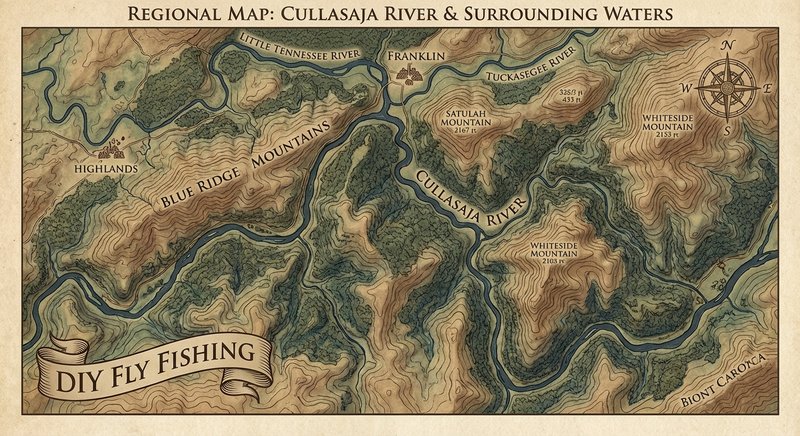
Cullasaja River
Fly fishing in North Carolina · Intermediate · Best seasons: Spring, Summer, Fall
Target Species
Brown Trout, Rainbow Trout
About This Water
Mountain stream near Highlands with wild trout. Scenic gorge with waterfalls.
Fishing Recommendations
The Cullasaja River is one of Western North Carolina’s most dramatic and rugged trout streams. Flowing from the Highlands Plateau down through a steep, jagged gorge toward Franklin, it offers a diverse experience ranging from technical pocket water to deep, emerald plunge pools.
As your guide, here is the comprehensive breakdown for fishing this Appalachian gem.
🎣 Location Overview
The Cullasaja (Cherokee for "Sugar Pine") is a high-gradient freestone river located in the Nantahala National Forest. What makes this river special is its sheer verticality. It drops over 2,000 feet in just a few miles, creating a landscape dominated by massive boulders, towering cliffs, and legendary waterfalls like Cullasaja Falls and Dry Falls.
Anglers love the Cullasaja because it offers a "choose your own adventure" experience. You can fish the more accessible stretches near the town of Highlands or scramble down into the "Gorge" for a wilderness experience where you likely won't see another soul. The water is crystal clear, cold, and highly oxygenated—perfect habitat for trout.
🐟 Target Species & Behavior
The Cullasaja holds a mix of Wild Brown and Rainbow Trout, supplemented by Stocked Trout in the lower sections.
- Rainbow Trout: Found primarily in the faster riffles and highly oxygenated "white water" at the heads of pools. They are opportunistic and will often rise to a well-presented dry fly.
- Brown Trout: The kings of the deep plunge pools. The larger, wild browns are notoriously "light-shy" and tend to hold deep under boulder shelves or in the shadows of the gorge walls. They feed aggressively during low-light transitions.
- Behavior: Because the river is so steep, fish are "pocket-oriented." They don't have the luxury of long, slow pools; they sit in small soft spots (seams) behind rocks, waiting for the current to bring food directly to them.
📅 Best Times to Fish
Optimal Seasons
- Spring (March – May): The peak of the season. As the water warms into the 50s, the aquatic insect life explodes. You’ll see the best hatches of the year (Quill Gordons and March Browns).
- Summer (June – August): While many NC rivers get too warm, the Cullasaja’s high elevation keeps it fishable. Focus on the upper stretches near Highlands. Use terrestrials (ants/beetles) along the banks.
- Fall (September – November): The most beautiful time to be on the river. Brown trout become aggressive and territorial as they prepare to spawn. Streamer fishing can be very productive now.
Prime Windows
- Time of Day: During Summer, fish from dawn until 11:00 AM. In Spring and Fall, the midday window (11:00 AM – 3:00 PM) is often the most productive as the sun triggers insect activity.
- Conditions: A light overcast day is gold on the Cullasaja. It cuts the glare on the water and makes the larger, wary browns feel comfortable moving out of the deep shadows.
🪰 Recommended Flies & Techniques
Top Fly Patterns
- Dry Flies: Parachute Adams (Size 14-18), Elk Hair Caddis (Tan/Yellow), Stimulators (Orange/Yellow), and Royal Wulff.
- Nymphs: Pheasant Tail (Size 14-18), Prince Nymph, Girdle Bug (Pat’s Rubber Legs in Coffee/Black), and Sexy Walt’s Worms.
- Streamers: Wooly Bugger (Black or Olive) and small sculpin patterns (Muddler Minnow).
Effective Techniques
- High-Sticking / Tight-Line Nymphing: This is the most effective way to fish the Cullasaja. Because the currents are so complex, a standard fly line on the water will cause instant drag. Keep as much line off the water as possible, using a heavy tungsten nymph to get down into the pockets.
- Dry-Dropper: In the summer, use a buoyant Stimulator as your "indicator" with a small Pheasant Tail dropped 18-24 inches below it. This covers both the surface and the mid-column.
- The "Plunge" Method: Cast your nymph directly into the white water of a waterfall or plunge. Let the turbulence suck the fly down to the bottom where the big fish are waiting in the "bucket."
💡 Pro Tips & Local Knowledge
- The "Gorge" Strategy: If you are physically fit, hike down into the lower gorge sections away from the road pull-offs. The fishing pressure drops significantly, and the fish size usually increases.
- Mind the Shadows: Because the gorge is deep, parts of the river stay in the shade longer. Target these shaded areas; trout feel safer there and are more likely to feed in the upper water column.
- Stealth is Key: The water is exceptionally clear. Avoid wearing bright colors and try to stay low. If you can see the fish, they have likely already seen you.
- Wading Safety: The rocks on the Cullasaja are notoriously slick (often covered in "rock snot" or algae). Felt soles with studs are highly recommended. A wading staff is not just a luxury here; it’s a safety requirement.
⚠️ Important Information
Access
- Highway 28/64: This road runs parallel to the river for most of its length between Highlands and Franklin. There are numerous small pull-offs.
- Caution: The road is narrow and winding with heavy tourist traffic. Be extremely careful when parking and exiting your vehicle.
Regulations & Permits
- License: A North Carolina Fishing License with a Trout Privilege is required.
- Classification: Most of the Cullasaja is classified as Hatchery Supported Trout Water (Green signs). This means it is closed to fishing in March and has a 7-fish limit with no bait restrictions from April through February.
- Note: Always check the NCWRC website for the most up-to-date regulations, as boundaries can change.
Special Considerations
- Water Levels: After heavy rain, the Cullasaja can become a raging torrent and extremely dangerous. Check local rain gauges; if the river looks "chocolate milk" brown, head to a smaller tributary like Turtleback Creek or wait 24 hours for it to clear.
Bug Hatches & Matching Flies
| Hatch | Type | Peak months | Time of day | Hook sizes | Matching flies |
|---|---|---|---|---|---|
| Quill Gordon Epeorus pleuralis | mayfly | March, April | Midday | #12-14 | Quill Gordon Dry #12-14, Quill Gordon Wet #12-14 |
| Blue-Winged Olive Baetis | mayfly | March, April, October, November | Afternoon | #18-22 | RS2 #18-22, Parachute BWO #18-20 |
| Yellow Sally Isoperla | stonefly | May, June, July | Late Afternoon/Evening | #14-16 | Yellow Sally Stone #14-16, Little Yellow Fellow #14-16 |
| March Brown Maccaffertium vicarium | mayfly | May | Midday/Afternoon | #10-14 | March Brown Parachute #12-14, Hare's Ear Nymph #10-14 |
| Mother's Day Caddis Brachycentrus | caddis | April, May | All Day | #14-16 | Elk Hair Caddis (Olive) #14-16, Holy Grail #14-16 |
| Light Cahill Stenonema/Stenacron | mayfly | June, July, August | Evening | #12-16 | Light Cahill Dry #12-16, Pheasant Tail #14-16 |
| Golden Stonefly Acroneuria | stonefly | June, July | Morning/Evening | #6-10 | Girdle Bug #6-10, Golden Stimulator #8-10 |
| Cinnamon Caddis Hydropsyche | caddis | June, July, August, September | Evening | #14-18 | Cinnamon Caddis #14-18, Soft Hackle Hare's Ear #14-16 |
| Terrestrials (Ants/Beetles) Formicidae/Coleoptera | terrestrial | July, August, September | All Day | #12-18 | Black Foam Beetle #14-16, Parachute Ant #16-18 |